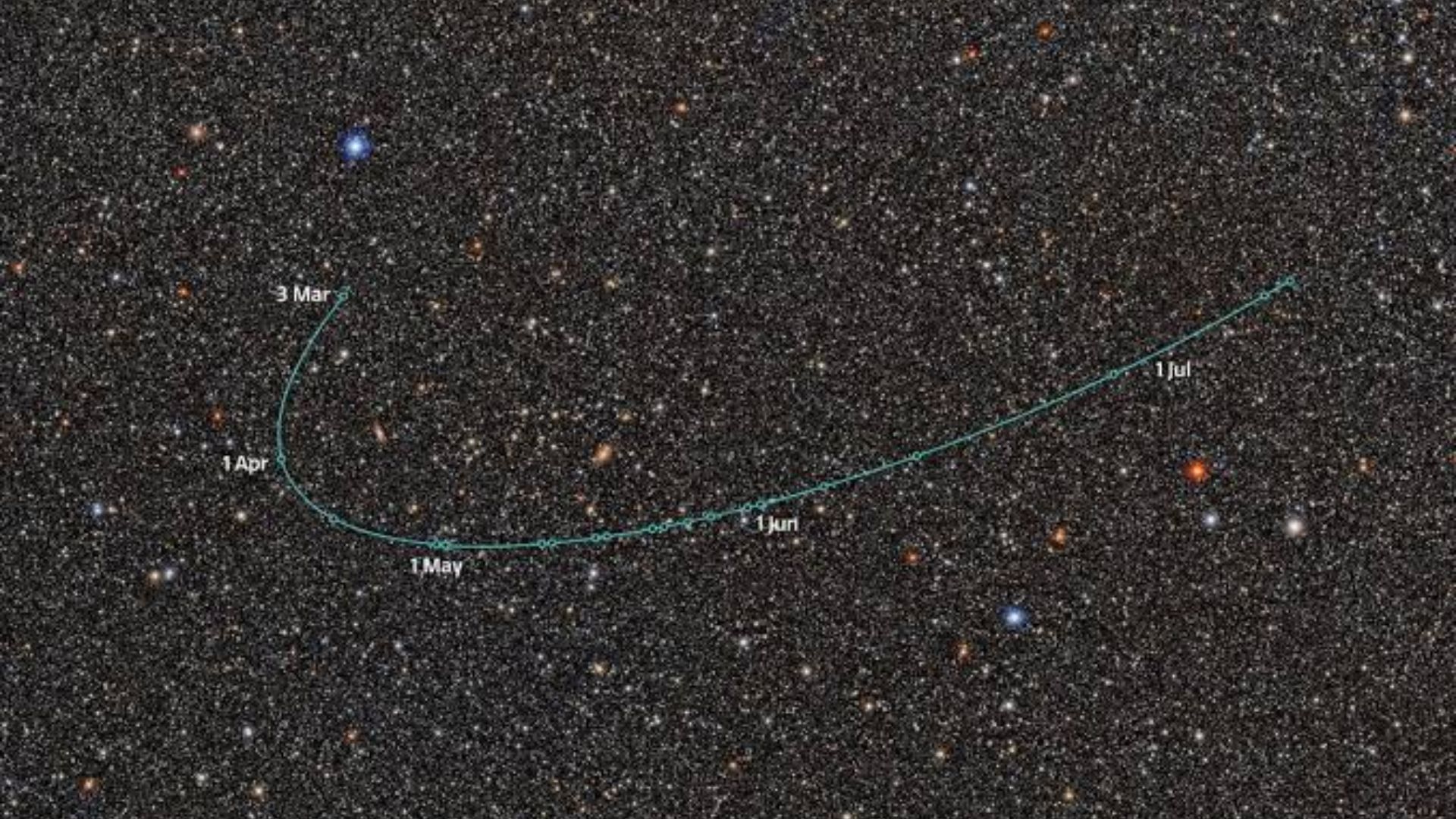
Scientists have identified an icy object beyond Pluto that could qualify as a dwarf planet, Reuters reported. Named 2026 ED138, the object was detected using the Vera C. Rubin Observatory in Chile.
Researchers estimate its diameter at between 600 and 1500 kilometres. It orbits the Sun at roughly 46 times Earth’s distance, compared with Pluto’s average distance of about 40 times.
Astrophysicist Matt Holman of the Center for Astrophysics, Harvard & Smithsonian, first spotted the object. The discovery was announced at a scientific meeting in Spokane, Washington.
The Rubin Observatory, located on Cerro Pachón mountain, is a joint initiative of the US National Science Foundation and Department of Energy.
What is a dwarf planet?
A dwarf planet is a category of celestial body that includes Pluto. One requirement is that the object has enough mass for its own gravity to pull it into a roughly round shape.
The available observations suggest 2026 ED138 may meet that requirement, but scientists need more information before confirming its status. The discovery does not mean the solar system has gained a ninth major planet.
The International Astronomical Union (IAU) recognises five dwarf planets: Pluto, Eris, Haumea, Makemake and Ceres. The first four orbit beyond Neptune, while Ceres lies in the asteroid belt between Mars and Jupiter.
Pluto was classified as the solar system’s ninth planet until 2006, when the union reclassified it because it did not meet the organisation’s formal definition of a planet.
Why is its size uncertain?
The Rubin telescope detects sunlight reflected by the object. A small, bright surface can reflect as much light as a larger, darker one, making size difficult to determine from brightness alone.
Holman said observations at longer wavelengths could help resolve that uncertainty. Chile’s Atacama Large Millimeter/submillimeter Array, known as ALMA, can detect radiation emitted by the object itself, helping researchers calculate its size.
Further observations will also help scientists investigate its composition and determine whether it should join the recognised dwarf planets.