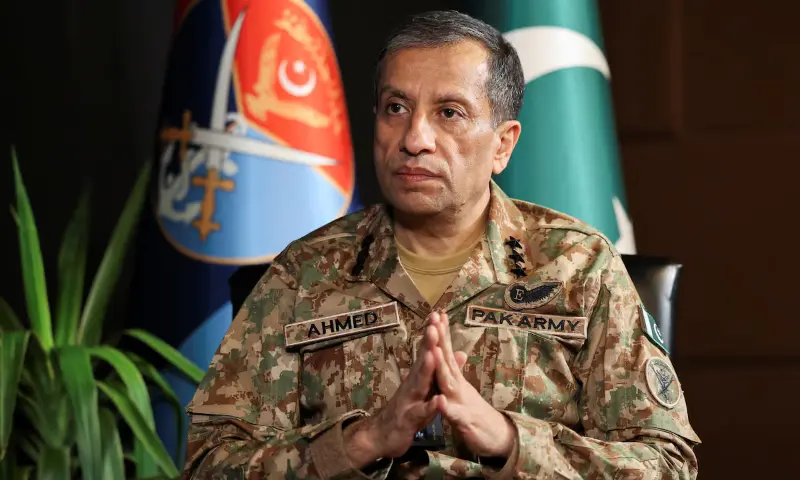
Lt Gen Ahmed Sharif Chaudhry said the Afghan Taliban government is sheltering the leaders of the TTP and the BLA, and warned that Kabul cannot absorb the punishment Pakistan can inflict.
India is the prime contractor behind terrorism in Pakistan, and the Afghan Taliban government, the Tehreek e Taliban Pakistan and the Balochistan Liberation Army are its proxies, Director General Inter Services Public Relations (ISPR) Lieutenant General Ahmed Sharif Chaudhry has said.
He was speaking in an interview with Reuters in Rawalpindi on Friday. His remarks on Afghanistan and India were broadcast on Sunday.
“In the case of Pakistan, the prime contractor is India. And the proxies are TTP and the BLA,” he said.
He was referring to the banned Tehreek e Taliban Pakistan (TTP), which the state has designated Fitna al Khawarij, and the banned Balochistan Liberation Army (BLA), designated Fitna al Hindustan. He described India as the biggest terror sponsor.
He said the Taliban administration in Kabul was sheltering terrorist leaders, naming:
- TTP chief Noor Wali Mehsud
- BLA commander Bashir Zeb
- militant commander Gul Bahadur
He said the formations that carry out attacks in Pakistan come from Afghanistan and are armed there. Afghan citizens, and even personnel of the Taliban administration, had been found among those involved.
He named other groups present in Afghanistan: the East Turkestan Islamic Movement, the Islamic Movement of Uzbekistan, Jaish al Adl, Al Qaeda and Islamic State Khorasan Province. He said United Nations reports and the intelligence assessments of the US and other countries had also documented them.
Asked about drones in the hands of the Afghan Taliban, he said their capability was not their own but was supplied by their sponsors. “Whatever they want to send, they can; they may try. We have the capability to take them on,” he said. “They don’t have, I think, the capability to then absorb the punishment that we can put on them.”
He recalled that India sent dozens of sophisticated drones during the May 2025 conflict, all of which Pakistan brought down, and said the armed forces had moved further ahead in operational readiness since then.
He said Pakistan would impose a cost if support for terrorism continued, and had the capability and “a clear strategy how to impose that cost.”
Pakistan’s demand, he said, was limited. “We only ask you that don’t support terrorism inside Pakistan. Stop harbouring the terrorist leaders.” How Afghanistan was governed was for Afghans to decide.
He said Pakistan did not want Afghanistan isolated, but the international community should press the Taliban administration to act like a state. “What Afghanistan is producing right now, it has only two products: terrorism and drugs,” he said.
He rejected allegations from Kabul that Pakistan was coordinating elements opposed to the Taliban. “We are a state. Afghanistan is not a state,” he said. He also cited earlier false claims made from Kabul, including that the Taliban had captured a Pakistani pilot.
He said the army was adapting to changes in warfare, including drones, cyber and other non contact capabilities, and was using artificial intelligence and other advanced technologies. He declined to give operational details.
In the same interview, he said Pakistan was “cautiously optimistic” about its mediation between Iran and the United States, pointing to two visits to Tehran this month by Chief of Defence Forces Field Marshal Asim Munir. He said counter terrorism in Khyber Pakhtunkhwa would remain based on intelligence based operations, and their tempo would increase.
The DG ISPR made the same case on India at a press conference in Rawalpindi on 1 October, when he said: “India is the biggest sponsor of terrorism and a terrorist state in the world.”
On Saturday, the information ministry said the Taliban administration’s refusal to act against terrorism was the main obstacle to normal relations. The Taliban administration claims Afghan soil is not used for attacks on Pakistan.
In September, Pakistan carried out calibrated airstrikes on terrorist hideouts in Afghanistan in response to terrorist attacks in Khyber Pakhtunkhwa. In October, security forces responded to unprovoked firing from the Afghan side in Kurram and at Angoor Adda. Talks facilitated by Qatar and Turkiye last year, and later efforts involving China, produced no agreement.