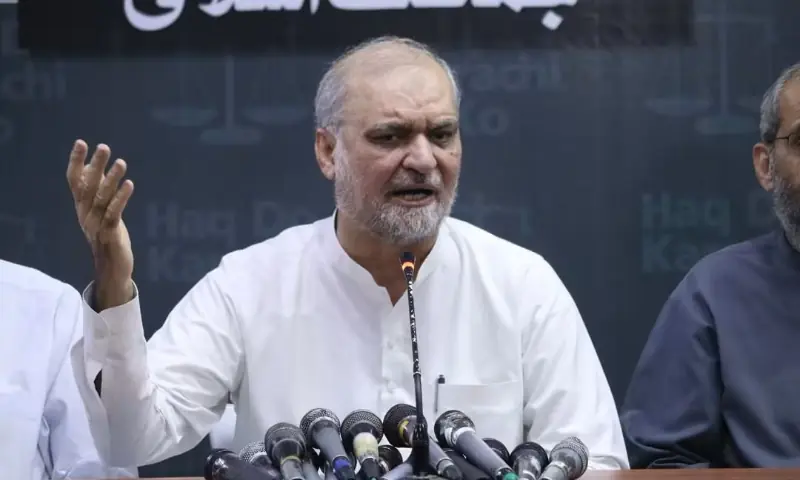
Lahore: Jamaat i Islami (JI) Emir Hafiz Naeemur Rehman on Monday warned that his party would march towards Islamabad in mid November if Prime Minister Shehbaz Sharif failed to abolish the petroleum levy or introduce measures to reduce fuel costs.
Addressing a press conference on October 26, Rehman said JI had exercised restraint amid international developments but would intensify its protest campaign if the government failed to respond to its demands.
“If the prime minister does not provide relief or abolish the petroleum levy, if he doesn’t take any steps, then in mid November we will, with full force, march to Islamabad,” he said.
JI has demanded the removal of petroleum levies for more than two months, citing the financial burden on consumers after global oil prices rose due to the conflict in the Middle East.
According to the party, the federal government is collecting Rs 114 per litre in levies on petrol and Rs 100 per litre on diesel. JI maintains that it should remove these charges to reduce fuel costs.
The warning follows renewed contact between JI and the federal government over the proposed meeting between Rehman and Prime Minister Shehbaz Sharif. On Sunday, JI said Planning Minister Ahsan Iqbal and Special Assistant to the Prime Minister Rana Sanaullah had contacted party Vice Emir Liaquat Baloch.
According to the party, both sides agreed to a meeting between the prime minister and the JI chief within two days.
Rehman acknowledged that government representatives had assured his party that they were working to determine what measures they could agree on during the meeting. However, he said JI would not accept discussions without concrete outcomes.
“We have never said no to a meeting, but I want to say this clearly to the government that we don’t want a meeting so we can make an event out of it,” he said.
He added that the party had already communicated its demands and expected the government to respond with measures rather than further assurances.
The petroleum levy is a federal charge imposed on fuel, separate from the underlying cost of imported petroleum products. It contributes to government revenue and is included in the final price consumers pay.
Changes in international oil prices, exchange rates and domestic taxation can affect retail fuel prices in Pakistan. The dispute has intensified amid disruptions to energy markets following the escalation of conflict in the Middle East earlier this year. JI argues that reducing or abolishing the levy would relieve consumers facing higher transport and household expenses.
The issue also involves fiscal considerations for the federal government, as removing the levy would reduce revenue collected through petroleum sales. Any decision would therefore affect both consumer prices and government finances.
JI questions government's fuel relief scheme
Rehman also criticised the fuel relief package announced by the federal government in September, arguing that it did not adequately address the financial pressure on households and transport operators. Under the scheme, owners of motorcycles and three wheeled vehicles were offered relief of Rs 100 per litre on a monthly quota of 20 litres.
Owners of vehicles with engine capacities of up to 800cc were eligible for the same per-litre relief on a monthly quota of 30 litres. The government introduced the programme to reduce the impact of rising international oil prices on selected categories of vehicle owners.
Rehman claimed that the scheme excluded several groups, including other motorists and public transport users. He also argued that higher diesel prices had increased the cost of transporting goods, contributing to rising prices of groceries and other essential commodities. JI maintains that targeted fuel subsidies do not fully address the wider economic effects of increased transport and distribution costs.
The latest warning follows a series of demonstrations and negotiations between JI and the federal government. On August 16, the party announced sit ins in Pakistan's provincial capitals to protest the petroleum levy. It subsequently called for a nationwide strike on September 3rd.
However, the planned strike was followed by an agreement between the government and JI to establish committees to recommend measures to reduce fuel levies. On 20 September, JI began a protest march towards Islamabad, warning that the campaign could expand if the government failed to meet its demands.
Two days later, Rehman announced that the march, which had reached Multan, would be postponed at the request of Prime Minister Shehbaz Sharif. According to JI, the prime minister had assured the party that a meeting would be arranged to discuss the petroleum levy. Last week, however, the party alleged that the government had not made further contact regarding the promised meeting.
Subsequent communication between federal ministers and Liaquat Baloch has reopened the possibility of negotiations. Despite these contacts, JI has maintained its call for protests and said its demand for the abolition of the petroleum levy remains unchanged.
The proposed meeting between Rehman and Prime Minister Shehbaz Sharif is expected to determine whether the two sides can agree on measures to address fuel costs. The government has previously introduced targeted relief and participated in discussions on reducing levies, while JI continues to demand their abolition.
No agreement on removing the petroleum levy has been announced. If negotiations fail to produce an outcome acceptable to JI, the party says it will proceed with its planned march towards Islamabad in mid November.
The dispute places fuel taxation, government revenue requirements and household transport costs at the centre of the next round of talks between the federal government and JI.