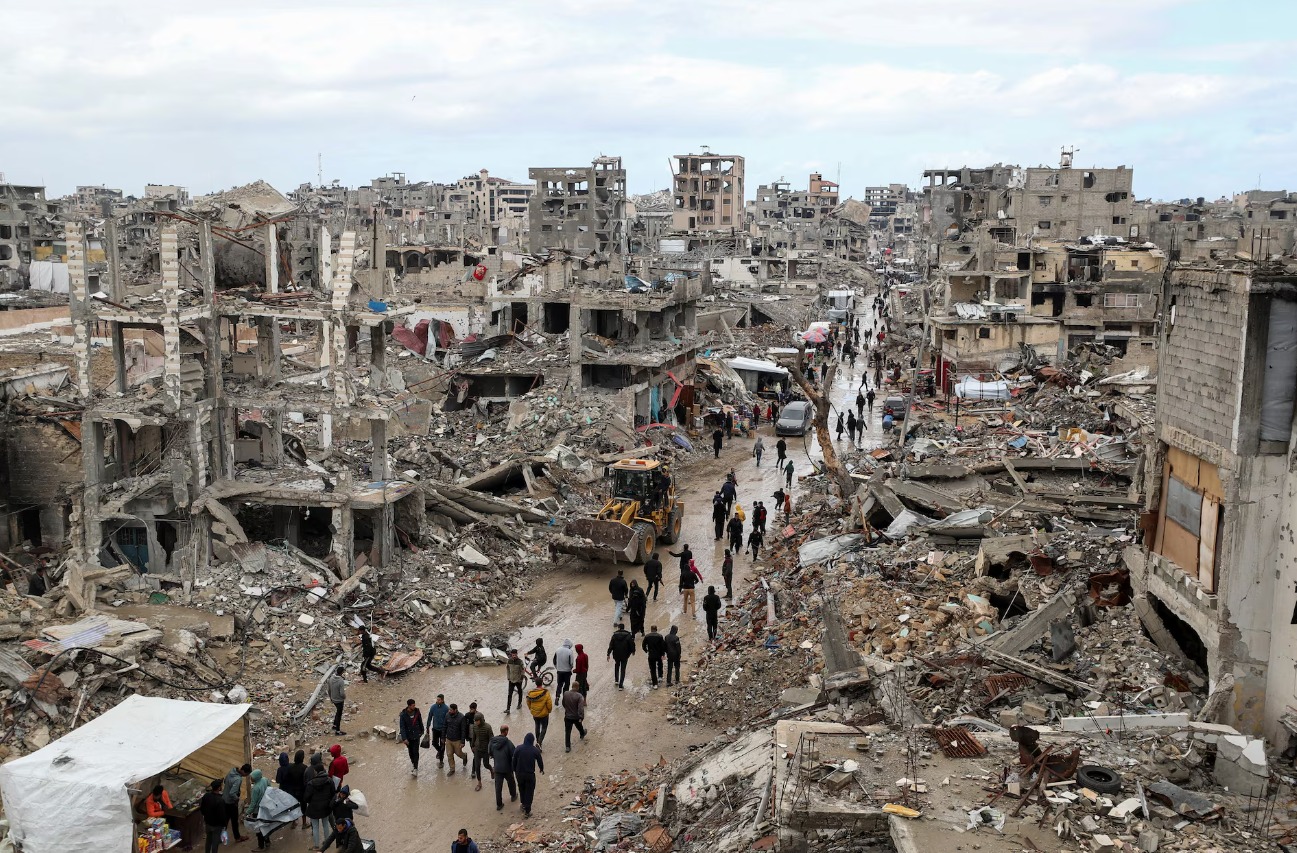
What does the law mean to a mother who reaches a hospital with her wounded child and finds that the hospital, too, has been destroyed?
For Palestinians, that question belongs to a history far older than October 7, 2023. It is a history of dispossession, displacement, occupation and the denial of a people’s right to determine their own future.
Beginning the story on October 7 strips that history from view. It asks the world to examine Palestinian resistance without examining the conditions that produced it, while treating the occupation’s violence as though it began only in response.
Palestinians were not free on October 6.
Their liberation struggle did not emerge from a single organisation, and it cannot be erased by reducing the Palestinian cause to Hamas. Whatever position one takes on the movement, the demand that Palestinians live free from occupation is neither exceptional nor negotiable.
The occupation’s brutality is not a new development. What has changed is the scale of destruction and the extent to which it has unfolded before a world equipped with laws, institutions and overwhelming evidence, yet unwilling to provide effective protection.
The warnings that demand answers
The account of October 7 as an entirely unforeseeable rupture also deserves scrutiny.
Reports of advance warnings raise questions that cannot be dismissed simply because they are politically inconvenient. In October 2023, US House Foreign Affairs Committee chairman Michael McCaul said Egypt had warned the occupation three days before the attacks that such an event could happen. More recent reporting has alleged further warnings from Egyptian and Emirati officials. Benjamin Mileikowsky who goes by Benjamin Netanyahu has denied receiving such warnings.
What was known? Who received the warnings? Why did they fail to produce effective action?
The political use of October 7 deserves scrutiny alongside the failures preceding it. A leadership facing questions about its own decisions cannot be allowed to turn that day into an unlimited mandate for Palestinian destruction.
No account of October 7 can suspend the law governing what followed.
A military target is not unlimited permission
There is something deeply unsettling about having rules for war. Yet humanity constructed those rules because it understood the consequences of violence without restraint.
Civilians are not combatants. The wounded must receive care. Medical facilities have special protection. Starvation cannot be used as a method of warfare.
These are legal obligations, not concessions an occupying power may grant or withdraw.
The genocide that the occupation unleashed in the wake of the Hamas attacks of October 7, 2023 included deliberate and indiscriminate attacks on civilians and countervalue targets, violating fundamental protections under international humanitarian law.
The principles of distinction, proportionality and precaution require parties to identify military objectives, assess foreseeable civilian harm and take all feasible measures to minimise it. The alleged presence of a fighter does not make every person nearby expendable.
Consider the occupation’s May 26, 2024 strikes on the Kuwaiti Peace Camp in Rafah. Amnesty International documented at least 36 deaths, including six children, and identified US made GBU39 bombs. Its investigation found that the attacks were disproportionate and that the military failed to take all feasible precautions to protect civilians.
Families had already fled their homes. Their makeshift shelters offered little protection. The presence of fighters did not relieve the occupation of its obligations towards them.
An evacuation warning likewise cannot substitute for safety. Where should an elderly person go? How does a parent transport a wounded child? What protection does another tent provide?
A warning does not answer these questions. Nor does it automatically make an attack lawful.
Destroying care, prolonging suffering
The destruction of healthcare reveals how violence unfolded.
By September 11, 2025, the World Health Organisation (WHO) had recorded 793 attacks on healthcare in Gaza, with 34 hospitals damaged.
A hospital is where a wounded person might survive. Its destruction removes that possibility for people who have not yet been injured, as well as those already waiting for treatment.
In October 2024, the UN Commission of Inquiry found that the occupation had pursued a concerted policy of destroying Gaza’s healthcare system, committing war crimes and the crime against humanity of extermination. Its findings included attacks on medical personnel and facilities and restrictions on medical evacuation.
The occupation invokes allegations that armed groups use civilian facilities. Those allegations require evidence and scrutiny. Even where a hospital loses its special protection under narrowly defined conditions, proportionality and precaution remain binding.
The patients do not lose their humanity. The premature baby does not become a military objective.
When electricity, medicine and surgical capacity disappear together, survival becomes precarious even for those who escape the bombardment.
Making survival itself impossible
The same logic applies to food and water.
Human Rights Watch’s December 2024 investigation documented the occupation’s deliberate deprivation of water through supply restrictions, electricity cuts, obstruction of fuel and damage to infrastructure. It concluded that these actions amounted to the crime against humanity of extermination and acts of genocide.
The effects enter every household. Water needed for drinking must also serve cooking, washing and cleaning wounds. Hospitals struggle to prevent infection. Families face illness while the facilities that might treat them are damaged or inaccessible.
In June 2024, the UN Commission of Inquiry concluded that the occupation had used starvation as a method of warfare and committed forcible transfer, among other war crimes.
These findings highlight the infliction of a deliberately crafted humanitarian emergency. They identify decisions, conduct and responsibility.
Food cannot become a reward for political submission. A child’s access to water cannot depend on the military objectives of the power controlling its supply.
Washington’s choices have consequences
The US cannot be treated as a detached observer of this destruction.
US made weapons identified in the Rafah camp strikes connect Washington’s arms policy to harm suffered by displaced Palestinians. Amnesty International has documented US weapons and components in other attacks it assessed as unlawful and argued that continued transfers violated US laws and policies intended to prevent civilian harm.
This demands examination of what Washington knew, what it supplied and what it continued to authorise.
Its diplomatic choices also matter. The US vetoed a Security Council resolution demanding an immediate humanitarian ceasefire in December 2023. In June 2025, it blocked another ceasefire resolution supported by the other 14 Council members.
These vetoes are not themselves battlefield offences. They are political decisions with consequences for the ability of international institutions to protect civilians.
Washington’s responsibility must therefore be examined through both its material support and its use of power to obstruct collective pressure on the occupation.
Punishing the pursuit of accountability
In November 2024, the International Criminal Court (ICC) issued arrest warrants for Benjamin Mileikowsky who goes by Benjamin Netanyahu and then defence minister Yoav Gallant. The allegations include starvation as a method of warfare and crimes against humanity. The occupation rejects the accusations and has challenged the proceedings.
However, the warrants have barely been useful as they are not convictions.
And the US subsequently imposed sanctions on ICC officials. In December 2025, the presidency of the court’s Assembly of States Parties warned that further US sanctions undermined the court’s independence and the integrity of the Rome Statute system.
What does accountability mean if investigating a powerful ally exposes the investigators to punishment?
The problem extends beyond individual prosecutions. In its July 2024 advisory opinion, the International Court of Justice (ICJ) found the occupation’s continued presence in the occupied Palestinian territory unlawful. It also identified obligations for other states not to recognise or assist the situation arising from that unlawful presence.
Palestinian freedom cannot be indefinitely postponed while governments debate how to dress up an unlawful situation as more tolerable.
A ceasefire is not freedom
The October 2025 ‘ceasefire’ has not resolved Gaza’s emergency. Reuters reported on October 6, 2026, that the occupation continued near daily attacks and controlled around two thirds of Gaza.
More than 1.2 million people still faced acute hunger, while reconstruction remained stalled and the city's infrastructure utterly destroyed. The occupation claims it is meeting its aid obligations; humanitarian agencies dispute the adequacy of access and supplies.
A reduction in bombardment does not restore a home, reopen a hospital or return a displaced family to its land.
Palestinians are entitled to more than survival under conditions imposed by the occupation. They are entitled to dignity, self determination and a future they can shape themselves.
The history of their persecution cannot be erased by starting the clock on October 7. Nor can that date become a permanent exemption from the laws meant to protect them.
A court may spend years examining evidence. A wounded child may have minutes.
The measure of international law is whether governments act in time to protect that child, and whether they confront the structures that keep placing Palestinian lives in danger.
Until then, the mother searching for a hospital remains the clearest witness to the distance between the world’s promises and its choices.