Pakistan’s cultural diversity is visible not only in its languages, festivals and traditions but also in the skills passed from one generation to the next. Traditional crafts provide a direct connection between communities, their surroundings and their history, with different regions developing distinctive forms of embroidery, weaving, pottery, woodwork, footwear and decorative art.
The country’s National Register of Intangible Cultural Heritage recognises traditional craftsmanship as an important part of this cultural landscape. Among the crafts documented in the national register are truck art, traditional clothing, blue pottery and tiles, as well as a wide range of regional skills.
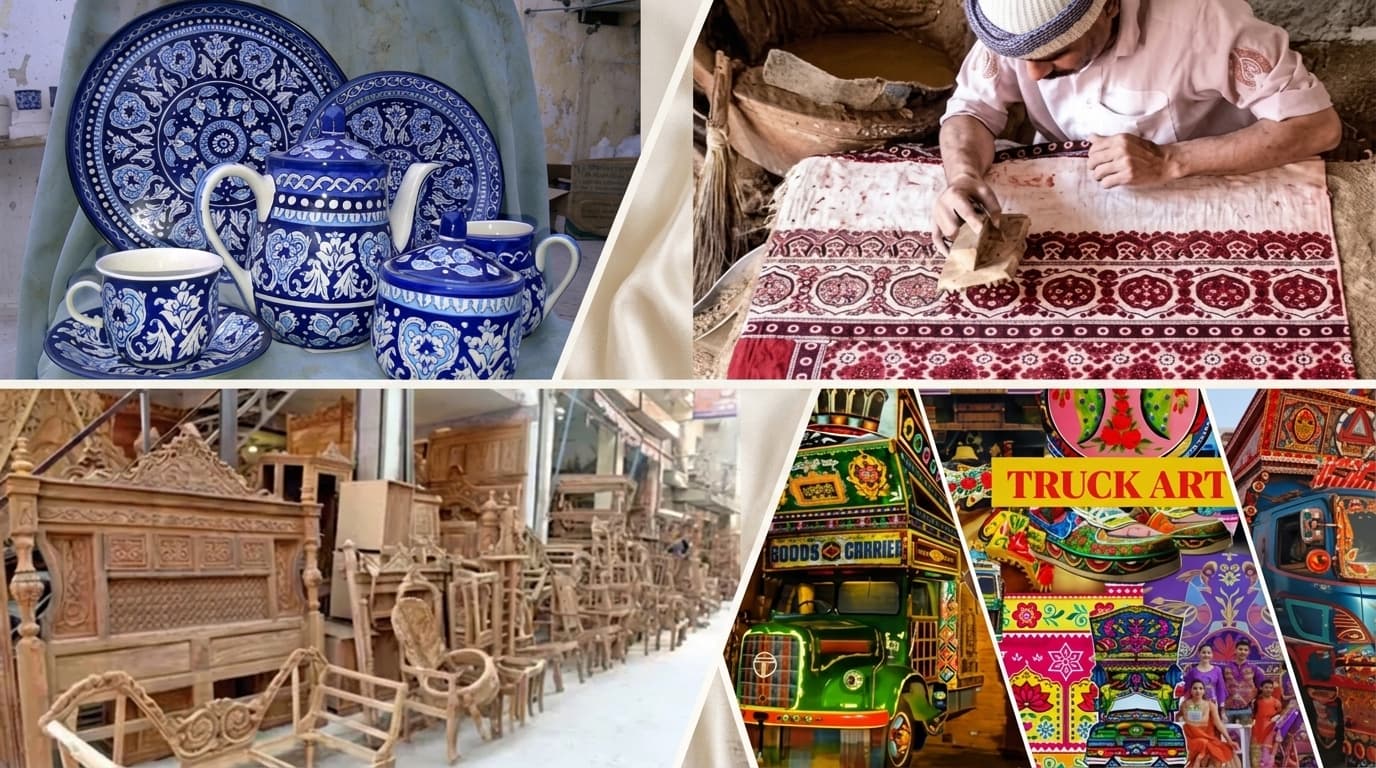
In Punjab, Multan is particularly associated with blue pottery and tile work. The craft involves preparing clay, shaping or carving the material, applying designs and colours, and firing the finished pieces in kilns. The national register documents the use of cobalt and copper compounds in the characteristic blue and turquoise blue designs. The process itself demonstrates that traditional craftsmanship is not simply decorative work. It requires specialised knowledge developed through practice and transmitted between artisans.
Textile traditions offer another expression of regional diversity. Sindhi ajrak and ralli, Kashmiri embroidery and shawl weaving, and Balochi needlework represent different approaches to working with fabric and thread. The traditions are associated with particular communities and regions, while continuing to appear in contemporary clothing and craft markets. Pakistan’s National Heritage and Culture Division has also identified these crafts among the country’s traditional cultural practices.
Woodwork provides another example. Chiniot has long been associated with wood craftsmanship, while other regions have developed their own forms of decorative and functional woodwork. Peshawari chappal and Chitrali caps similarly demonstrate how everyday objects can become expressions of regional identity. Their continued production connects contemporary life with established techniques and designs.
Truck art presents a different form of craftsmanship. Painted trucks have become recognisable for their elaborate colours, patterns and imagery. United Nations Educational, Scientific and Cultural Organization (UNESCO) has documented the use of truck art in community based awareness initiatives, including a project promoting girls’ education in Kohistan. This illustrates how an established local art form can also be used for contemporary social communication.
Some traditions are less widely known but are equally important to Pakistan’s cultural record. In 2025, UNESCO placed the boreendo, also known as the bhorindo, on its List of Intangible Cultural Heritage in Need of Urgent Safeguarding. The traditional clay instrument is associated with the Thari community. Its production involves shaping and firing clay, while knowledge of making and playing the instrument has traditionally been transmitted through practical learning within families and communities.
The recognition of such traditions also highlights an important distinction between preserving an object and preserving the knowledge behind it. A piece of pottery, embroidery or woodwork can be displayed in a museum, but the skill required to produce it survives only when people continue to practise and teach it.
Pakistan has already undertaken efforts to document and safeguard this heritage. UNESCO records community based projects involving Sindh and Khyber Pakhtunkhwa that have included inventorying cultural practices, developing educational tools and building the capacity of artisans. These efforts recognise that cultural heritage remains living heritage when communities continue to practise, teach and adapt it.
The diversity of Pakistan’s crafts therefore lies not simply in the number of traditions found across the country. It lies in the knowledge attached to each tradition and in the communities that have carried that knowledge forward. Preserving these skills means preserving techniques, stories and forms of expression that connect the present with earlier generations.
For Pakistan, safeguarding traditional craftsmanship is consequently both a cultural responsibility and an opportunity. Supporting artisans, documenting their skills and creating opportunities for younger generations to learn can help ensure that these traditions remain part of everyday life rather than becoming only records of the past.