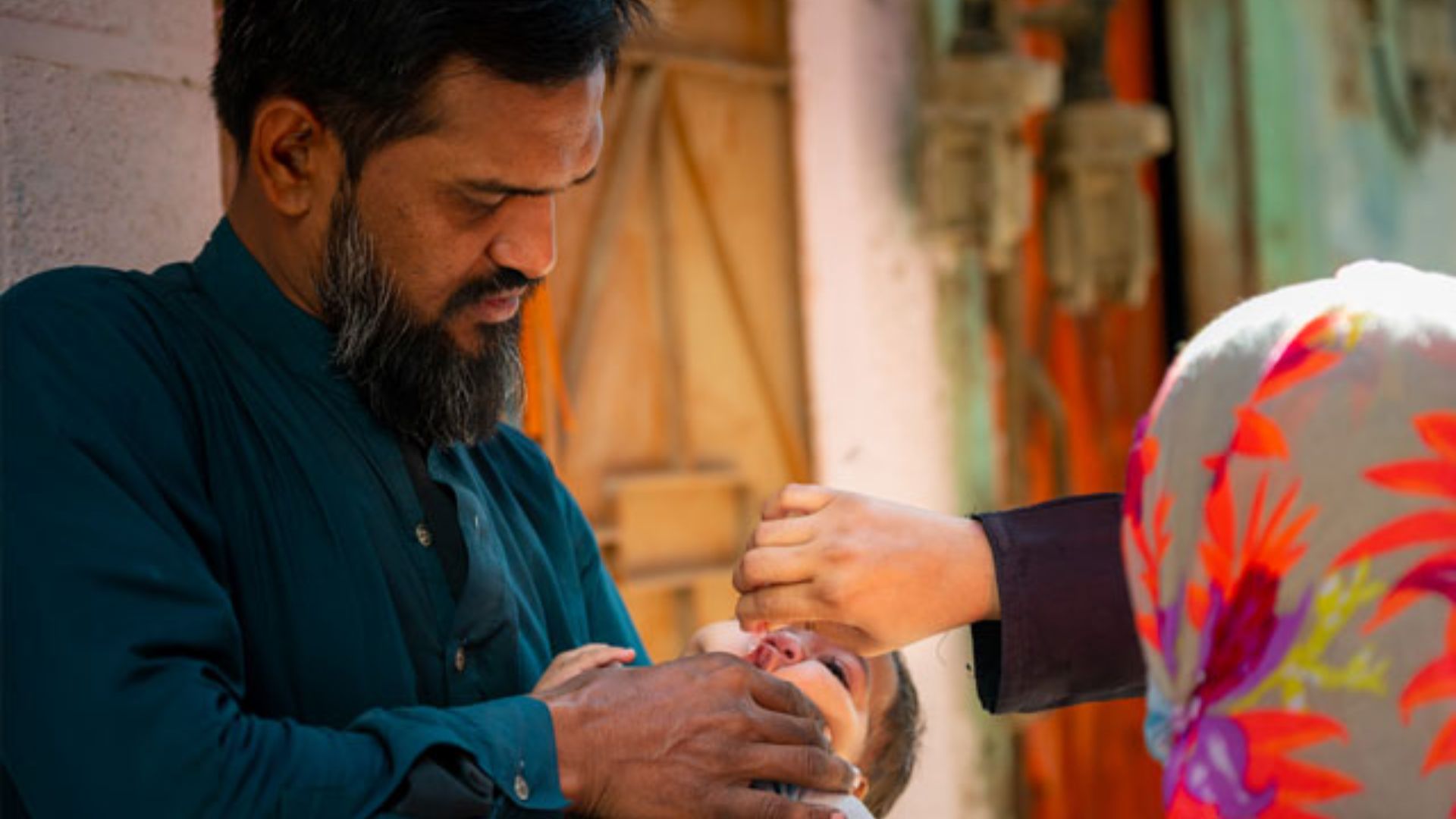
More than three decades of vaccination campaigns have brought Pakistan close to eliminating polio. Yet the virus persists where insecurity, fragile health systems and public mistrust intersect, raising questions that extend far beyond immunisation.
Pakistan has spent more than three decades trying to eliminate a disease that much of the world has already consigned to history. Millions of children have been vaccinated, billions of rupees and substantial international resources have been invested, and successive governments have declared polio eradication a national priority. Yet Pakistan remains one of only two countries, alongside Afghanistan, where wild poliovirus transmission has never been interrupted.
The persistence of polio presents a troubling contradiction. Pakistan has demonstrated the institutional capacity to conduct vaccination campaigns across difficult terrain, mobilise hundreds of thousands of health workers and maintain an extensive disease surveillance network. Nevertheless, the virus continues to find children beyond the effective reach of these interventions.
On World Polio Day, the question is not merely why polio remains in Pakistan, but what its persistence reveals about the country's public health infrastructure, security environment and relationship between citizens and the state.
A preventable disease with irreversible consequences
Poliomyelitis, commonly known as polio, is a highly infectious viral disease that primarily affects children under five. The poliovirus spreads mainly through the faecal oral route, particularly where contaminated water, inadequate sanitation and poor hygiene facilitate transmission.
Most infected individuals experience no symptoms, while others develop fever, fatigue, headaches or gastrointestinal discomfort. In a small proportion of cases, however, the virus attacks the nervous system, causing irreversible paralysis, sometimes within hours. When the muscles responsible for breathing are affected, the disease can be fatal.
There is no cure for paralytic polio. Rehabilitation and supportive treatment can improve quality of life, but vaccination remains the principal means of prevention.
The distinction between infection and visible illness is particularly important. A community may report no paralytic cases while the virus continues circulating among people who show no symptoms. This is why environmental surveillance, including the testing of sewage samples, has become central to Pakistan's eradication strategy.
A positive environmental sample does not represent a confirmed case of paralysis. It indicates that the virus is present in the population and that unprotected children remain vulnerable.
Three decades of progress, and a difficult final stretch
Pakistan launched its national Polio Eradication Programme in 1994, following the establishment of the Global Polio Eradication Initiative in 1988. At the time, the country recorded an estimated 20000 polio cases annually.
The reduction since then has been substantial. Pakistan reported 31 wild poliovirus cases in 2025, compared with thousands in the early 1990s. This achievement reflects sustained immunisation, improved surveillance, international cooperation and the work of frontline health personnel.
Yet the final stage of eradication has proved particularly difficult.
As of 24 October 2026, Pakistan has confirmed seven wild poliovirus cases this year. Five were reported from Khyber Pakhtunkhwa (KP) and two from Sindh. The latest, announced on 19 October, involved a six month old boy from Karachi's East district, the city's first reported case since December 2024.
The numbers are comparatively small, but their geographical distribution is significant. Southern KP and Karachi remain areas of concern, reflecting different but interconnected challenges: insecurity and difficult access in parts of the northwest, and population mobility, dense settlements and uneven immunisation coverage in urban centres.
The World Health Organization (WHO) has also identified cross border transmission corridors linking Pakistan and Afghanistan. The two countries effectively constitute a single epidemiological region for polio, meaning that sustained eradication in either depends partly on progress in the other.
This is particularly consequential in a region shaped by decades of conflict, migration, displacement and fluctuating border restrictions. A virus does not recognise territorial sovereignty. Public health responses, however, remain dependent on national institutions, bilateral coordination and access to communities.
When vaccination became entangled with conflict
The challenges facing Pakistan's polio programme cannot be understood without examining the country's security history.
For years, militant organisations have targeted vaccination workers and their security escorts, particularly in KP and the former tribal areas. The attacks have disrupted campaigns, restricted access to vulnerable communities and transformed an essential public health intervention into a dangerous assignment.
The roots of this hostility are complex. Militant propaganda has portrayed vaccination as a foreign conspiracy, spread false claims about infertility and questioned the religious permissibility of vaccines. These narratives have persisted despite repeated endorsements of immunisation by religious scholars and medical authorities.
However, public mistrust cannot be examined without acknowledging the 2011 Abbottabad episode.
In the operation preceding the killing of Osama bin Laden, the US Central Intelligence Agency used a vaccination campaign organised through Pakistani doctor Shakil Afridi as cover for an intelligence effort intended to obtain DNA evidence. The operation involved a purported hepatitis B vaccination drive, not a legitimate polio campaign.
Its consequences extended well beyond Abbottabad.
The use of medical services for intelligence gathering undermined confidence in vaccination programmes and provided militant groups with material to reinforce existing suspicions. Subsequent research identified a decline in vaccination uptake associated with the resulting mistrust.
The episode illustrates the consequences of compromising the neutrality of humanitarian and medical interventions. It does not validate misinformation about vaccines, nor does it justify attacks on health workers. It demonstrates how actions taken for security objectives can produce lasting public health consequences.
In 2012, militant restrictions on immunisation in North and South Waziristan deprived large numbers of children of access to vaccination. The same year witnessed deadly attacks on polio workers, marking a particularly violent chapter in Pakistan's eradication campaign.
The security threat has not disappeared. In April 2026, Pakistan's Polio Eradication Initiative condemned attacks targeting vaccination teams and security personnel in KP and Balochistan.
For the women and men delivering vaccines, the implications are immediate. Their work requires entering unfamiliar neighbourhoods, negotiating access, addressing parental concerns and, in some areas, operating under armed protection.
Women health workers are especially important because they can access households and communicate with mothers in communities where social conventions restrict interaction with male workers. Their contribution extends beyond administering drops to establishing the relationships on which effective immunisation depends.
The problem beyond vaccine refusal
Although vaccine hesitancy attracts considerable attention, it would be misleading to attribute Pakistan's continuing polio transmission primarily to parental refusal.
Some children are missed because their families move frequently. Others live in informal settlements, remote communities or areas affected by insecurity. Weak routine immunisation, malnutrition, inadequate sanitation and gaps in local health services further complicate prevention.
These conditions are interconnected.
A family without reliable access to clean drinking water faces greater exposure to diseases transmitted through contaminated environments. A malnourished child may develop a weaker immune response to vaccination. A household displaced by conflict or economic hardship may fall outside established vaccination records.
Consequently, the same populations that face the greatest risk of infection are frequently those least consistently reached by preventive services.
The distinction matters for policymaking. Where refusal is the problem, engagement and trust building are necessary. Where access is the obstacle, security arrangements, mobile teams and better population mapping become essential. Where routine immunisation is weak, supplementary campaigns alone cannot provide a sustainable solution.
Pakistan's programme has increasingly relied on environmental surveillance to identify circulation before paralysis is detected. Sewage testing, genetic analysis and investigation of acute flaccid paralysis cases help authorities trace transmission and direct vaccination responses.
But surveillance can identify the presence of a virus without eliminating the conditions that allow it to spread.
Why repeated vaccination remains necessary
One persistent misconception concerns the frequency of polio vaccination campaigns. Parents sometimes question why children who have already received several doses must be vaccinated again.
Pakistan uses both oral polio vaccine, administered as drops, and inactivated polio vaccine, delivered through injection.
The oral vaccine is particularly valuable for controlling transmission because it develops immunity in the intestine, where the virus multiplies. The injectable vaccine provides strong protection against paralytic disease.
Repeated doses help build immunity, particularly among children whose nutritional status or exposure to other infections may affect their immune response. High vaccination coverage is also necessary to prevent the virus from finding susceptible individuals within a community.
The vaccines are safe and effective, although medical communication should acknowledge their scientifically documented limitations. In rare circumstances, weakened viruses used in oral vaccines can circulate for prolonged periods in severely underimmunised communities and evolve into vaccine derived polioviruses.
These are distinct from the wild poliovirus type 1 responsible for Pakistan's current endemic transmission. The existence of rare vaccine associated risks does not negate the overwhelming protective benefits of immunisation.
Clear communication on such distinctions is essential. Public confidence is better sustained through accurate explanations than through dismissing every concern as ignorance.
Eradication as a measure of governance
Pakistan's polio response has achieved measurable progress. During the February 2026 nationwide campaign, approximately 400000 frontline workers were mobilised to reach an estimated 45 million children. In October, a subnational campaign vaccinated more than 29.3 million children.
These figures demonstrate the scale of the country's public health mobilisation.
Yet the effectiveness of a campaign cannot be measured by the number of doses administered alone. Equally important are the children repeatedly missed, the quality of coverage in high risk areas and whether surveillance findings translate into timely interventions.
The WHO's August 2026 assessment acknowledged progress in reducing transmission while warning that gaps in programme quality remained, particularly in southern KP, Karachi and cross border corridors.
This distinction between activity and outcome is central to evaluating Pakistan's eradication strategy.
A sustainable response requires strengthening routine immunisation, improving water and sanitation services, addressing local security constraints and incorporating community participation into programme design.
It also requires recognising that health workers cannot independently resolve failures rooted in broader governance structures.
Polio has consequences beyond individual disability. Paralysis can impose lifelong financial and caregiving burdens on families, especially those with limited access to rehabilitation, assistive devices and inclusive education. Continued transmission also carries international implications, including vaccination requirements for travellers and the possibility of exporting the virus to countries that have already eliminated it.
Pakistan's success is therefore not merely a domestic public health objective. It remains integral to the global eradication effort.
The final mile
The world has already demonstrated that polio can be defeated. Two of the three naturally occurring wild poliovirus types have been eradicated, and global cases have fallen by more than 99 per cent since 1988.
Pakistan has contributed to that progress, but it has yet to complete the task.
The remaining challenge demands more than repeated campaigns and annual commitments. It requires sustained investment in primary healthcare, credible communication, protection for frontline workers and coordinated responses to the social and geographical inequalities that leave children unprotected.
Most importantly, it requires viewing polio eradication not as an isolated programme but as part of a functioning public health system.
Every confirmed case represents a child whose future may have been permanently altered by a preventable infection. Every missed child represents a vulnerability that extends beyond one household.
On World Polio Day, Pakistan has reason to recognise how far it has come. But the measure of success will not be the number of campaigns conducted or targets announced. It will be the point at which no child faces lifelong paralysis because a preventable virus was allowed to circulate.
That remains Pakistan's unfinished responsibility.