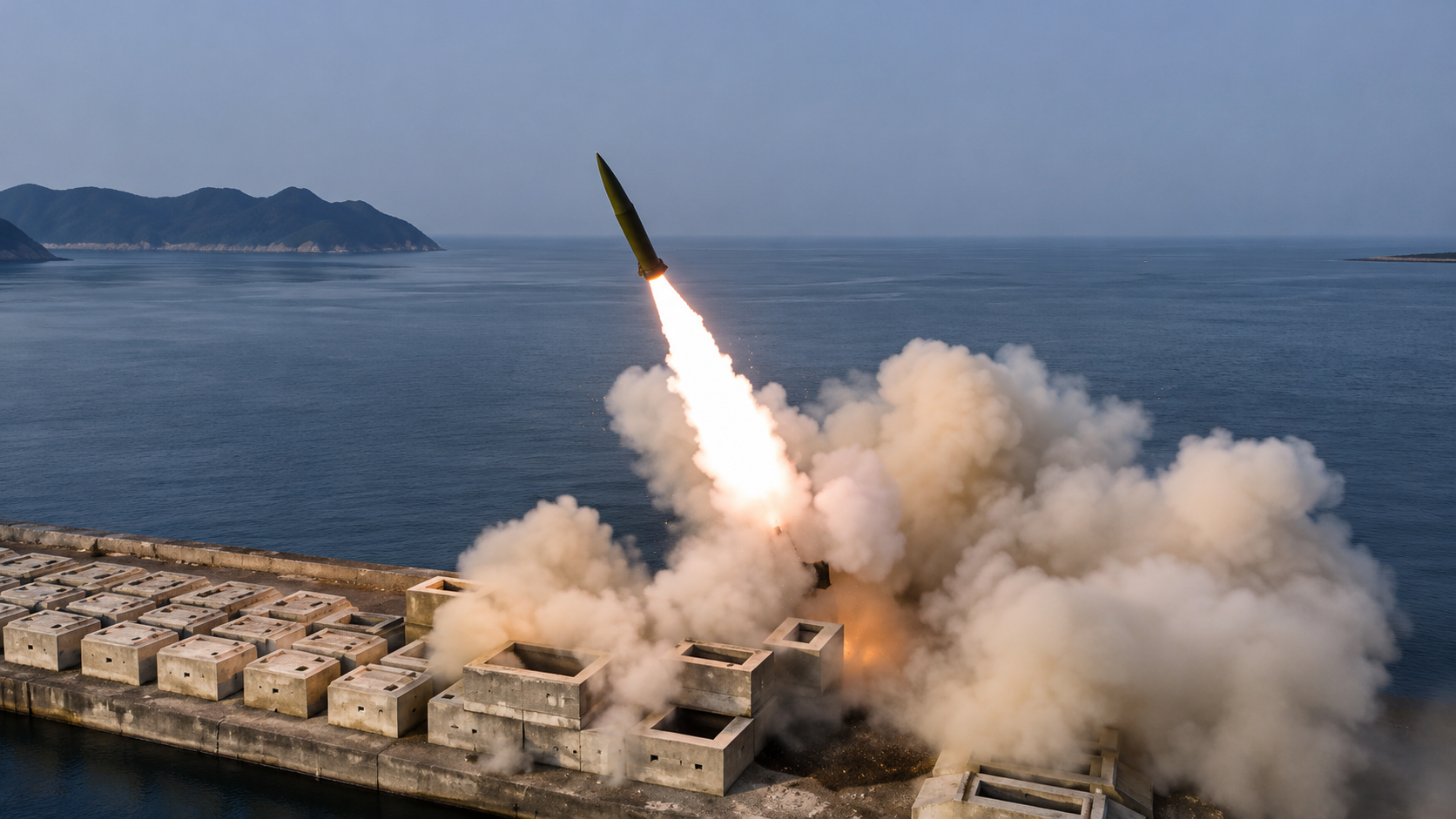
Pyongyang: North Korea conducted a test of cluster bomb warheads on Saturday, October 31, as part of efforts to assess their use with tactical ballistic missiles, the country's state run Korean Central News Agency (KCNA) reported on Sunday.
According to KCNA, the exercise was intended to evaluate the warheads' performance and suitability for use by military units. North Korean officials claimed the weapon could affect an area measuring between 12 and 13 hectares. The reported capability has not been independently verified.
Photographs released by the agency showed a projectile being launched from a mobile platform and multiple impacts at a designated target site.
North Korean leader Kim Jong Un did not attend the latest exercise. He had previously overseen a test involving cluster bomb warheads mounted on a ballistic missile in April, accompanied by his daughter, Ju Ae.
Weapons development and military planning
The latest test follows North Korean trials involving attack drones, a precision-guided torpedo system and an intermediate-range hypersonic missile. The series of exercises reflects Pyongyang's efforts to expand the range of weapons available to its armed forces and assess their suitability for different military operations.
The director general of North Korea's Missile Administration said military units would be able to select and use different types of weapons according to operational requirements before the end of the year. Cluster munitions are designed to disperse multiple smaller explosive devices across an area. Their use has raised humanitarian concerns because unexploded submunitions can remain hazardous to civilians after hostilities have ended.
The Convention on Cluster Munitions prohibits the use, production, transfer and stockpiling of these weapons by states that have joined the treaty. North Korea is not a party to the convention.
Tensions along the Korean border
The test comes amid renewed tensions between North and South Korea following a landmine explosion near their fortified border that wounded three South Korean soldiers. North Korea has denied responsibility for the incident and announced plans to reinforce its border defences and resume loudspeaker broadcasts.
The two countries remain technically at war because the 1950–1953 Korean War ended with an armistice rather than a peace treaty. The Demilitarised Zone separating them remains subject to military restrictions, with incidents near the border carrying the risk of further confrontation.
North Korea has continued to develop missile and other weapons systems despite United Nations Security Council sanctions restricting its ballistic missile and nuclear programmes. Pyongyang maintains that its military development is necessary for national defence, while South Korea and its security partners regard North Korea's missile activities as a threat to regional security.
The latest exercise adds to concerns over the Korean Peninsula's security environment, although KCNA did not announce any deployment date for the tested warheads.
There was no independent confirmation of the test's reported performance or an immediate response from South Korean authorities in the supplied report.