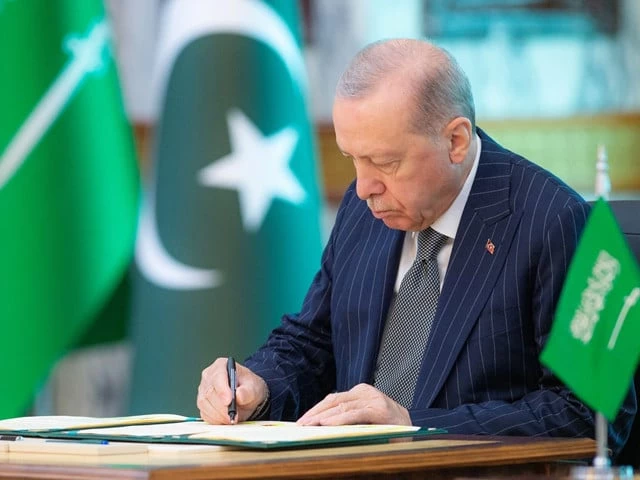
Ankara:Turkish President Recep Tayyip Erdogan has formally approved the Makkah Joint Defence Agreement (MJDA) with Pakistan and Saudi Arabia, completing Turkiye's ratification process as the three countries move towards implementing their collective defence commitments.
The approval was published in Turkiye's Official Gazette on Friday, November 27, following the Turkish parliament's ratification of the agreement on November 5.
Signed in Makkah on August 7, the pact establishes a defence arrangement under which an armed attack against one member is considered an attack against all three.
The agreement provides for military assistance and cooperation, subject to the laws and procedures of the participating countries. Erdogan's approval completes the ratification process and allows the three governments to proceed with implementing the agreement.
Islamabad hosts talks on defence cooperation
The development coincides with a two day meeting of the alliance's Strategic Political and Defence Committee in Islamabad on November 27 and 28.
The committee brings together foreign and defence ministers and military representatives from Pakistan, Saudi Arabia and Turkiye to discuss how the agreement will operate.
Officials are expected to review procedures for military coordination, the deployment of forces and arrangements for responding to threats against member countries.
The meeting follows consultations held since the agreement was signed in August, amid concerns about the conflict involving Iran, Israel and the United States. Saudi Arabia's confrontation with Yemen's Houthi movement has also increased the importance of the defence arrangement.
The Houthis have carried out attacks against Saudi territory and energy infrastructure, prompting military responses from the Saudi-led coalition operating in Yemen. The agreement could provide a framework for Pakistan and Turkiye to assist Saudi Arabia in the event of further attacks.
Turkish troop deployment would require further approval
Although Turkiye has ratified the pact, the approval does not automatically authorise the deployment of Turkish troops to Saudi Arabia.
A lawmaker from Erdogan's ruling party told Reuters in October that the government intended to submit a parliamentary mandate seeking authorisation to deploy military personnel under the agreement.
Any deployment would therefore need to comply with Turkish constitutional and parliamentary procedures. No deployment under the agreement was announced alongside Friday's ratification.
Turkiye maintains NATO's second largest military by personnel, while Pakistan and Saudi Arabia have longstanding defence relationships involving training, equipment and military cooperation. The trilateral pact brings these relationships under a framework for coordinating responses to security threats.
It also provides opportunities for cooperation in defence production, technology transfers and intelligence sharing.
Regional tensions shape alliance's priorities
The agreement comes as the three countries assess the implications of conflicts across the Middle East. Saudi Arabia, one of the world's leading oil exporters, faces security concerns arising from attacks on its energy infrastructure.
Turkiye maintains military and diplomatic interests across the region, while Pakistan has defence relations with Riyadh and Ankara and shares a border with Iran. These relationships mean the three governments must determine how collective defence commitments would apply to conflicts involving other regional powers.
The alliance's institutional arrangements are also under development, including procedures for taking military decisions and coordinating assistance. For Pakistan, the agreement expands defence cooperation with two partners while raising questions about its obligations during a regional crisis.
For Turkiye, completing ratification establishes the legal basis for participation, although any decision to deploy forces would remain subject to further authorisation.
The outcome of the Islamabad talks will help determine how the three countries translate their mutual defence commitment into operational arrangements.