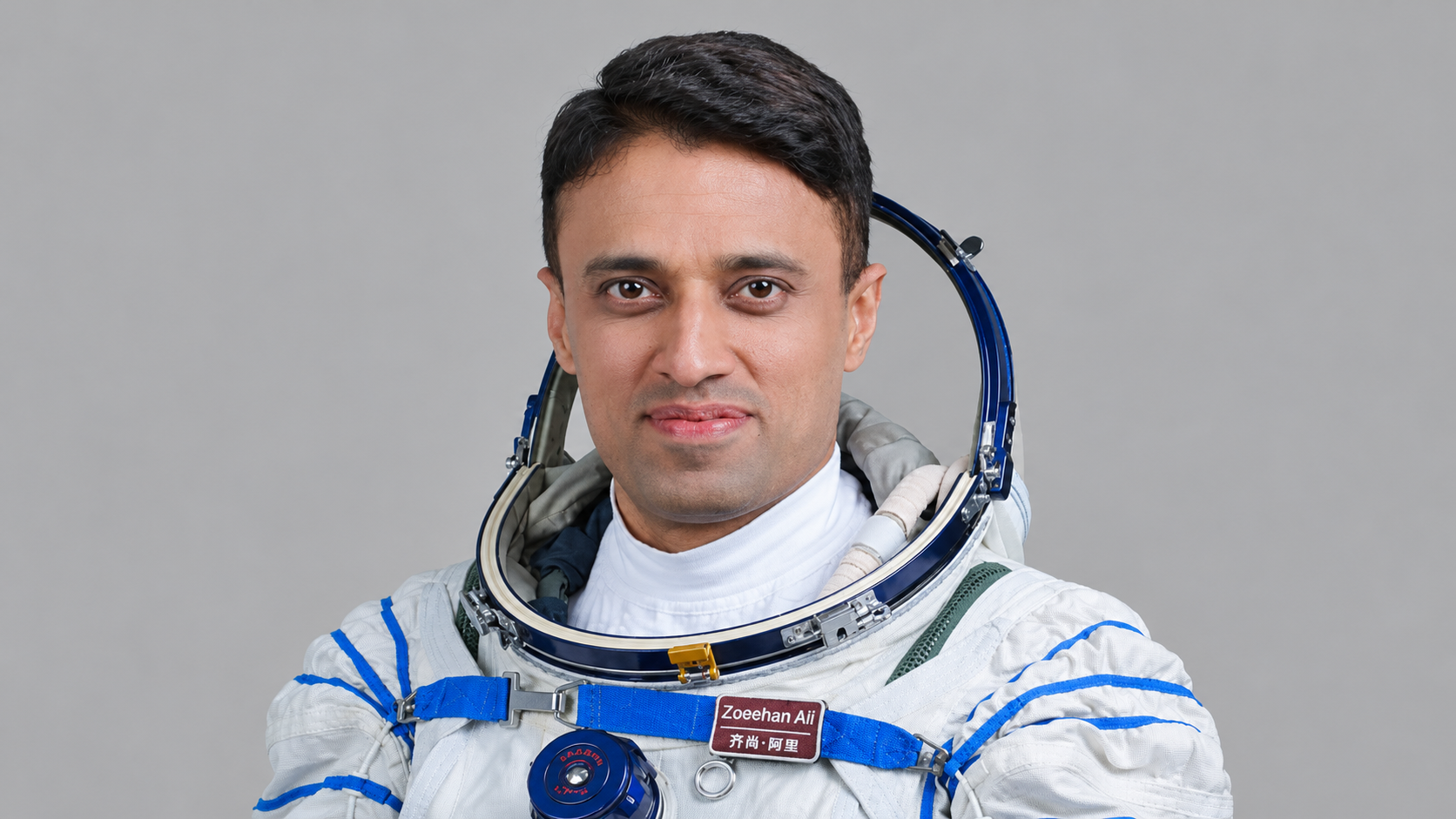
Jiuquan: Pakistan's Muhammad Zeeshan Ali has been selected for China's Shenzhou 24 mission, scheduled to launch on November 25, marking Pakistan's first human spaceflight and the first visit by a foreign astronaut to China's Tiangong space station.
The China Manned Space Agency (CMSA) announced the three member crew on November 24, naming Chinese astronauts Tang Hongbo and Wu Yi alongside Ali.
The spacecraft is scheduled to lift off from the Jiuquan Satellite Launch Centre in northwestern China at 8:18 am Beijing time, corresponding to 5:18 am in Pakistan.
Tang Hongbo will command the mission, Wu Yi will serve as flight engineer, while Ali will undertake scientific responsibilities as a payload specialist.
Pakistani astronaut to spend one week in space
Ali, a former pilot in Pakistan's armed forces, is expected to spend approximately one week aboard the Tiangong space station.
During his stay, he will conduct scientific experiments related to cooperation between Pakistan and China and assist with daily operations aboard the station.
According to CMSA, the mission will include approximately 90 experiments covering space science, payload operations and other research activities.
The Shenzhou 24 crew will also undertake maintenance work and participate in a crew rotation with astronauts from the earlier Shenzhou 23 mission.
Ali is expected to return to Earth aboard the Shenzhou 23 spacecraft, which docked with Tiangong in May.
His participation will make him the first foreign national to board China's space station and mark the first joint flight involving Chinese and foreign astronauts under Beijing's crewed space programme.
Carrying the hopes of 250 million Pakistanis
Addressing a press briefing in China, Ali said he had arrived at the Astronaut Centre of China carrying the hopes of 250 million Pakistanis.
He expressed gratitude to the Chinese government for supporting Pakistan's ambition to send an astronaut into space.
Ali said his training had equipped him with spaceflight skills and allowed him to develop professional and personal relationships with Chinese astronauts.
He also learned Mandarin to communicate with his crewmates during training and the mission.
Describing the experience, Ali said his participation represented a national achievement and reflected cooperation between Pakistan and China in space exploration.
Planning Minister Ahsan Iqbal congratulated him, describing the mission as a reflection of bilateral trust.
Information Minister Attaullah Tarar also welcomed the announcement.
Pakistan China space cooperation expands
The mission follows an agreement signed in February 2025 between the Space and Upper Atmosphere Research Commission (Suparco) and CMSA.
Under the agreement, two Pakistani astronaut candidates were selected for training in China, with one designated to participate in a mission to Tiangong.
Muhammad Zeeshan Ali and Khurram Daud began their training programme in April 2026.
Prime Minister Shehbaz Sharif met both candidates following their selection and said the programme would strengthen scientific cooperation between the two countries.
China operates Tiangong independently of the International Space Station and has expanded its space programme through crewed missions, scientific research and international partnerships.
Beijing also plans to land astronauts on the Moon by 2030.
Ali's flight will be Pakistan's first opportunity to conduct scientific work through a national astronaut aboard an orbital space station, opening another area of cooperation between Islamabad and Beijing.