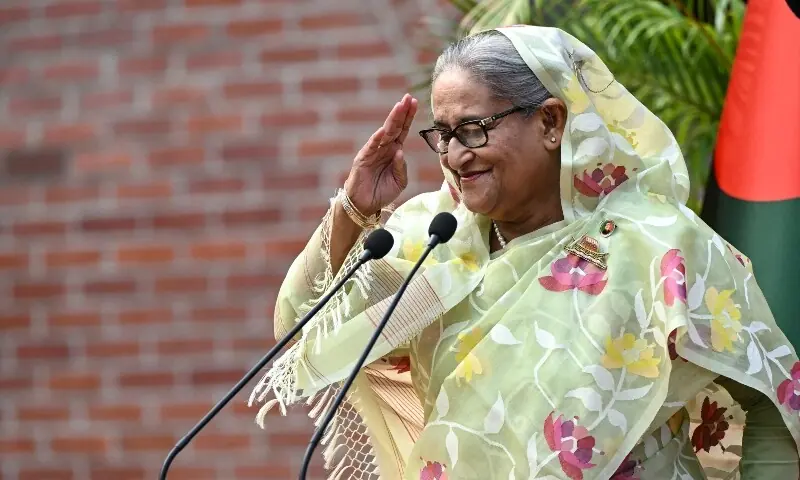
Dhaka: Former Bangladesh prime minister Sheikh Hasina has announced plans to return from exile in India on December 16, prompting a warning from the Bangladeshi government that she will only be allowed to return through extradition and will face imprisonment upon arrival.
Hasina's spokesperson, Syed Mozammel Ali, confirmed the proposed date to Reuters on Tuesday, November 24, marking the first time the former leader has specified when she intends to return since fleeing Bangladesh in August 2024.
The date coincides with Bangladesh's Victory Day, which commemorates the country's independence following the 1971 war with Pakistan. The announcement comes amid a dispute between Dhaka and New Delhi over Hasina's extradition, as well as protests and incidents of violence linked to her proposed return.
Hasina, 79, has asked the Bangladeshi government to arrange her journey from New Delhi to Dhaka aboard the national carrier, Biman Bangladesh Airlines. Her spokesperson argued that because she had been flown to India on a Bangladeshi aircraft on August 5, 2024, the government should take responsibility for facilitating her return.
He also claimed that Hasina had been forced into exile in violation of the Constitution. The former prime minister has sought a passport and national identity card to facilitate her journey, but the authorities have rejected the requests. Her travel documents were cancelled after she left the country.
The government has dismissed her request for an aircraft, maintaining that her return must follow the extradition process. State Minister for Foreign Affairs Humaiun Kobir told Reuters that Hasina could only return under the extradition treaty between Bangladesh and India.
He said she would be brought back in custody and under surveillance, rather than through arrangements made at her request. Kobir also rejected the proposal for a government-arranged flight.
The government has not announced any agreement with India on transferring Hasina to Bangladesh. The disagreement follows Hasina's conviction by Bangladesh's International Crimes Tribunal in November 2025.
The tribunal sentenced her to death in absentia after finding her guilty of crimes against humanity in connection with the suppression of student-led protests in 2024. Hasina has denied the charges and described the proceedings as politically motivated.
The protests began over a government job quota system before developing into a movement demanding her resignation. Demonstrations spread across Bangladesh, leading to confrontations involving protesters, police and security forces. According to the United Nations, as many as 1,400 people were killed during the unrest, which ended Hasina's 15 year period in power.
She fled to India on August 5, 2024, as protesters approached the prime minister's residence in Dhaka. Bangladesh has formally requested her extradition, relying on an agreement with India covering the transfer of individuals wanted for prosecution or convicted of offences.
New Delhi has not announced a decision on the request.
In April, India's Ministry of External Affairs said it was examining Bangladesh's application and intended to maintain engagement with Dhaka. India's foreign ministry did not immediately respond to requests for comment following Tuesday's announcement.
The dispute places India in a diplomatic position involving a former leader with whom it maintained close relations and a Bangladeshi government seeking enforcement of a criminal conviction.
Although the extradition treaty establishes a framework for cooperation, any transfer would depend on the applicable legal procedures and decisions by the Indian authorities.The announcement has also intensified political tensions within Bangladesh.
Hasina's Awami League party remains banned following the uprising that removed her from power. Earlier in November, the party organised demonstrations and called for a nationwide shutdown in support of her return.
Authorities reported incidents involving crude bomb explosions and arson attacks on vehicles across several districts, leaving police personnel and civilians injured. Government representatives have accused supporters of the former ruling party of contributing to the violence.
Awami League officials have disputed those allegations and blamed the current political establishment. Responsibility for individual incidents remains a matter for investigation.The December 16 announcement has raised questions about whether Hasina will attempt to travel without government approval and how the authorities would respond if she reaches Bangladesh.
Bangladesh's chief prosecutor at the International Crimes Tribunal has questioned her request for official travel arrangements, arguing that someone convicted by the court cannot expect the government to facilitate a return outside the legal process.
For Hasina, returning on Victory Day would carry political significance because of her family's association with Bangladesh's independence movement. Her father, Sheikh Mujibur Rahman, led the country's independence struggle and became its founding president.
For the government, however, the issue centres on implementing the tribunal's verdict and obtaining her custody through extradition. No flight has been arranged, and India has not confirmed that it will allow or facilitate her departure.
With December 16 approaching, Hasina's announced plans remain uncertain, while Bangladesh continues to insist that any return must take place through the legal process rather than a government sponsored journey.