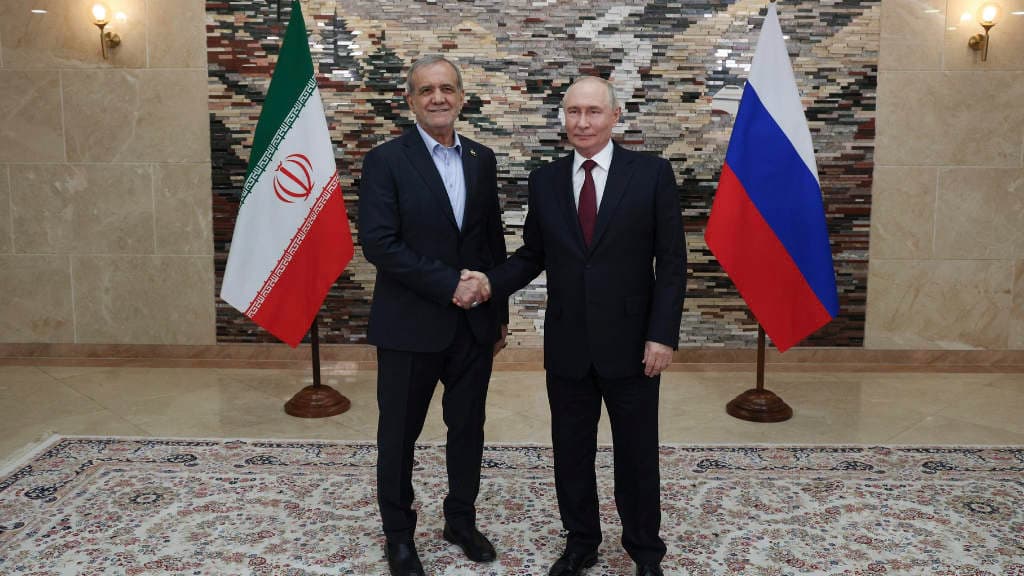
Bishkek: Russian President Vladimir Putin met Iranian President Masoud Pezeshkian on the sidelines of the Shanghai Cooperation Organisation (SCO) summit in Bishkek, as both countries seek to expand cooperation amid continuing geopolitical tensions and Western sanctions.
During the meeting, they reaffirmed their strategic partnership, with energy, trade, transport and security cooperation dominating talks.
Putin said Russia Iran relations were developing across multiple sectors under the Comprehensive Strategic Partnership Treaty (CSPT) signed in 2025. He also reaffirmed Moscow’s support for Iran and highlighted the continued growth of economic ties between the two countries.
Whilst Pezeshkian thanked Moscow for its support at international organisations and described relations with Russia as strategic. He also called for greater cooperation through multilateral organisations, including the SCO, in response to what Tehran views as unilateral sanctions and pressure.
The meeting signals that Russia Iran relations are extending beyond individual areas of cooperation towards a broader strategic framework. For the wider region, stronger links in energy, trade and transport could further reshape Eurasian connectivity while reducing both countries’ reliance on Western dominated economic networks.
Trade remains a central component of the relationship. Bilateral trade reached about USD 5.76 billion in 2025, with the figure growing by around 20 percent during the year. Putin also pointed to the Free Trade Agreement between Iran and the Eurasian Economic Union (EAEU), which has helped facilitate greater economic exchange.
Financial cooperation has expanded alongside trade. Russia and Iran have increased the use of their national currencies for bilateral transactions and have developed alternative financial mechanisms as both countries face restrictions on access to US and European financial systems. Russia has also made its System for Transfer of Financial Messages available to Iranian financial institutions.
Energy cooperation is another major pillar. Russia’s state nuclear agency, Rosatom, is involved in plans to construct four nuclear power units at Sirik in southern Iran. It is pertinent to note that Moscow previously developed Iran’s first operational nuclear power plant at Bushehr, and the two countries have discussed further nuclear energy projects.
Transport connectivity also featured in the broader bilateral agenda. Iran is a key link in the International North South Transport Corridor (INSTC), which aims to connect Russia with Iran and onward markets in the Persian Gulf and South Asia. Completion of the Rasht Astara railway link would strengthen the route and reduce transit times between northern Europe and South Asia.
Security cooperation remains an important element of the relationship. Senior Russian officials responsible for military technical cooperation attended the meeting, reflecting the growing institutional links between the two countries.