Three years after October 7, Gaza's physical landscape has changed, while displacement and Israeli military control continue despite the 2025 ceasefire. Yet Palestinian cultural memory increasingly travels without depending on a single physical location. A manuscript can be digitised. Tatreez can be stitched elsewhere. A key can pass from one generation to another. A keffiyeh can appear at a graduation thousands of kilometres away. A film can carry a Palestinian story into Venice, and 360 degree footage can preserve a street that no longer looks as it once did.
That may be the clearest thread connecting the library, the films, the restrictions and the symbols: when physical spaces become inaccessible or disappear, culture becomes a record. For the Palestinians, preserving that record has increasingly become a way of insisting that memory, history and identity remain visible.
Before October 2023, Gaza's towns, markets, mosques, churches and neighbourhoods formed part of a densely populated Palestinian cultural landscape, alongside traditions expressed through embroidered dress, music, books, food and everyday activities such as children flying kites. The scale of Gaza's population today is difficult to establish with certainty because of deaths, displacement, migration and disruption to demographic data during the genocide.
The Palestinian Central Bureau of Statistics estimated the population of the State of Palestine at approximately 5.56 million at the end of 2025, including about 3.43 million people in the West Bank and 2.13 million in the Gaza Strip, but these figures remain estimates rather than a confirmed count. Against widespread destruction visible across Gaza, cultural symbols have also taken on renewed importance as markers of Palestinian identity and memory.
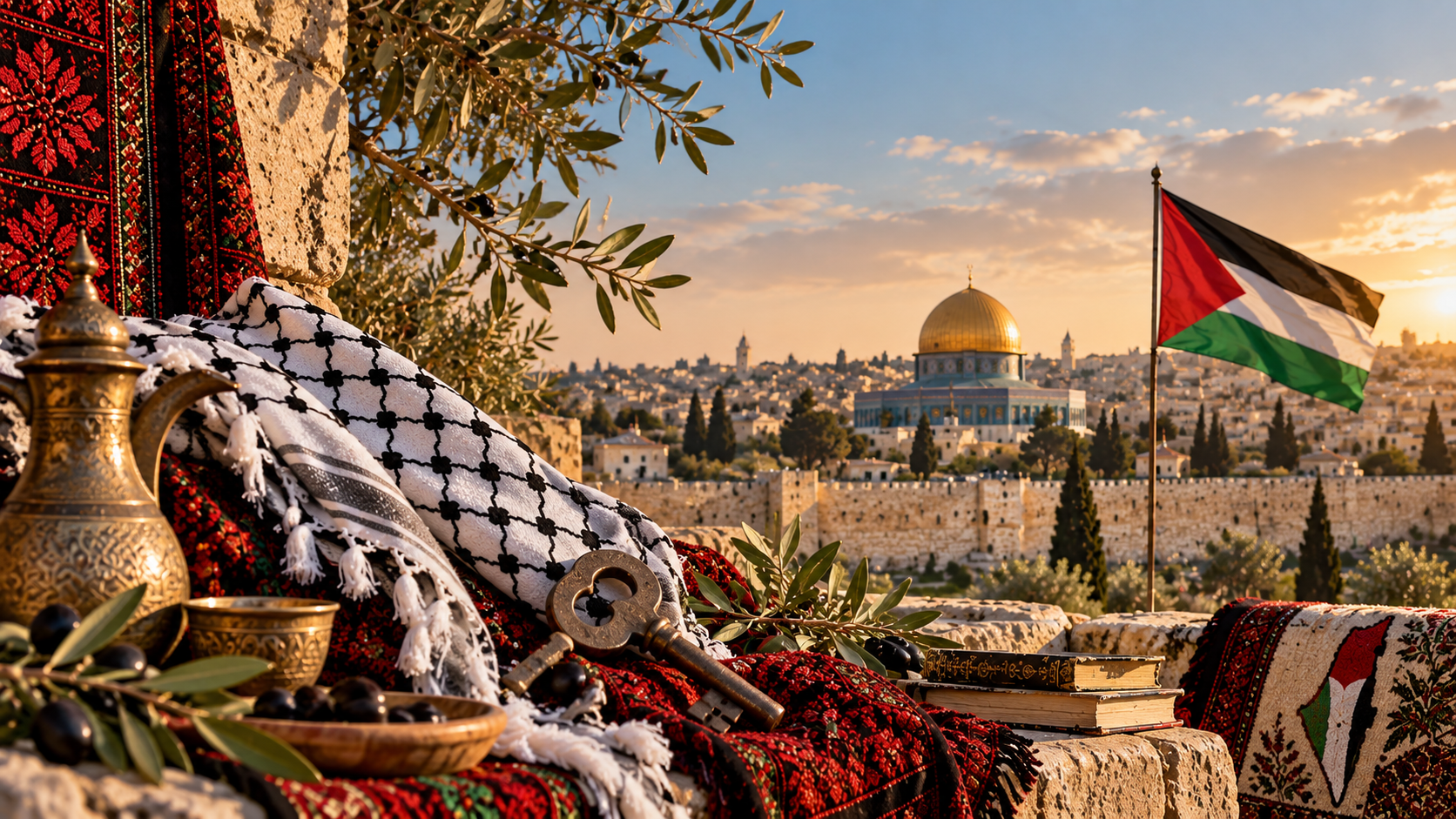
The key, associated with homes Palestinians left during the 1948 Nakba, has been passed through generations as a symbol of displacement and return. Tatreez, the Palestinian tradition of embroidery, preserves regional patterns and practices and was inscribed on UNESCO's Intangible Cultural Heritage list in 2021. The watermelon, whose colours mirror those of the Palestinian flag, has been used to express Palestinian identity, particularly during periods when displaying the flag was restricted. The keffiyeh, meanwhile, had become a recognisable symbol of Palestinian national identity and resistance decades before October 7.
On October 7, 2026, three years after the Hamas led attacks on Israel triggered the Gaza war, more than 74,000 Palestinians have been reported killed in Gaza, according to local health authorities. In this context, these ordinary expressions of culture have taken on another meaning: evidence of a society attempting to preserve its memory amid displacement, restrictions, and destruction.
The struggle did not begin in 2023. Israel has restricted the movement of people and goods in and out of Gaza for decades, with the blockade tightened after Hamas took control of the territory in 2007. Research assembled by Israeli human rights group Gisha showed that between 2007 and 2010 restrictions extended far beyond material classified as having an obvious military purpose. Newspapers, notebooks, toys, spices, sweets and musical instruments were among items barred at different points. The lists changed over time, making the restrictions as much a story about everyday life as about border policy.
Even food production was affected. A Gaza biscuit and wafer factory told the Guardian in 2010 that although dates could enter, date paste could not, while cocoa powder, milk powder, packaging and machinery parts were among materials it struggled to import. The distinction matters: it would be inaccurate to say that “biscuits were banned” in a permanent sense. Rather, shifting restrictions on ingredients, consumer goods, and industrial materials repeatedly disrupted what Gazans could make, sell, and consume.
The same pattern has reached objects associated with recreation and childhood. In August 2026, committees running displacement camps in Gaza told parents to stop children flying kites after Israel warned it would respond to kites crossing the border because of their past use to carry incendiary devices. Reuters reported that recent kites spotted crossing into Israel had not been reported to contain incendiary material. Yaser al Naouq, who runs a displacement camp, said families complied because they feared for children’s safety, calling the restriction one on “children’s freedom”.
If restrictions have made ordinary objects politically significant, the destruction of cultural spaces has made preservation itself an act of documentation. The Great Omari Mosque library in Gaza holds a manuscript tradition stretching back centuries. Its collection includes works on religion, philosophy, medicine and education, with some material dating to the 14th century. Digitisation projects before the war preserved tens of thousands of manuscript pages, while conservation work continues on surviving books and manuscripts.
In 2026, preservation teams began emergency work on the Great Omari Mosque library, cleaning, conserving and securing surviving material. The British Council’s Cultural Protection Fund is also supporting conservation work connected to rare manuscripts from the library. The effort reflects an argument increasingly heard among Palestinian archivists: rebuilding cultural life is not separate from rebuilding Gaza, because libraries and archives carry the record of who lived there and what they produced.
That idea also runs through The Phoenix of Gaza XR, an extended reality archive built from 360 degree footage recorded before the war. The footage captured markets, streets, the Mediterranean coast, the Great Omari Mosque and the Church of Saint Porphyrius. What began as a way for Palestinians unable to enter Gaza to experience it virtually later became an archive of places that were damaged or destroyed. Project co founder Naim Aburaddi described its purpose simply: “They couldn't kill the memory.”
The preservation of memory has also moved far beyond Gaza. Palestinian symbols that long predate October 7 have become increasingly visible on campuses, streets and cultural stages internationally. The black and white keffiyeh developed into a symbol of Palestinian nationalism during the Arab Revolt of 1936 39 and later became associated internationally with Palestinian identity. In recent years, students have worn keffiyehs and displayed Palestinian flags at university graduation ceremonies, extending that visual language into academic spaces.
Cinema has become another archive. Kaouther Ben Hania's The Voice of Hind Rajab premiered at the Venice Film Festival in 2025 and received a standing ovation lasting more than 23 minutes. The audience chanted “Free Palestine”, while Palestinian flags appeared inside the festival. The film later won Venice's Grand Jury Prize. Brad Pitt, Joaquin Phoenix, Rooney Mara, Alfonso Cuarón and Jonathan Glazer were among its executive producers.
The response did not end with one film. No Other Land, made by Palestinian and Israeli filmmakers, won the Academy Award for Best Documentary Feature in 2025. In September 2026, NAZA, directed by Yuval Abraham and Rachel Szor, brought Gaza back to Venice and received another prolonged standing ovation before winning the Special Jury Prize. Together, such films have turned international festivals into spaces where Gaza is discussed not only through news footage and diplomatic statements but through cinema and testimony.
Musicians have entered the same cultural space. Macklemore served as an executive producer of The Encampments, a 2025 documentary about the Gaza solidarity encampment at Columbia University and the student movement that spread across campuses. The film was subsequently screened as part of the Toronto Palestine Film Festival. His involvement illustrates how the cultural response has moved between music, cinema and student activism, although the specific claim that he said such issues could “only” be discussed at film screenings could not be independently verified.
The argument connecting these stories is not that every restriction on a consumer product equals the destruction of a library or historic building. It is that culture exists at several levels at once: in monuments and manuscripts, but also in food, clothing, songs, recreation and inherited symbols. When access to those things is restricted, or the places holding them are destroyed, questions about cultural survival become inseparable from the wider conflict.
UN Special Rapporteur Francesca Albanese wrote in 2024 that the scale of destruction in Gaza had prompted allegations including “cultural genocide”, alongside scholasticide, domicide and other forms of destruction. Israel rejects accusations that its Gaza campaign constitutes genocide, saying its military operations target Hamas following the October 7 attacks. The term therefore carries a legal and political dispute that remains central to international debate.
Some of the symbols associated with Palestine have also faced restrictions in Western countries, including Germany and Australia, although these measures are generally limited to particular institutions or settings rather than nationwide bans. As Palestinian culture travels beyond Gaza through clothing, archives, cinema and public demonstrations, its preservation has become more than an act of remembrance. It is a way of asserting that amid genocide, displacement and restrictions, Palestinian identity and collective memory cannot simply be erased.