A school that exists only on paper, with no children in its classrooms. A building meant for learning that has become a warehouse, a shelter for animals or simply an abandoned structure. For millions of children in Pakistan, the absence of a functioning school is more than a policy failure. It is a barrier to education and, potentially, to a different future.
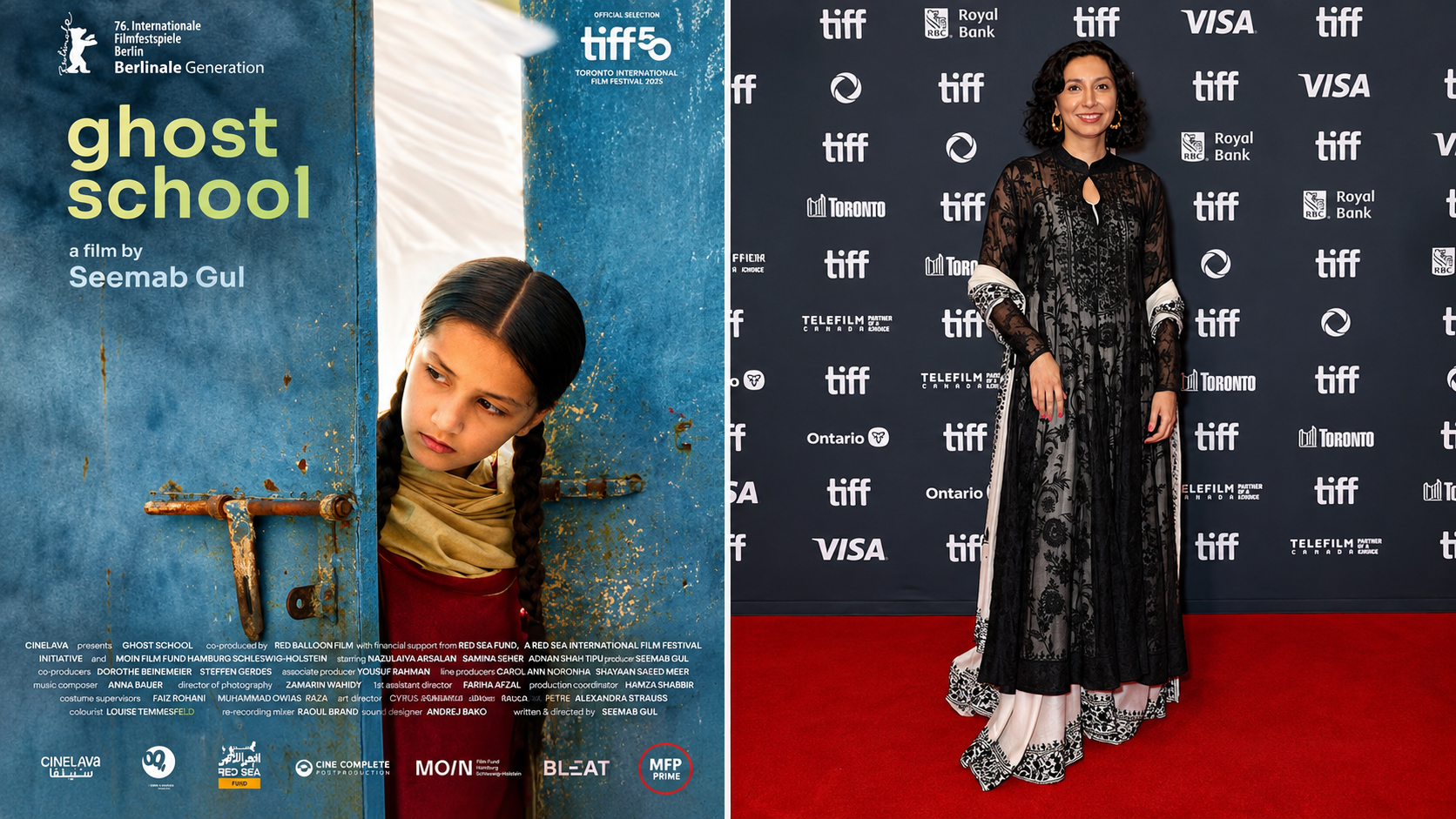
Encounters with such schools across Punjab, interior Sindh and Balochistan inspired British Pakistani filmmaker Seemab Gul to make Ghost School. Told through the eyes of Rabia, a young girl questioning why the only school in her village has closed, the film raises a question that extends far beyond its fictional setting: who is responsible when a school stops functioning, and who answers to the children left behind?
In an exclusive interview, Gul discusses the experiences that shaped the film, her legal battle with the Sindh Board of Film Censors and why she believes Pakistan needs to establish which schools are functioning and which exist only in official records.

Why Rabia became the voice of Ghost School
Choosing a young girl as the protagonist was a deliberate creative decision shaped by Gul's own experiences as a woman. She said she felt she could communicate Rabia's perspective more effectively and wanted to portray a girl willing to question adults' decisions.
Gul also spoke about how international audiences approach films as a way of understanding societies and experiences unfamiliar to them. Recalling a screening in Germany, she said some viewers initially assumed Ghost School was a supernatural story about a little girl.
They were unfamiliar with the term 'ghost school', used in Pakistan to describe institutions that exist on paper but are closed, lack staff or no longer provide regular instruction. The response highlighted how an issue familiar within Pakistan could remain largely unknown to audiences elsewhere.
From film censorship to the Sindh High Court
Gul's attempt to bring the film to Pakistani audiences led to a legal dispute when the Sindh Board of Film Censors initially declined to grant it permission for public exhibition. She said she was surprised by the decision. After discussing the matter on Instagram, lawyers contacted her and advised that she could challenge the refusal because the authorities had not explained the grounds for their decision.
Gul and associate producer Muhammad Yousuf Rehman subsequently approached the Sindh High Court. In August 2026, the court directed the censor board to reconsider its decision and provide reasons for any restrictions.
Following that order, the board issued a list of eight objections, including expressions such as manhoos siyasatdan, haram khor and wadera, as well as scenes depicting books and a school being set on fire. Gul asked why language reflecting social and political realities, along with a scene central to the film's narrative, should be barred from public exhibition.
The matter returned to the Sindh High Court, where the filmmakers challenged the proposed cuts. On October 19, a two member bench comprising Justice Yousuf Ali Sayeed and Justice Adnan Iqbal Chaudhry set aside most of the censor board's objections, finding that the authorities had failed to provide adequate legal reasons for the restrictions.
The filmmakers agreed to remove one objectionable remark involving a child. The court directed the board to reconsider certification within 10 days of its removal, either allowing exhibition without further cuts or providing a reasoned decision if a different age classification was considered necessary.
Millions of children remain outside classrooms
For Gul, the debate over Ghost School should focus on the state of Pakistan's education system rather than objections to its title or dialogue. She referred to an estimated 10000 ghost schools across the country, questioning how institutions could remain registered despite no longer providing education. Gul did not independently establish the figure during the interview.
She also expressed concern about the impact of the 2025 floods on educational infrastructure, questioning whether reconstruction and development spending had adequately addressed schools damaged or rendered non-functional.
Gul cited approximately 26 million out of school children in Pakistan. UNICEF's published estimates put the figure at around 25 million children aged five to 16, including 13.4 million girls and 11.9 million boys. She also raised concerns about female illiteracy, saying women and girls continue to face barriers to education.
A question that goes beyond the film
Despite the political questions raised by Ghost School and the controversy surrounding its screening, Gul said she did not intend to enter politics, but to use filmmaking to draw attention to an issue affecting millions of children.
She hopes the conversation sparked by the film will extend beyond cinema audiences and reach policymakers, education authorities and parliament, where decisions about the country's schools are made.
For Gul, the issue is bigger than the fate of any single school. It is about children being denied an opportunity to learn and the absence of accountability when the institutions meant to educate them stop functioning.
At the heart of Ghost School is a question that remains unanswered for countless children like Rabia: why is their school closed, and who will take responsibility for reopening it?