
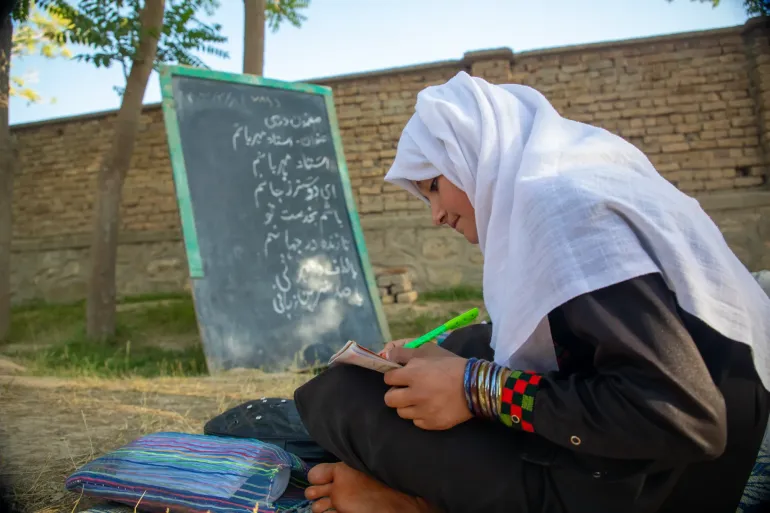
Kabul: Five years after the Taliban returned to power, more than 2.6 million Afghan girls have been denied secondary education, according to UNICEF, making Afghanistan the only country where girls and women are effectively barred from secondary and higher education.
The restrictions began soon after the Taliban took control of Afghanistan in August 2021. Girls were initially allowed to continue primary education, but secondary schools for girls were closed in September 2021. In March 2022, authorities postponed the reopening of secondary schools for girls beyond Grade 6, despite an earlier announcement that schools would reopen.
The restriction was later extended to higher education. In December 2022, the authorities ordered universities to stop admitting female students, effectively ending women's access to university education.
That means girls can generally continue formal schooling only through Grade 6. UNESCO estimates that around 2.4 million girls were excluded from secondary education by 2026, while UNICEF's latest calculation puts the number denied secondary education since 2021 at more than 2.6 million. The difference reflects different methodologies and counting periods.
What happens when girls cannot continue school?
The consequences extend beyond missed lessons.
UNICEF says girls who remain out of school face increased exposure to child labour, early marriage, violence and abuse. The agency also warns that the restrictions are creating a shortage of women qualified for professions that depend on female workers, particularly teaching and healthcare.
The impact is already visible among teachers. UNICEF says the number of female teachers in basic education fell by more than 9 percent, from nearly 73000 in 2022 to around 66000 in 2024. The agency estimates Afghanistan could lose up to 20000 women teachers and 5400 female health workers by 2030 if current restrictions continue.
There is also an economic cost. A 2026 UNICEF analysis estimates that restrictions on girls' education and women's employment are costing Afghanistan about USD 84 million a year in lost economic output, with losses accumulating over time.
Has education stopped completely?
No.
UNICEF and UNESCO continue to support community based education, literacy and skills programmes. In 2025, UNICEF said 442000 children participated in community based learning, 66 percent of them girls. More than 3.7 million children also received emergency education support through public schools.
These programmes, however, do not replace access to the formal secondary and university system.
Why is the issue still unresolved?
The authorities have maintained restrictions despite repeated calls from the UN and other international organisations to reopen secondary schools and universities to girls and women.
UNESCO says the restrictions have reversed much of the progress made over the previous two decades. By 2021, nearly one million Afghan girls were enrolled in secondary education, compared with extremely limited access before 2001.
The result is a widening gap between generations. Girls who were in primary school when the restrictions began are now reaching the age at which they would normally enter higher grades, but the formal education pathway remains closed.
This is no longer only a question of access to classrooms. The five year interruption is affecting Afghanistan's future pool of teachers, health workers and other skilled professionals. For every cohort that cannot progress through education, the country loses years of potential human capital.