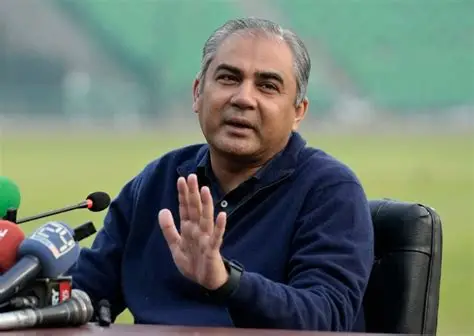
London: Pakistan Cricket Board (PCB) Chairman Mohsin Naqvi defended the sweeping alterations to the national Test squad, admitting that Pakistan’s performances in the longest format have been poor and that selection mistakes were made. Speaking to the media in London, Naqvi stated that performance based changes were inevitable, stressing that players who consistently fail to deliver cannot be retained indefinitely.
While acknowledging that the two heavy Test defeats against England could not be overlooked, he insisted that performance was not the only factor being evaluated. He urged critics to focus on facts rather than subjecting players and Pakistan cricket to unfair targeted criticism. The PCB executed a major shake up ahead of the third and final Test in Birmingham following heavy losses by an innings and 103 runs at Headingley and by 194 runs at Lord’s which allowed England to secure an unassailable 2-0 series lead.
Seven players were released from the touring squad, including Mohammad Rizwan, Imamul Haq, and Salman Agha, alongside Ali Usman, Aamer Jamal, Awais Zafar, and Khurram Shahzad. In their place, the board called up seven replacements, including five uncapped players Arafat Minhas, Mohammad Imran Jnr, Saad Baig, Mohammad Imran Randhawa, and Razaullah as well as Saim Ayub and Abdullah Fazal. Additionally, white ball coaches Mike Hesson and Ashley Noffke were brought in to replace Sarfaraz Ahmed and Umar Gul as head coach and bowling coach, respectively.
In response to intense scrutiny from former players and analysts, Naqvi pushed back against claims that the losses signalled the demise of Pakistani cricket. Drawing comparisons to other major international teams, he highlighted that unexpected defeats happen across world sports, pointing out recent upsets such as India losing to Ireland and South Africa to Namibia. Naqvi noted that while defeats warrant legitimate criticism, treating every loss as though "Pakistan cricket is over" is excessive. He further emphasised that rebuilding the Test team from ninth position in the rankings will require patience, reminding observers that no team becomes a champion overnight.
Highlighting broader organisational progress, Naqvi pointed to improvements achieved in white ball formats under the new coaching framework. He noted that Pakistan has climbed from eighth to fifth in the ODI rankings, winning four of its last six series, while its T20I ranking improved from ninth to sixth alongside a rise in success rate from 24 percent to 73 percent. Stating that the board is developing strategies to regularly compete with top international sides, Naqvi reiterated that he routinely consults legendary former players like Wasim Akram and Waqar Younis to guide the national team’s long term structure.