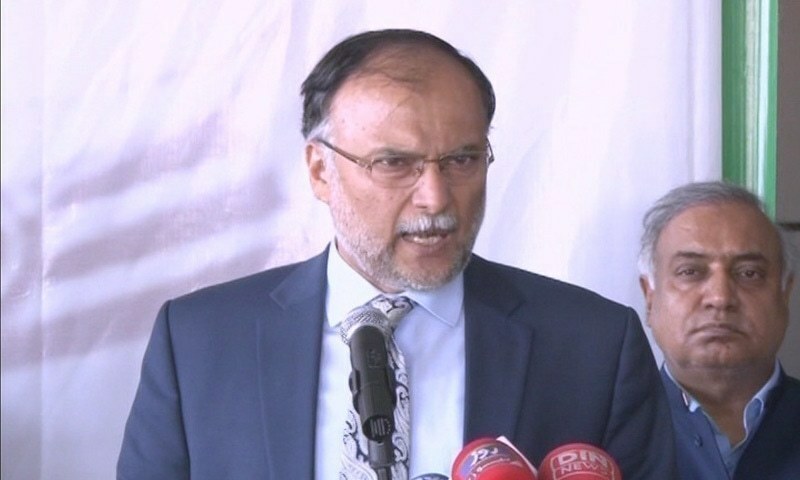
Beijing: Federal Minister for Planning, Development and Special Initiatives Ahsan Iqbal has requested preferential, zero tariff access for Pakistani products to the Chinese market as Islamabad seeks to increase exports and address its trade imbalance with Beijing.
The proposal was discussed during a meeting with Liu Haixing, Minister of the International Department of the Communist Party of China (CPC) Central Committee, in Beijing on Thursday, November 26, according to a statement released on Friday.
Iqbal proposed increasing Pakistan's annual exports to China from approximately USD 3 billion to between USD 20 billion and USD 25 billion by securing concessions that would allow Pakistani goods to compete more effectively in the Chinese market.
He cited China's tariff concessions for African countries as a possible model for Pakistan, noting that China imports nearly USD 3 trillion worth of goods annually. The minister also followed up on discussions held on November 3 and a proposal previously raised by Prime Minister Shehbaz Sharif with Chinese President Xi Jinping.
However, no agreement on zero tariff access was announced following the meeting.
Pakistan seeks to reduce trade imbalance with China
The proposal comes as Pakistan seeks to increase its share of China's import market and reduce the gap between exports and imports. According to government figures, Pakistan exported goods worth approximately USD 2.71 billion to China during the 2025 to 26 financial year, while imports from China stood at USD 22.34 billion.
The figures indicate a trade deficit of approximately USD 19.63 billion. Although Pakistan and China already have a bilateral free trade agreement, Islamabad is seeking additional concessions to improve market access for its exporters.
The proposed arrangement would be non-reciprocal, meaning China would grant duty free access to Pakistani products without requiring Pakistan to offer equivalent concessions.
Such an arrangement could help reduce tariff-related costs for exporters, although increasing exports to the proposed level would also require improvements in production capacity, product quality and access to Chinese buyers.
The government has not announced a timeline for reaching the USD 25 billion target or identified the products that would benefit first from the proposed concessions.
Knowledge Corridor proposed for 10,000 Pakistani scholars
During the meeting, Iqbal also sought China's support for establishing the Pakistan China Knowledge Corridor, an initiative intended to provide doctoral education and research opportunities to approximately 10,000 Pakistani scholars over the next decade.
The proposed programme would involve scholarships, partnerships with Chinese universities and joint financing arrangements. Priority fields include artificial intelligence, engineering, manufacturing, agriculture, biotechnology and mineral sciences.
The minister said the initiative could help Pakistan develop expertise in sectors connected to industrial production and technological development. The proposal also seeks to strengthen cooperation between universities and research institutions in the two countries.
However, details concerning funding, selection criteria and the participating universities have yet to be finalised. The programme remains under discussion, with Pakistan seeking China's agreement on its implementation.
CPEC Phase II to focus on industry and agriculture
Iqbal also discussed the second phase of the China Pakistan Economic Corridor (CPEC), identifying industrial development, agricultural cooperation, technology transfer, mineral resources and environmental projects as areas for investment.
He said Pakistan wanted to move beyond infrastructure construction towards cooperation that could increase industrial output, exports and employment.
According to figures presented by the minister, the first phase of CPEC attracted approximately USD 25 billion in investment and added more than 8,000 megawatts of power generation capacity.
He said the programme had also delivered 888 kilometres of highways and motorways and generated an estimated 236,000 direct and indirect jobs. These figures were provided by the minister as part of his assessment of the project's contribution to Pakistan's economy.
Iqbal linked the next phase of CPEC with Pakistan's URAAN development programme and China's 15th Five Year Plan, emphasising the need to coordinate economic policies and investment priorities.
CPEC Phase II is intended to place greater emphasis on industrial cooperation and business partnerships, with Pakistan seeking investment that can support production and exports rather than infrastructure alone.
Pakistan seeks progress on party cooperation agreement
The minister also proposed appointing focal persons and establishing timelines for implementing the memorandum of understanding signed between the Pakistan Muslim League Nawaz (PML N) and the Communist Party of China in May 2026.
The agreement provides a framework for cooperation and exchanges between the two political parties. Iqbal called for follow up arrangements to ensure that commitments made under the memorandum were implemented.
The discussions took place as Pakistan and China marked 75 years of diplomatic relations, with both governments seeking to expand cooperation in trade, technology and education.
Security of Chinese personnel remains a priority
Iqbal reaffirmed Pakistan's commitment to protecting Chinese personnel and projects operating in the country. Security has remained a concern for Chinese investments in Pakistan following attacks targeting Chinese nationals and projects associated with CPEC.
The minister said Pakistan would continue taking measures to protect Chinese workers and investment activities. He also requested updates from Chinese officials on the proposed tariff concessions and Knowledge Corridor initiative.
The discussions reflect Pakistan's efforts to secure greater economic benefits from its relationship with China, particularly through increased exports and investment in industries capable of producing goods for international markets.
While China remains one of Pakistan's principal trading and investment partners, the imbalance in bilateral trade continues to be a challenge for Islamabad.
Securing duty-free access could help Pakistani exporters enter the Chinese market on more competitive terms, but the scale of any increase would depend on Beijing's approval and Pakistan's ability to expand production.
The outcome of the discussions will therefore depend on whether the two governments agree on tariff arrangements, financing mechanisms and implementation schedules for the proposed initiatives.