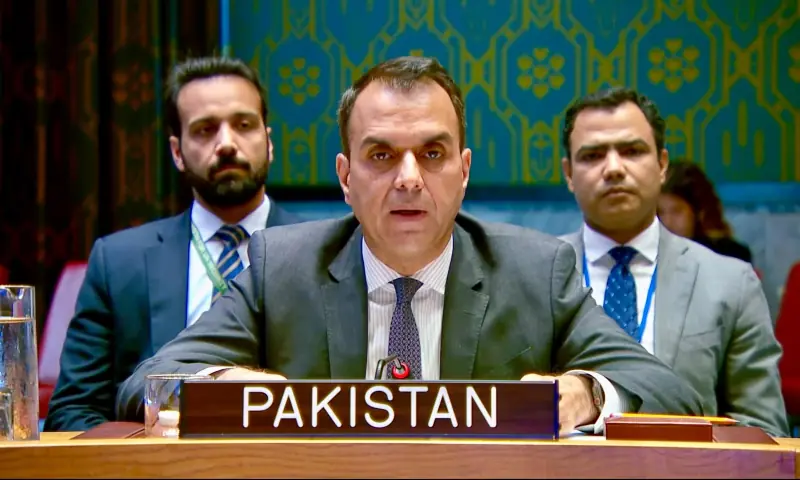
Washington: Pakistan has condemned Houthi attacks on Saudi Arabia's civilian and economic infrastructure, reaffirming its support for the kingdom's security and right to self defence during a United Nations Security Council (UNSC) debate on the Middle East on Thursday.
Addressing the council, Pakistan's acting Permanent Representative to the UN, Ambassador Usman Jadoon, demanded an immediate end to the attacks and reiterated Islamabad's support for a negotiated settlement to the conflict in Yemen.
Pakistan also endorsed efforts by the UN special envoy to resume dialogue between the parties and work towards a political resolution.
The statement comes amid an escalation in the Yemen conflict following the collapse of a UN brokered truce in July. Saudi Arabia has faced attacks on its infrastructure, including a strike on Riyadh's international airport.
The conflict, which has involved a Saudi led coalition fighting the Houthis since 2015, has left much of Yemen's population dependent on humanitarian assistance.
During the same Security Council session, Pakistan raised concerns over developments in Gaza and the occupied West Bank, including East Jerusalem.
Jadoon criticised settlement expansion, land seizures, demolitions and the displacement of Palestinians, warning that such measures were undermining the territorial basis of a future Palestinian state.
He specifically referred to the E1 settlement project, which threatens to separate East Jerusalem from the West Bank and disrupt territorial continuity.
Pakistan called for an end to settlement activity and settler violence, alongside accountability for violations affecting Palestinian communities. Jadoon maintained that international support for a two state solution must be accompanied by measures to protect Palestinian territorial integrity.
He cited Security Council Resolution 2803, the Comprehensive Plan to End the Gaza Conflict and the New York Declaration as frameworks for advancing a political settlement. Pakistan also condemned incursions into Al Aqsa Mosque and called for respect for the historical and legal status of religious sites in Jerusalem.
Turning to Gaza, Jadoon expressed concern over ceasefire violations, Palestinian casualties and restrictions on humanitarian assistance.
He warned that the approaching winter could worsen conditions for displaced families lacking shelter and essential services.
Islamabad called for compliance with the ceasefire, the delivery of humanitarian assistance without restrictions and the commencement of recovery and reconstruction efforts. Pakistan also urged continued support for the UN Relief and Works Agency for Palestine Refugees (UNRWA) and the release of Palestinian revenues withheld from the Palestinian Authority.
Jadoon rejected the forced displacement of Palestinians and attempts to divide Gaza from the occupied West Bank, maintaining that both territories, including East Jerusalem, must remain a single territorial unit. He called for a political process leading to the establishment of a Palestinian state based on pre 1967 borders, with Al Quds Al Sharif as its capital.
Other Security Council members also addressed settlement expansion and humanitarian conditions.
France's Ambassador Jerome Bonnafont warned that settlement activity, settler violence and financial restrictions on the Palestinian Authority were contributing to instability. Britain's Ambassador Sarah MacIntosh demanded a halt to the E1 project and called for restrictions on humanitarian assistance to Gaza to be removed.
The United States defended President Donald Trump's Gaza peace plan, arguing that its implementation depended on Hamas disarming.
Meanwhile, Palestinian Deputy Permanent Observer Majed Bamya criticised continued Palestinian deaths despite the ceasefire and called for Gaza and the West Bank to be governed under the Palestinian Authority.
UN acting Special Coordinator for the Middle East Peace Process Ramiz Alakbarov warned that the ceasefire remained at risk, citing approximately 1500 Palestinian deaths since its implementation, according to Gaza's Ministry of Health.
He also reported that around 950000 people were living in areas exposed to flooding risks, while more than 4000 buildings being used as shelters faced the risk of collapse.
Alakbarov called for the implementation of the Gaza peace plan, including the withdrawal of occupying forces, the disarmament of armed groups and arrangements for transitional governance.
Pakistan concluded its intervention by reiterating that diplomatic engagement and recognition of Palestinian self determination were necessary to address the region's conflicts and establish lasting peace.