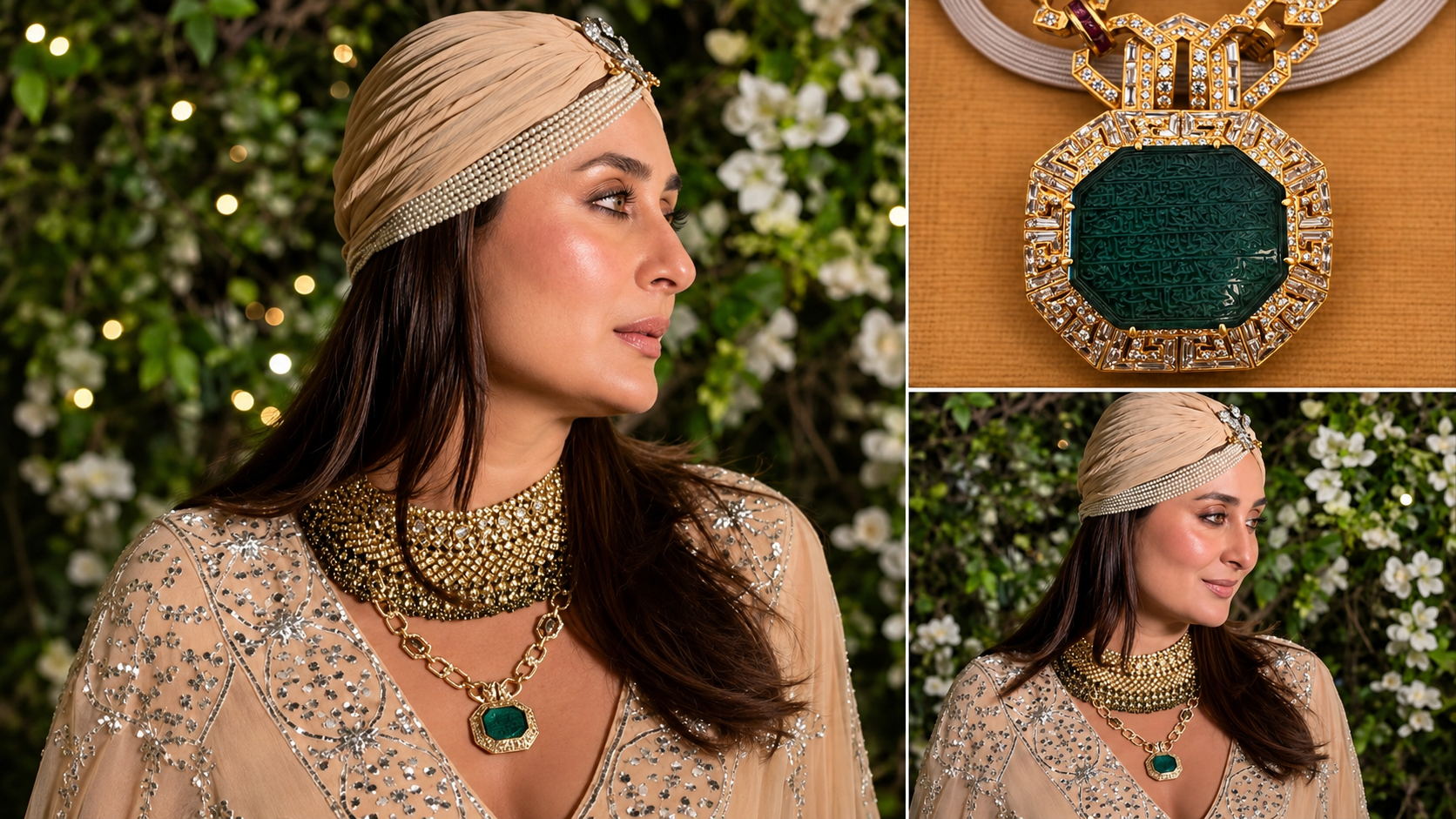
Mumbai: Bollywood actor Kareena Kapoor Khan has been served a legal notice over photographs showing her wearing a pendant inscribed with Ayat ul Kursi, a verse from the Quran, as a statement jewellery piece during Diwali celebrations.
The notice, issued on November 11 by Congress leader Abbas Hafeez, also names celebrity stylist Rhea Kapoor and demands the removal of the photographs and videos from social media, along with a public apology. Hafeez alleges that the manner in which the religious inscription was displayed failed to respect its significance in Islam.

The controversy centres on a 30 carat emerald pendant associated with the former royal family of Bhopal. The jewellery bears Ayat ul Kursi, the 255th verse of Surah Al Baqarah, which holds religious significance for Muslims and is commonly recited as a prayer for protection.
Kapoor wore the pendant as the centrepiece of an outfit designed by Punit Balana, paired with a kaftan, matching turban and a royal ornament known as a kalgi.
Her stylist, Rhea Kapoor, shared photographs of the look on Instagram, describing the jewellery as a family heirloom inherited through Kareena's husband, actor Saif Ali Khan.

Saif's paternal grandmother, Sajida Sultan, was the daughter of Hamidullah Khan, the last ruling Nawab of Bhopal. According to the stylist, the emerald belonged to the Begum of Bhopal and was passed down through the family.
The photographs presented the pendant as part of a fashion statement celebrating royal heritage, but its use drew objections over the treatment of a religious inscription as a decorative accessory.
Hafeez, who is associated with the Congress party in Madhya Pradesh, said his objection was not directed at Kapoor's clothing, religious celebrations or freedom to wear jewellery. Instead, he argued that the pendant represented the religious heritage of Bhopal's former rulers and should not be presented primarily as a fashion accessory.
His lawyer, Mohammad Zafar, warned that further legal remedies could be pursued if the demands were not met. The notice itself does not establish any legal wrongdoing by the actor or her stylist. The Hindu Utsav Samiti has defended Kapoor, rejecting calls for an apology and supporting her freedom to wear the jewellery.
Religious symbols and celebrity fashion
The controversy has brought attention to the use of religious inscriptions in celebrity styling, particularly where objects associated with faith are presented as fashion statements. Kapoor is not the first Bollywood celebrity to publicly wear an accessory featuring Ayat ul Kursi.
In 2016, Priyanka Chopra Jonas shared details of a charm necklace inherited from her father, Ashok Chopra, which included an Ayat ul Kursi charm alongside symbols from Hindu and Egyptian traditions.
The necklace also featured an Om symbol, rudraksha beads and other religious objects collected by her family. Chopra described the jewellery as a personal reminder of her father and her cultural identity.
Unlike Kapoor's pendant, which was presented as part of a styled festive appearance, Chopra's necklace was associated with family memories and spiritual protection. The distinction illustrates how the same religious inscription can be presented in different contexts, from personal expressions of faith to fashion and inherited cultural heritage.
The cultural appropriation debate
The incident also raises questions associated with cultural appropriation, a concept examined in cultural studies and international relations through discussions of identity, representation and unequal power relations.
Cultural appropriation generally refers to the adoption of elements from one culture by members of another, particularly when their original meaning is removed, commercialised or presented without acknowledgement.
However, cultural exchange and appropriation are not necessarily the same. Religious and cultural symbols have moved between communities for centuries through trade, migration, marriage and shared histories.

In South Asia, where religious traditions and cultural practices have influenced one another across generations, distinguishing personal inheritance from cultural appropriation can be particularly complex.
Kapoor's connection to the pendant through her husband's family adds another dimension to the dispute. The jewellery is not an accessory acquired solely for a fashion appearance but an heirloom associated with Bhopal's Muslim ruling family. At the same time, the objection concerns how the Quranic inscription was publicly presented rather than the question of ownership.
From an international relations perspective, such disputes reflect wider tensions between cultural identity, religious freedom and the global circulation of cultural symbols through entertainment and fashion.
Celebrities can bring religious and cultural objects to audiences beyond the communities from which those objects originate. This visibility can promote cultural recognition but may also generate criticism when the objects are perceived as being separated from their religious meaning.
The debate therefore extends beyond whether a celebrity has the right to wear an object, raising questions about how inherited religious heritage is represented in public.
In Kapoor's case, no court finding has established that her use of the pendant violated the law. The dispute remains centred on the complainant's interpretation of religious respect and the actor's freedom to present jewellery belonging to her family.