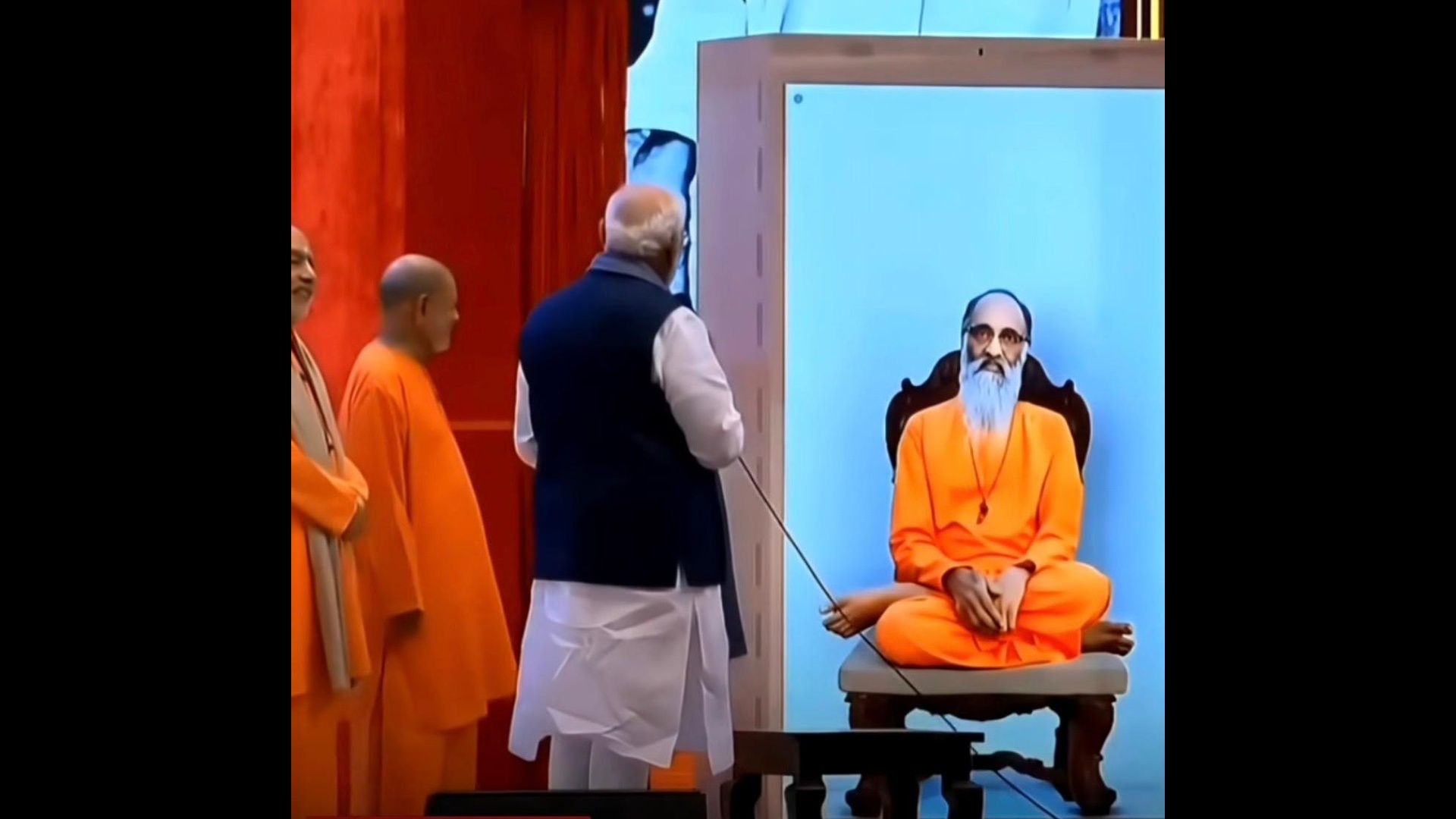
New Delhi: Indian YouTuber and political commentator Dhruv Rathee has questioned India's priorities in artificial intelligence after Prime Minister Narendra Modi interacted with an AI generated holographic representation of spiritual leader Swami Chinmayananda at the Chinmaya Amrit Mahotsav Global Summit on October 23.

Rathee contrasted the demonstration with the use of AI in mathematical research and advances in robotics, arguing that attention should also be directed towards applications with scientific, industrial and economic benefits. His criticism followed the circulation of footage showing Modi interacting with a digital recreation of Chinmayananda, who died in 1993.
The event in New Delhi featured an AI generated representation of the spiritual leader, using technology intended to recreate aspects of his appearance and communication.
The interaction prompted discussion on social media about the use of artificial intelligence to represent deceased religious figures, particularly when the presentation involves political leaders.
Rathee questioned the contrast between such demonstrations and developments elsewhere, where AI systems are being applied to mathematical problems, scientific research and engineering.
His comments raised a distinction between using AI for public presentations and investing in systems designed to address research and development challenges.
China has been expanding its work in robotics, autonomous systems and AI applications for defence and manufacturing. These technologies form part of wider international competition over industrial production, military capabilities and access to advanced computing.
India is also developing its AI sector through government programmes, research institutions, technology companies and investment in computing infrastructure. The hologram demonstration, however, does not provide a measure of either country's overall AI capabilities or research investment.
Questions over AI generated representations
Artificial intelligence can reproduce elements of a person's voice, appearance and manner of speaking using digital models. Such applications are used in education, museums, entertainment and the preservation of historical material. They also raise questions about whether audiences can distinguish authentic recordings from generated content.
In the case of deceased public figures, an AI generated interaction does not necessarily represent statements the individual actually made during their lifetime. Rathee's criticism centred on the priorities associated with the demonstration rather than establishing that AI based historical recreations have no educational purpose.
The discussion also reflects a wider debate over how governments allocate resources between public facing technology demonstrations and research in fields such as mathematics, healthcare, education, robotics and manufacturing.
The summit footage and Rathee's response have brought those questions into the political discussion surrounding India's technology ambitions.