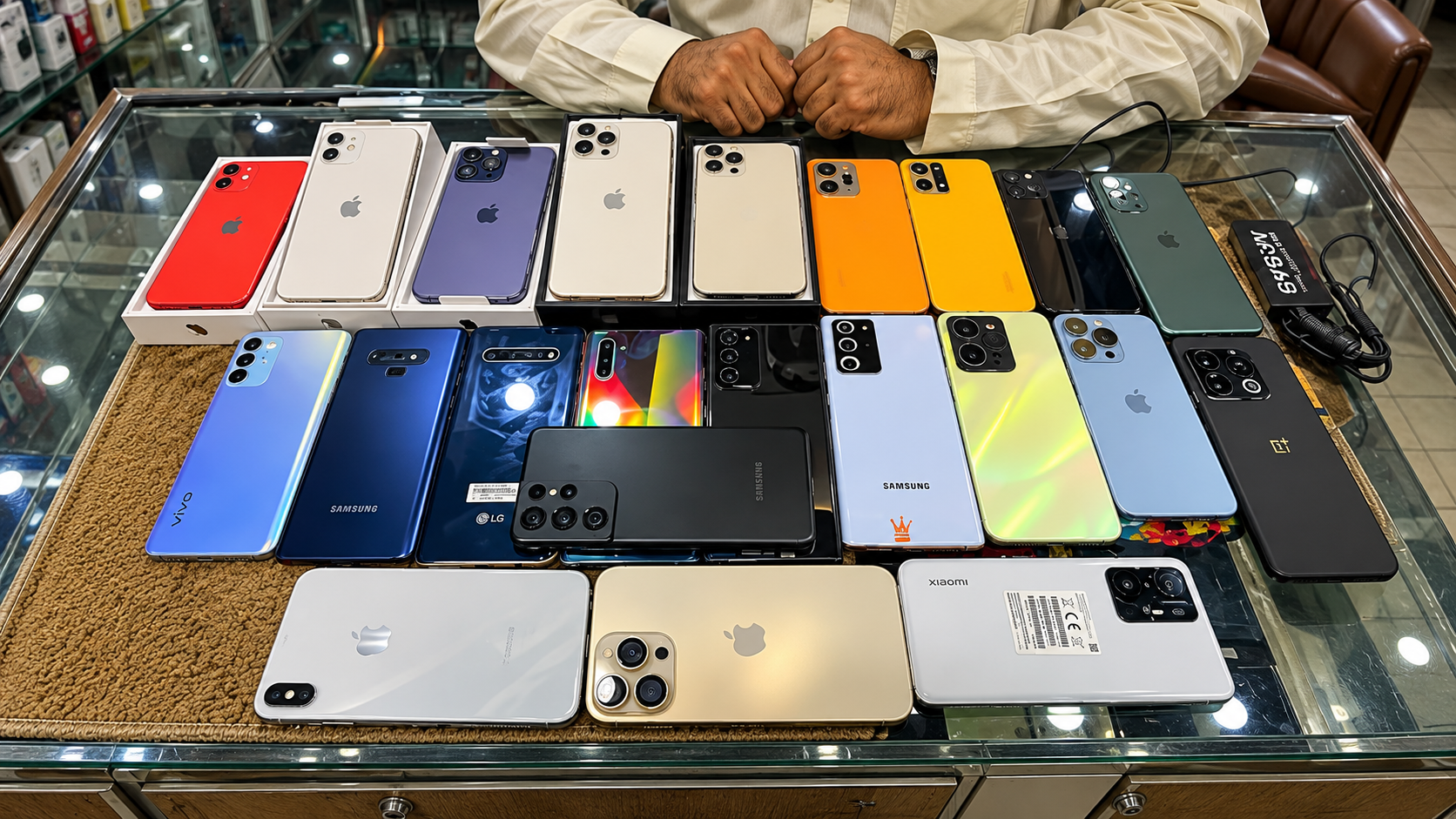
Karachi: Imports of used smartphones into Pakistan increased from 1,434 units in July to 98,383 in October 2026, prompting the Pakistan Mobile Phone Manufacturers Association (PMPMA) to raise concerns with the government over declining domestic production and employment.
The association has approached the Ministry of Industries and Production and the Federal Board of Revenue (FBR), arguing that changes in import duties and customs valuations have made imported handsets more competitive than phones assembled in Pakistan.
According to industry figures, total imports of completely built up (CBU) smartphones increased from 18,431 units worth USD 17.8 million in July to 150,133 units valued at USD 71.7 million in October. During the same period, domestic smartphone production fell from 906,711 to 752,870 units, a decline of approximately 17 per cent.
The association attributed the decline partly to the increase in imported phones, particularly second-hand devices. However, the figures alone do not establish how much of the production decline was caused by imports rather than other market factors.
PMPMA Chairman Abdul Rehman identified two factors behind the increase in imports.
The first concerns the difference in duties between imported finished smartphones and completely knocked down (CKD) kits used by local manufacturers to assemble phones. According to the association, the tariff difference has narrowed to approximately 11 per cent for a phone valued at USD 100 and 14 per cent for one valued at USD 200.
Rehman argued that the difference was insufficient to protect domestic assembly operations from competition with imported devices, particularly in the price segment accounting for a large proportion of smartphone sales. The association has also raised concerns about the valuation of used phones for customs purposes.
In January 2026, the FBR revised the customs values applied to imported second hand handsets. Manufacturers claim the changes have reduced the cost of importing used smartphones and created opportunities for under invoicing, in which goods are declared at values below their actual transaction prices.
They argue that this could reduce tax collection and create an advantage for importers over companies assembling phones locally. However, the association's allegations do not establish that all imported used smartphones are undervalued or that individual importers have violated customs rules.
The FBR has not announced findings confirming the extent of any revenue loss associated with the reported increase. The manufacturers also highlighted the effect on employment.
According to the PMPMA, Pakistan's mobile phone manufacturing sector supports more than 40,000 jobs directly and indirectly. The association said manufacturers had begun reducing their workforce and that some companies were laying off trained employees to manage costs.
It warned that continued pressure on domestic production could discourage investment in assembly facilities and the development of locally manufactured components.
The number of jobs lost has not been independently verified, and the industry has not provided a company by company breakdown of layoffs. Another concern raised by manufacturers involves the duty structure applied to components.
The association said that while a mobile phone charger imported as part of a CKD kit may attract zero duty, importing the raw materials and subcomponents required to manufacture the same charger locally can result in a cumulative duty burden of approximately 20 per cent.
This arrangement, described as reverse tariff cascading, can make it more expensive to manufacture components in Pakistan than to import them. Manufacturers argue that the disparity discourages investment in local production of chargers, batteries, cables and motherboard assemblies.
They have asked the government to review the structure to support manufacturing beyond the assembly of imported kits. According to industry representatives, increasing local component production could reduce import dependence and create opportunities for exports.
The PMPMA has cited India's mobile phone industry as an example of how government incentives can support manufacturing and exports. India has used production-linked incentive schemes and measures encouraging domestic value addition to attract investment in smartphone manufacturing.
Industry representatives argue that Pakistan could consider similar policies to encourage manufacturers to expand production beyond domestic assembly. However, the two countries differ in market size, supply chains, investment levels and manufacturing capacity, meaning that adopting similar incentives would not necessarily produce the same results.
Pakistan has already developed a domestic mobile phone assembly industry.
According to Pakistan Telecommunication Authority data reported in November, local plants manufactured or assembled approximately 23.03 million mobile phones between January and October 2026, compared with 3.85 million commercially imported handsets during the same period.
The figures include mobile phones across different categories and should not be directly compared with the PMPMA's monthly figures for smartphone production alone. They nevertheless show that domestic assembly continues to account for a substantial share of Pakistan's overall handset supply.
There is also a consumer dimension to the debate.
Imported used smartphones can provide buyers with access to devices that might otherwise cost more if purchased new. Higher import duties or restrictions could protect domestic assembly operations but may also affect handset prices and consumer choice.
For policymakers, the question is how to encourage domestic manufacturing and employment while maintaining competition and access to affordable phones.
The FBR has previously stated that a substantial portion of Pakistan's mobile phone import bill consists of components brought into the country for assembly rather than finished devices.
In July, Pakistan Customs said approximately Rs420 billion of the Rs520 billion mobile phone import value in the 2025 to 26 financial year represented CKD and semi knocked down kits used by domestic manufacturers.
It also argued that an increase in documented imports could reflect a shift from informal trade into tax-compliant channels. According to the PMPMA, imported CBU smartphones have captured 41.8 per cent of the domestic smartphone market by value.
The association believes the trend could undermine investment unless the government reviews the difference between duties on finished devices and locally assembled phones.
A delegation of manufacturers is expected to meet government officials to discuss the matter. No decision has been announced on changing customs valuations or import duties in response to the association's concerns.
The outcome will depend on whether the government alters its tariff structure and how any changes balance manufacturing investment, tax revenue, employment and the cost of smartphones for consumers.