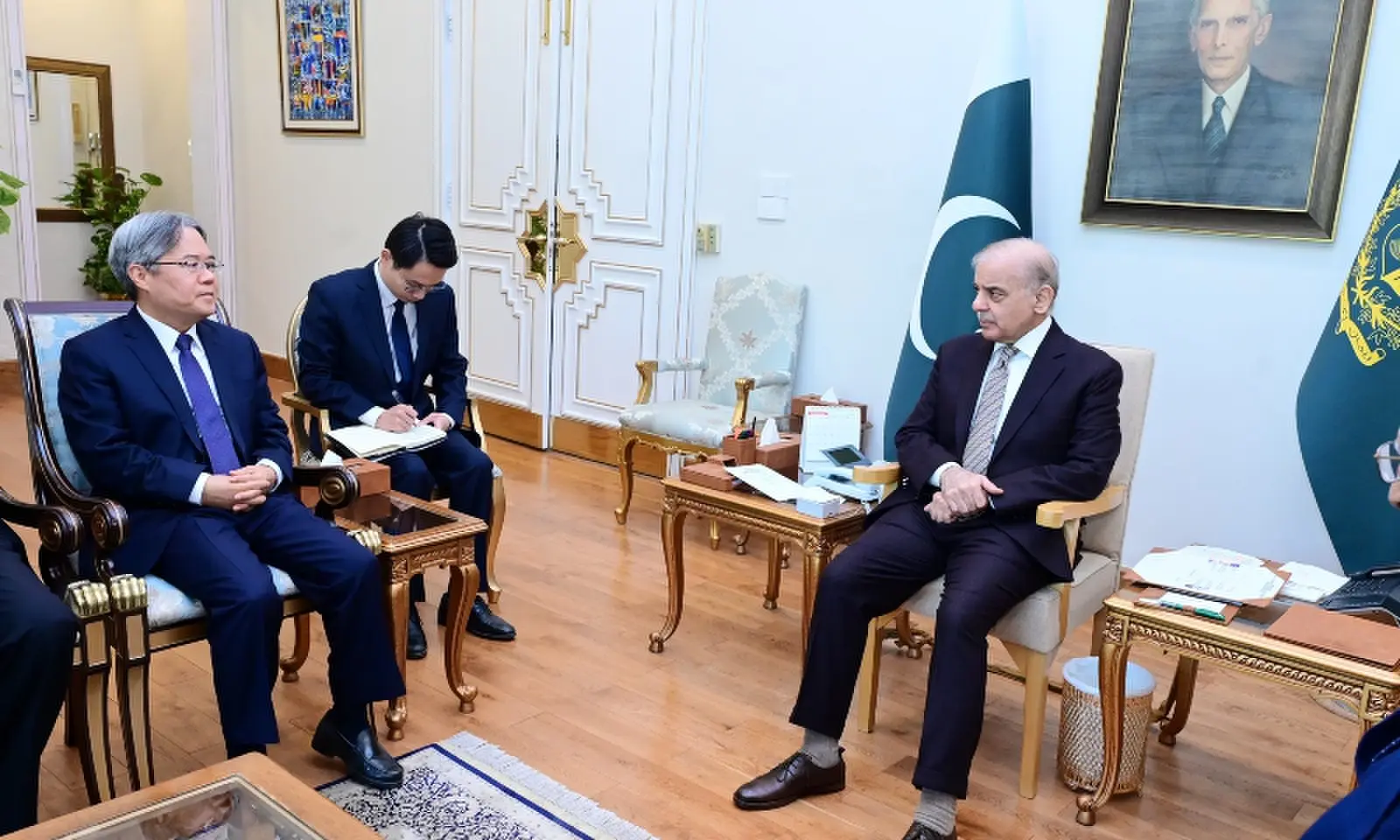
Islamabad: Prime Minister Shehbaz Sharif on Thursday, November 26, described Pakistan's participation in China's Shenzhou 24 mission as evidence of the countries' cooperation in science and technology, as he met Chinese Ambassador Jiang Zaidong at the Prime Minister House in Islamabad.
According to a statement issued by the Prime Minister's Office (PMO), Shehbaz congratulated the Chinese leadership and people on the launch of the spacecraft, which carried Wing Commander Muhammad Zeeshan Ali to the Tiangong space station on Wednesday.
The prime minister described the mission as "living proof of the ironclad friendship" between Pakistan and China, saying bilateral cooperation had now extended into space exploration.
He thanked Beijing for providing Pakistan with the opportunity to participate in its human spaceflight programme and acknowledged the role of Chinese institutions in training Pakistani astronauts.
Shehbaz said the achievement represented more than an astronaut's journey, reflecting the aspirations of Pakistan's population, particularly young people seeking careers in science and technology.
The prime minister also praised the Space and Upper Atmosphere Research Commission (SUPARCO), academic institutions, scientists and the armed forces for their contributions to the programme.
Ali became the first Pakistani to enter orbit on November 25 after travelling aboard the Shenzhou-24 spacecraft alongside Chinese astronauts Tang Hongbo and Wu Yi.
The spacecraft launched from the Jiuquan Satellite Launch Centre in northwestern China and docked with the Tiangong station later that day.
The three member crew subsequently entered the station, making Ali the first foreign astronaut to board the Chinese orbital facility. Serving as a payload specialist, Ali is expected to spend between five and 10 days aboard Tiangong, conducting experiments before returning to Earth.
The mission provides Pakistan with an opportunity to participate in research conducted in orbit, while enabling its scientists and technical personnel to gain experience through cooperation with China's space programme.
The flight follows a February 2025 agreement between SUPARCO and the China Manned Space Agency to train Pakistani candidates for astronaut missions.
Ali and another Pakistani candidate underwent training in China before he was selected for the Shenzhou 24 crew.
Pakistan, China reaffirm cooperation in space research
During Thursday's meeting, Shehbaz reiterated Pakistan's commitment to working with China on the exploration and use of outer space for peaceful purposes.
He also acknowledged Chinese President Xi Jinping's role in expanding China's space programme and opening opportunities for international participation. The prime minister asked Ambassador Jiang to convey his greetings to President Xi and Premier Li Qiang and handed over letters congratulating both leaders on the mission.
Pakistan and China have cooperated in satellite technology, communications and space research for decades.
The latest mission extends that partnership into human spaceflight, where Pakistan has previously lacked the infrastructure and training facilities required to send astronauts into orbit.
For China, the inclusion of a Pakistani astronaut also reflects its efforts to expand international participation in the Tiangong programme. The two countries' collaboration now covers satellite launches, astronaut training and research activities in space, providing opportunities for Pakistani institutions to develop their technical capabilities.
The meeting also covered bilateral relations and events marking the 75th anniversary of diplomatic ties between Pakistan and China in 2026. The two countries established diplomatic relations on May 21, 1951, and have since developed cooperation in trade, infrastructure, defence and technology.
Their space partnership forms part of efforts to extend cooperation beyond existing economic and security arrangements. Although the Shenzhou 24 launch and docking have been completed, Ali's mission remains under way.
The results of the experiments and the experience gained by Pakistani researchers could help shape future cooperation between SUPARCO and Chinese space institutions.
The PMO did not announce any new space projects, funding commitments or agreements during Thursday's meeting.
The immediate focus remains on completing Ali's mission and ensuring his return to Earth, while Pakistan and China assess opportunities for further cooperation in human spaceflight and scientific research.