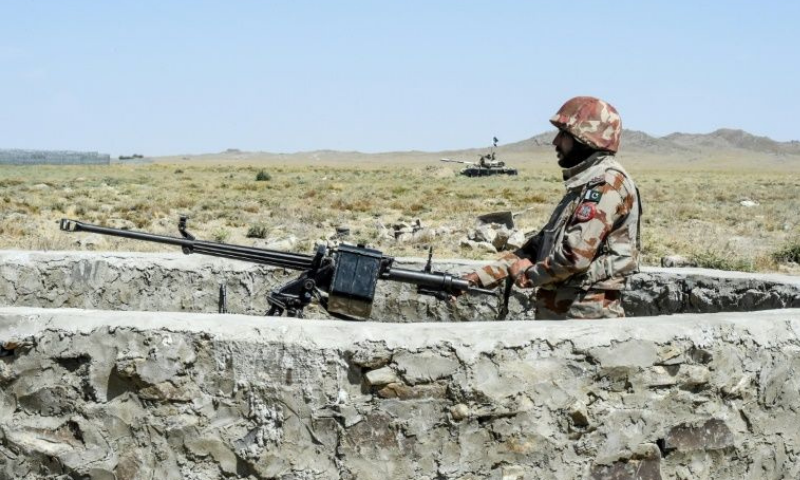
Rawalpindi: Security forces killed 12 suspected militants in four intelligence based operations (IBOs) across Balochistan between November 20 and 23, the military's media wing said on Thursday, as counterterrorism operations continue in the province.
According to the Inter Services Public Relations (ISPR), the operations targeted militant hideouts and movements in Nushki, Sibi, Panjgur and Kech districts following intelligence about the presence of armed groups.
The military identified those killed as members of what it calls Fitna al Hindustan, a designation used by Pakistani authorities for Balochistan based militant organisations they accuse of receiving support from India.
The allegation of Indian sponsorship was made by the military and has not been independently verified. The first operation took place in Nushki on November 20, when troops raided a suspected militant hideout. Eight militants were killed following an exchange of fire, while weapons and ammunition were recovered from the location, the ISPR said.
On November 21, security personnel intercepted a group of suspected militants in Sibi district, killing two during the engagement. Two further operations were conducted in Panjgur and Kech on November 22 and 23, resulting in the deaths of two more militants and the dismantling of their hideouts.
The military did not disclose the identities of those killed or provide details about possible casualties among security personnel.
Counterterrorism operations continue in Balochistan
The latest engagements follow a series of military operations in the province, where security forces have been targeting militant networks accused of attacks on state institutions, security personnel and civilians. On November 21, security forces reported killing 15 militants during two operations in Mastung district.
Earlier, on November 14, four soldiers, including a major, were killed during operations in Balochistan and Khyber Pakhtunkhwa, while the military reported killing 24 militants. On November 1, security forces also reported killing 17 militants in operations in Kachhi and Kharan districts, during which a soldier lost his life.
The operations form part of Pakistan's counterterrorism campaign under Azm i Istehkam, approved by the Federal Apex Committee on the National Action Plan.
The ISPR said the campaign would continue against militant organisations and their networks, with the objective of preventing further attacks and disrupting their operational capabilities.
Balochistan has faced an insurgency involving separatist militant groups, alongside violence linked to other armed organisations operating in the region. Security operations have increased as authorities seek to protect transport routes, infrastructure and communities affected by militant activity.
The latest military statement comes amid concerns over the frequency and impact of militant violence across Pakistan. According to the Pakistan Institute for Conflict and Security Studies (PICSS), the country recorded fewer militant attacks during the November 6 to 12 reporting period, but the number of people killed and injured increased.
Khyber Pakhtunkhwa remained the principal centre of violence, recording 16 attacks and 44 fatalities during the period. Balochistan registered 13 attacks, resulting in eight deaths and 19 injuries, while the former tribal districts recorded a reduction in incidents.
The findings suggest that a decline in attack frequency does not necessarily translate into fewer casualties, particularly when incidents involve more casualties per attack.
The organisation has also highlighted changes in militant tactics and the continued threat faced by security personnel and civilians.
In September, Balochistan accounted for 131 of the 225 militant attacks reported nationwide, representing more than half of the month's incidents, according to PICSS.
Security operations and governance challenges
The security situation has also affected economic activity and development in Balochistan, where militant attacks have disrupted transport, investment and access to public services.
The provincial government has maintained that counterterrorism measures must be accompanied by improvements in governance, education, employment and infrastructure.
Chief Minister Sarfraz Bugti has repeatedly called for political grievances to be addressed through constitutional means while rejecting the use of violence by armed groups.
However, the province continues to face challenges involving public confidence, political representation and access to services, alongside the threat posed by militancy.
The ISPR's latest statement did not indicate whether further operations were planned in the four districts or whether additional arrests had been made. The military said security forces would continue intelligence led operations under the national counterterrorism framework to prevent armed groups from carrying out attacks.
The reported deaths remain based on the military's account, with no independent confirmation of the identities or affiliations of those killed.