
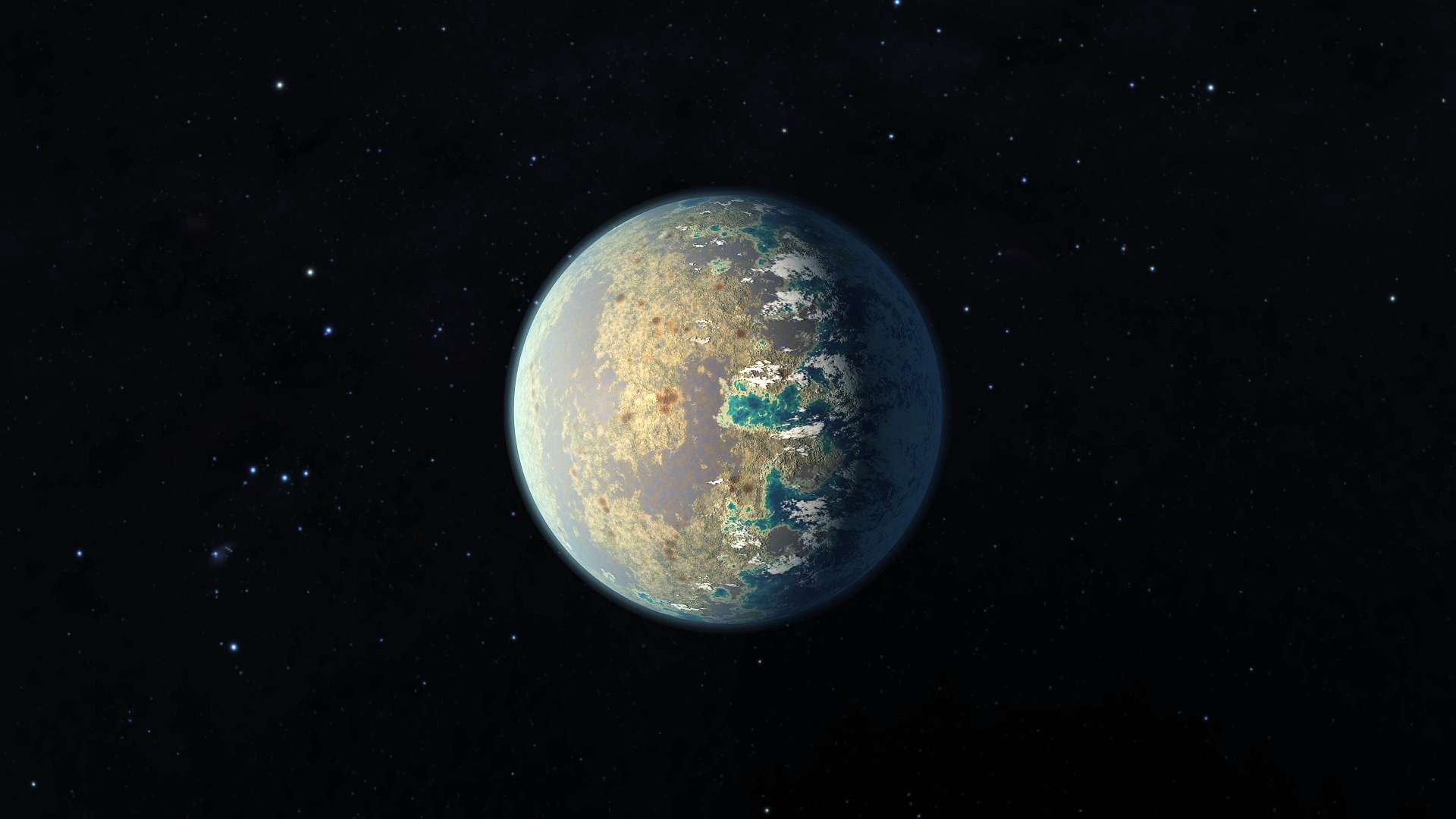
About 40 light years away, seven Earth sized worlds orbit a single red dwarf star so closely that their entire planetary system would fit inside a fraction of the orbit of Mercury.
One of those worlds, TRAPPIST 1f, sits in the outer part of the star’s habitable zone, alongside its neighbours TRAPPIST 1e and TRAPPIST 1g. The region is considered potentially suitable for liquid water, but only if other conditions are right.
TRAPPIST 1f receives only about 37 per cent of the starlight Earth receives from the Sun, making its surface environment considerably colder in the absence of atmospheric warming. Whether it can maintain liquid water therefore depends partly on whether it possesses an atmosphere and what that atmosphere is made of.
That atmosphere remains an open question.
The system was first mapped through observations by NASA’s Spitzer Space Telescope and ground based telescopes, which helped establish the existence, size and properties of the seven planets. Later observations showed that all seven are rocky and roughly Earth sized.
Now the James Webb Space Telescope (JWST) is taking a closer look. In August 2026, researchers reported the first JWST transit spectra of TRAPPIST 1f after observing five planetary transits.
JWST transit spectra are measurements made by the JWST to figure out what an exoplanet's atmosphere is made of.
The data ruled out a hydrogen helium dominated atmosphere above certain pressure levels, but did not determine whether the planet has a heavier atmosphere.
The challenge is made harder by TRAPPIST 1 itself. The red dwarf is highly active, producing stellar flares and other activity that can interfere with the faint atmospheric signals astronomers are trying to isolate. NASA says observations of planets f, g and h are still being analysed and that many more Webb observations may be needed.
For now, TRAPPIST 1f is not a second Earth. It is something more scientifically useful: a nearby natural laboratory for testing how rocky planets behave when they orbit a small, active star.
And the most intriguing question remains unanswered: can a world receiving so little light still keep water liquid?