
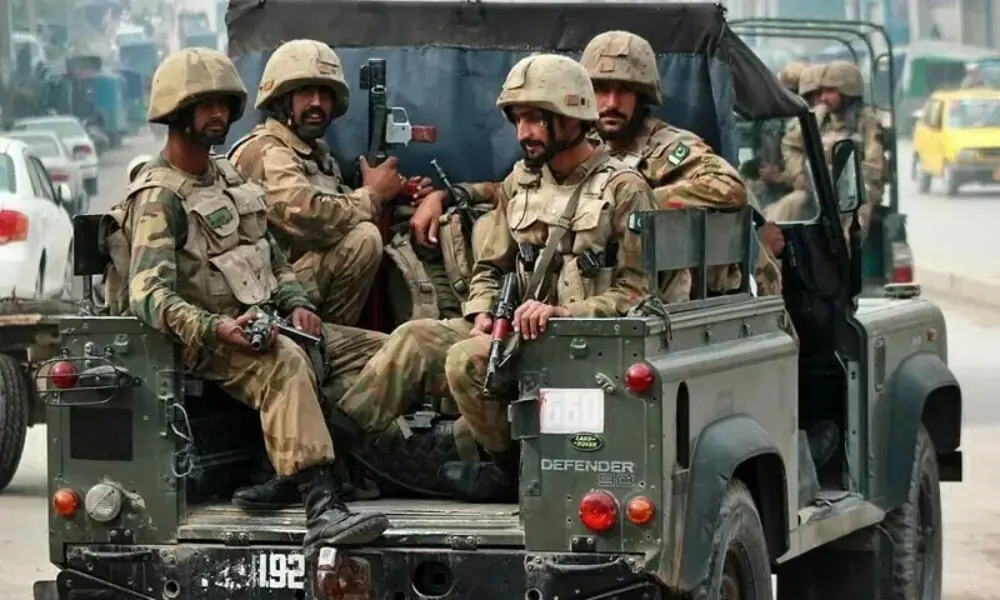
Islamabad: Security forces have killed 11 militants in a series of intelligence based operations across KP and Balochistan, marking another critical phase in the state’s ongoing counter terrorism campaign. According to official sources, the raids targeted high-threat militant hideouts in the Bannu and South Waziristan districts of Khyber Pakhtunkhwa, as well as the Khuzdar in Balochistan. In Bannu, troops raided a compound belonging to Fitna al-Khawarij (TTP), neutralising 2 militants and destroying an arsenal of weapons and ammunition. A simultaneous operation in South Waziristan led to the elimination of 5 militants after intelligence units tracked their movement. Meanwhile, in Khuzdar, ground forces deployed quadcopter surveillance to pinpoint and neutralise 4 militants. Authorities confirmed that clearance operations are underway and that strict measures were taken to protect civilian lives and local infrastructure.
President Asif Ali Zardari and Prime Minister Shehbaz Sharif praised the security personnel, reaffirming the state's determination to eradicate externally backed violent networks.
However, today's security landscape requires looking back at how militancy evolved following the launch of the War on Terror. As foreign and local armed groups established strongholds across the former tribal belt, they realised they could not control the population through ideology alone. Instead, they launched a calculated, bloody campaign to rip apart the local social fabric.
Central to the TTP’s strategy was the systematic liquidation of traditional tribal leaders (Maliks) and peace committee members who anchored the region's governance. According to South Asia Terrorism Portal, over 1,000 tribal elders were targeted and murdered across the former FATA region, with assassinations reaching a devastating peak between 2011 and 2013. Highly influential leaders including Malik Faridullah Khan Wazir, Malik Khadeen, Malik Shir Zaman, and Malik Abdul Majeed, alongside key peace committee figures like Malik Nasrullah were brutally executed in targeted ambushes and suicide bombings.
By wiping out the traditional Jirga leadership the literal bridge between tribal communities and the state the militants intentionally created a massive power vacuum.
With the elder leadership silenced, militants used public executions, fear, and economic coercion to hold ordinary tribesmen hostage. They weaponized the local population, turning innocent citizens into human shields, forcing young men into their ranks, and systematically turning the region against the state to serve their own strategic ends.
The sacrifice paid by Pakistan’s armed forces, law enforcement, and tribal communities over the decades has been immense. Today’s precision strikes in Bannu, Waziristan, and Khuzdar represent a continuous effort to ensure those dark years never return, dismantling the remnants of networks that sought to hold Pakistan's tribal belt captive.