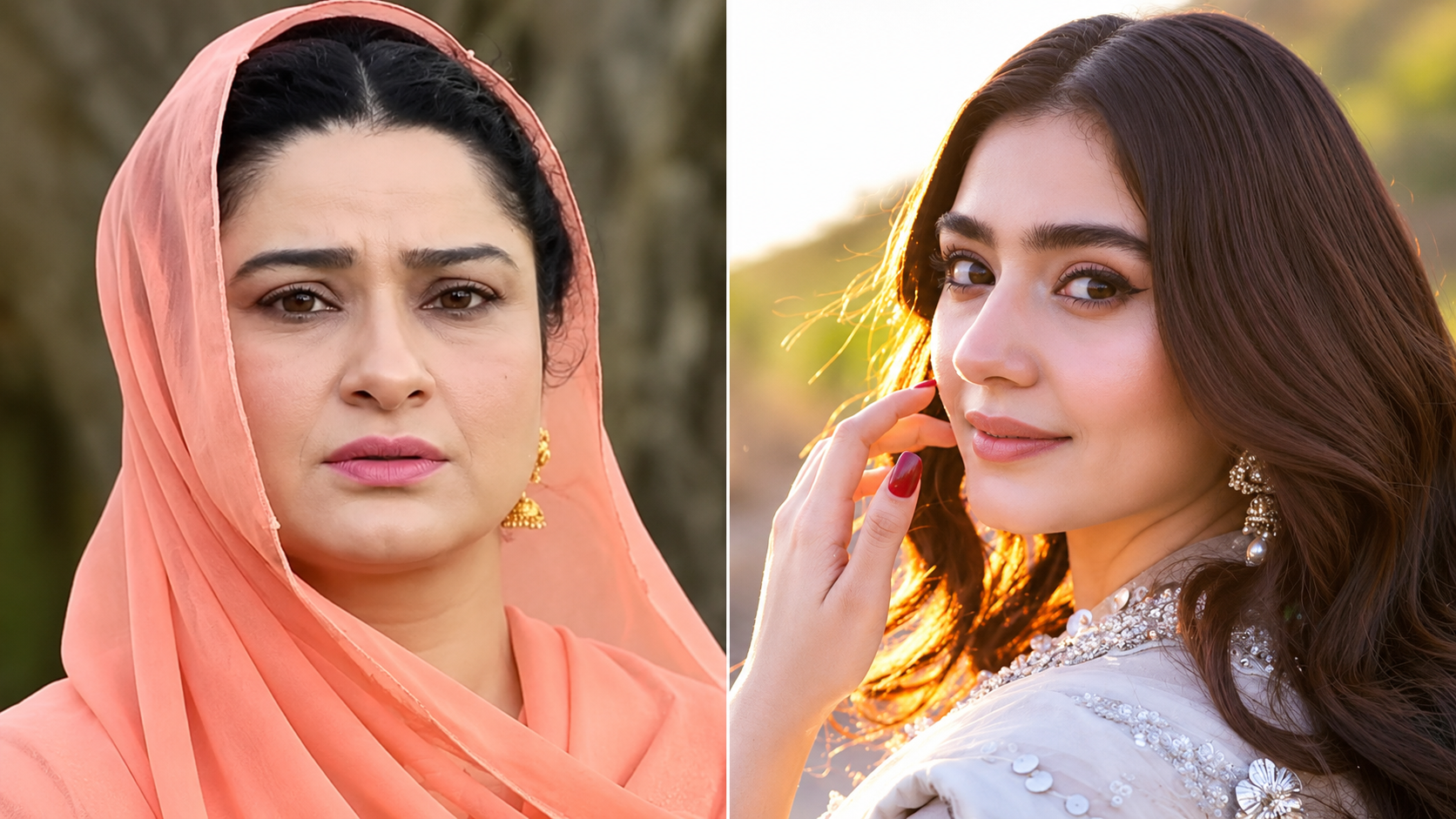
Karachi: Pakistani actor Sania Saeed has praised co-star Durefishan Saleem for portraying emotional distress without relying on dialogue in the television drama Dar e Nijaat.
Speaking during an interview with entertainment journalist Hassan Chaudhary, Saeed discussed Saleem’s performance as Zaryab, a character who experiences depression following the breakdown of a relationship.
Saeed said Saleem had managed to communicate the character’s feelings through her expressions and reactions, even during sequences in which she had little dialogue.
The remarks were shared by entertainment platform Galaxy Lollywood on Instagram and subsequently reported by entertainment news outlets.

Saeed drew attention to the changes in Zaryab’s character as the story progressed, saying Saleem’s performance reflected the transition from the person viewers encountered at the beginning of the drama to someone struggling with the consequences of emotional trauma.
She praised the way Saleem communicated that transformation without explaining the character’s feelings through spoken lines.
The comments place attention on the role of non-verbal acting in television drama, where facial expressions, pauses and body language can communicate emotions that a character does not express openly.
Dar e Nijaat, written by Umera Ahmed and directed by Saqib Khan, airs on ARY Digital. The drama stars Durefishan Saleem as Zaryab, Sheheryar Munawar as Abu Bakr and Nameer Nawaz Khan as Zamil. Its cast also includes Sania Saeed, Saba Hameed, Faran Tahir and Nadia Afgan.
The story follows Zaryab as she deals with the emotional consequences of betrayal by Zamil, her longtime romantic partner, who marries another woman.
Her relationship with Abu Bakr becomes part of the narrative as the drama explores recovery, trust and changing expectations within relationships.
Saeed plays Khushbakht, Abu Bakr’s mother, whose relationship with her son and personal history form another part of the storyline. Her praise for Saleem comes after months of discussion among viewers about Zaryab’s choices and the way the drama portrays depression and recovery.
In September, Saleem addressed questions about whether Zaryab needed a relationship with Abu Bakr to recover from heartbreak. She said her intention was to portray how betrayal could affect a person's sense of identity and self worth, rather than present the character’s decisions as an example for viewers to follow.
The portrayal has also prompted discussion about whether marriage should be presented as a response to emotional distress. In an earlier interview with BBC Urdu, Saeed questioned the tendency to view marriage as a solution to problems between people of marriageable age.
She argued that individuals experiencing trauma needed time to recover and that entering another relationship was not necessarily an answer to their difficulties. Saeed also discussed the expectations placed on women in Pakistani television, saying audiences frequently judged female characters through questions of morality and acceptable behaviour.
Saleem’s performance has faced criticism as well as support during the drama’s run. Earlier, actor Sanam Saeed criticised social media users who mocked Saleem’s accent in the serial, arguing that the reaction unfairly targeted the performer.
Sania Saeed’s latest remarks focus instead on the acting choices used to represent Zaryab’s emotional condition.
By drawing attention to sequences in which the character has few or no lines, Saeed highlighted how Saleem has relied on expressions to show changes in Zaryab’s state of mind. The discussion adds to the debate surrounding Dar e Nijaat, which has prompted viewers and cast members to examine how television represents women's emotional experiences, relationships and recovery.