
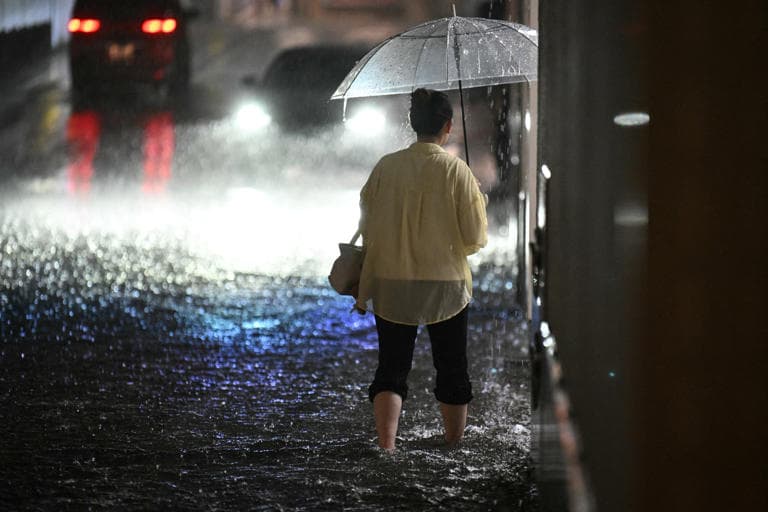
Nagoya: Nagoya's streets turned into waterways on Tuesday after the Japanese city recorded its highest hourly rainfall since meteorological observations began 136 years ago.
The city received 104.5 millimetres of rain in one hour, more than twice the roughly 50 millimetres per hour that standard urban drainage systems are designed to handle. The resulting flooding disrupted subway services, affected underground shopping areas and suspended the Tokaido Shinkansen between Nagoya and Gifu Hashima.
The storm also triggered Japan's highest level flood warning for parts of the Shonai River. At its peak, about 2.65 million people across Aichi, Gifu and Mie prefectures were under evacuation advisories or orders, while at least 41 people were injured.
The rainfall surpassed Nagoya's previous hourly record of 97 millimetres, set during the devastating Tokai Heavy Rain in 2000. That disaster flooded large parts of the city and prompted major investment in flood defences, including stronger river infrastructure and greater pumping capacity.
This week's flooding, however, exposed a different challenge. The city's drainage network was confronted with rainfall far beyond the intensity for which many urban systems were designed.
The rain came from a linear precipitation band, a phenomenon in which successive thunderstorms develop along the same atmospheric boundary and repeatedly release heavy rain over the same area. Such systems can produce extreme rainfall within a short period, leaving little time for water to drain away.
The timing has also raised concerns ahead of the Asian Games, which open in Aichi and Nagoya on September 19. Several venues reported water leaks, while about 400 athletes, coaches and officials staying in temporary accommodation were briefly moved to higher ground as a precaution. Organisers said there was no structural damage and the Games would proceed as planned.
Japan's recent experience with extreme rainfall has increasingly brought climate change into the conversation. A warmer atmosphere can hold more moisture, providing greater fuel for intense rainfall when the right weather systems develop.
For Nagoya, the immediate task is recovery and preparing for the Games. But the record has left a larger warning: infrastructure can be upgraded, yet the definition of an extreme storm can change faster than the concrete beneath a city.