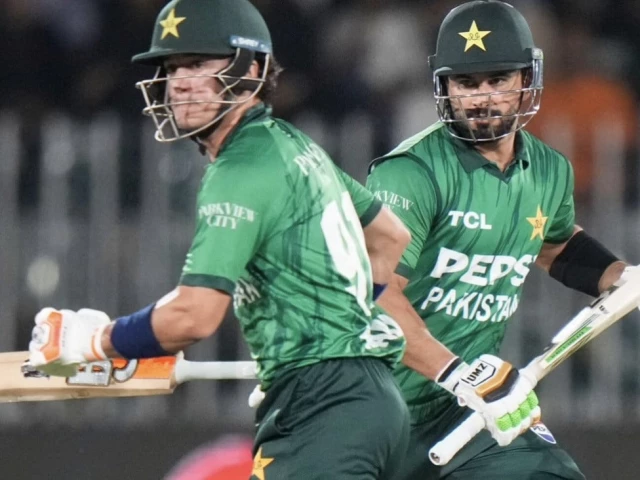
Lahore: Pakistan's Maaz Sadaqat has emerged as one of the biggest movers in the latest men's T20I batting rankings, climbing 187 positions to reach 45th place following his performances against Sri Lanka.
The left handed batter accumulated 533 rating points after scoring 50 and 96 in the opening two matches of the series, marking a significant rise in his international standing.
His performances have placed him among Pakistan's leading batters in the format, reflecting the impact of his recent contributions at the international level.
Meanwhile, Pakistan's Sahibzada Farhan retained third position in the batting rankings after a record breaking series against Sri Lanka.
Farhan scored 238 runs across three matches, taking his rating to 883 points. He remains behind India's Ishan Kishan, who leads with 904 points, and Abhishek Sharma, who occupies second place with 891.
The Pakistani opener's 238 run tally also surpassed the previous record for the most runs in a three-match T20I series, held by Abhishek Sharma, who scored 229 against Afghanistan earlier this year.
India's Shreyas Iyer moved up three places to a career best fourth position with 798 points following his maiden T20I century against the West Indies.
England's Harry Brook occupies fifth place, while Jos Buttler shares sixth position with South Africa's Dewald Brevis.
Among other Pakistani batters, Saim Ayub climbed four positions to 42nd with 550 points, while former captain Babar Azam dropped four places to 48th with 528 points.
Hasan Nawaz shares 51st position with Sri Lanka's Kusal Perera on 526 points, while Salman Ali Agha slipped five places to 56th with 520 points.
Sri Lanka's Kusal Mendis rose three positions to 23rd with 624 points, while West Indies batter Sherfane Rutherford climbed 13 places to a career best joint 24th position with 620 points.
India's Sanju Samson also improved his standing, moving up four places to 27th with 605 points.
Abrar Ahmed remains Pakistan's leading T20I bowler
Pakistan's Abrar Ahmed maintained fourth position in the T20I bowling rankings with 695 points, sharing the spot with England's Adil Rashid.
Afghanistan's Rashid Khan leads the rankings with 720 points, while Australia's Adam Zampa occupies second position with 700 points.
Pakistan fast bowler Salman Mirza recorded a notable improvement, climbing nine places to 14th with 635 points.
He is now just two rating points behind England's Jofra Archer and South Africa's Corbin Bosch, who share 11th place with 637 points.
Mohammad Nawaz also improved his bowling ranking, moving up six positions to 18th with 626 points.
Shaheen Shah Afridi occupies 40th position with 572 points, while Sufyan Moqim dropped three places to 53rd with 532 points.
Saim Ayub climbed eight places to 54th in the bowling rankings with 529 points, reflecting his contributions beyond his primary role as a batter.
India's Axar Patel holds ninth position with 649 points, while Jasprit Bumrah shares 11th place with Archer and Bosch.
West Indies captain Roston Chase also registered a significant improvement, climbing 24 places to 23rd with 618 points.
What the rankings mean for Pakistan
The latest rankings highlight contrasting developments within Pakistan's T20I squad, with emerging players making substantial gains while several established batters have slipped.
Sadaqat's rise is particularly significant because it follows two strong performances in a short series, demonstrating how international rankings can change rapidly when players produce substantial scores against recognised opponents.
Farhan's continued presence among the world's top three T20I batters provides another positive development for Pakistan's batting line up, particularly as the team seeks consistent performances at the top of the order.
In bowling, Abrar's fourth place standing and Mirza's nine position improvement underline Pakistan's presence among the leading international performers.
However, ranking positions alone do not determine a team's overall strength. Consistency across different opponents, playing conditions and match situations remains important when assessing individual performances and the balance of Pakistan's T20I squad.