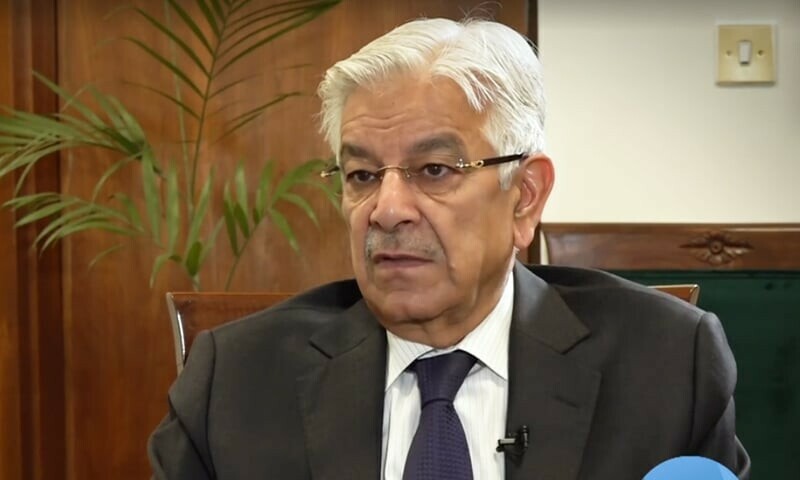
Islamabad: Defence Minister Khawaja Asif on Tuesday expressed support for Adviser to the Prime Minister on Political Affairs Rana Sanaullah amid a dispute within the federal government over proposals to create new provinces, highlighting differences among ruling coalition figures over how the issue should be handled.
In a post on social media platform X, Asif praised Sanaullah's political career and commitment to the Pakistan Muslim League Nawaz (PML N), describing him as a credible political worker who had remained loyal to the party despite facing persecution under previous governments.
“Rana Sanaullah is a credible and respected political worker. In fact, a political worker deserves even greater respect than a political leader,” Asif wrote.
He referred to Sanaullah's experiences during the governments of former military ruler Pervez Musharraf and former prime minister Imran Khan, saying neither administration had succeeded in forcing him to abandon his political position.
Asif also commended Sanaullah's political judgement and loyalty to the PML N, describing his experience as an asset to the party.
The statement came as tensions between Sanaullah and Interior Minister Mohsin Naqvi escalated over the proposal to establish additional provinces and administrative units in Pakistan.
The disagreement centres on Naqvi's handling of the proposal rather than solely on the principle of creating new provinces. Sanaullah has argued that the issue requires consultation with coalition partners, particularly the Pakistan Peoples Party (PPP), before being pursued publicly.
On Monday, Sanaullah accused Naqvi of turning the matter into a political controversy by raising it at an inappropriate forum without securing the necessary support from other parties.
He maintained that decisions involving provincial boundaries should be discussed in parliament and taken forward through political consensus rather than statements by individual ministers.
The exchange intensified after Naqvi warned on Sunday, without naming Sanaullah, that a cabinet colleague who had criticised him repeatedly over the past two and a half years would be unable to face the public if he decided to respond.
Sanaullah subsequently acknowledged that the remarks were directed at him and said he was prepared to respond to any criticism from the interior minister.
Amid the exchanges, Prime Minister Shehbaz Sharif intervened on Tuesday and instructed cabinet members to stop making public statements against one another.
According to the Prime Minister's Office, Shehbaz said disagreements should be addressed through mutual understanding and consultation, warning that public criticism between government figures created an adverse impression and distracted from the administration's priorities.
The controversy has also exposed differences within the PML N and its coalition partners over administrative restructuring. Asif has previously supported increasing the number of provinces to as many as 12, arguing that smaller administrative units could improve governance and public service delivery.
His support for Sanaullah therefore comes despite differences in their public positions on the provinces debate, suggesting that the dispute concerns the political process as well as the proposed reforms.
The PPP, a coalition partner of the PML N led government, has opposed proposals that could divide Sindh. The Muttahida Qaumi Movement Pakistan (MQM P), meanwhile, has advocated the creation of additional provinces, particularly in Sindh, citing governance and administrative concerns.
The Sindh Assembly passed a resolution in September opposing any attempt to alter the province's geographical boundaries, reflecting the political resistance that proposals for territorial restructuring are likely to face.
Under Article 239 of the Constitution, legislation altering a province's boundaries requires approval by a two thirds majority in the affected provincial assembly, in addition to the parliamentary process for constitutional amendments.
The requirement makes support from provincial lawmakers and coalition parties central to any proposal to redraw Pakistan's administrative boundaries.
Although the debate has prompted competing statements from federal ministers and political parties, no agreed framework for establishing additional provinces has been announced.
The prime minister's intervention has shifted attention towards whether members of the ruling coalition can develop a common position on the issue while preventing the dispute from affecting relations within the federal government.