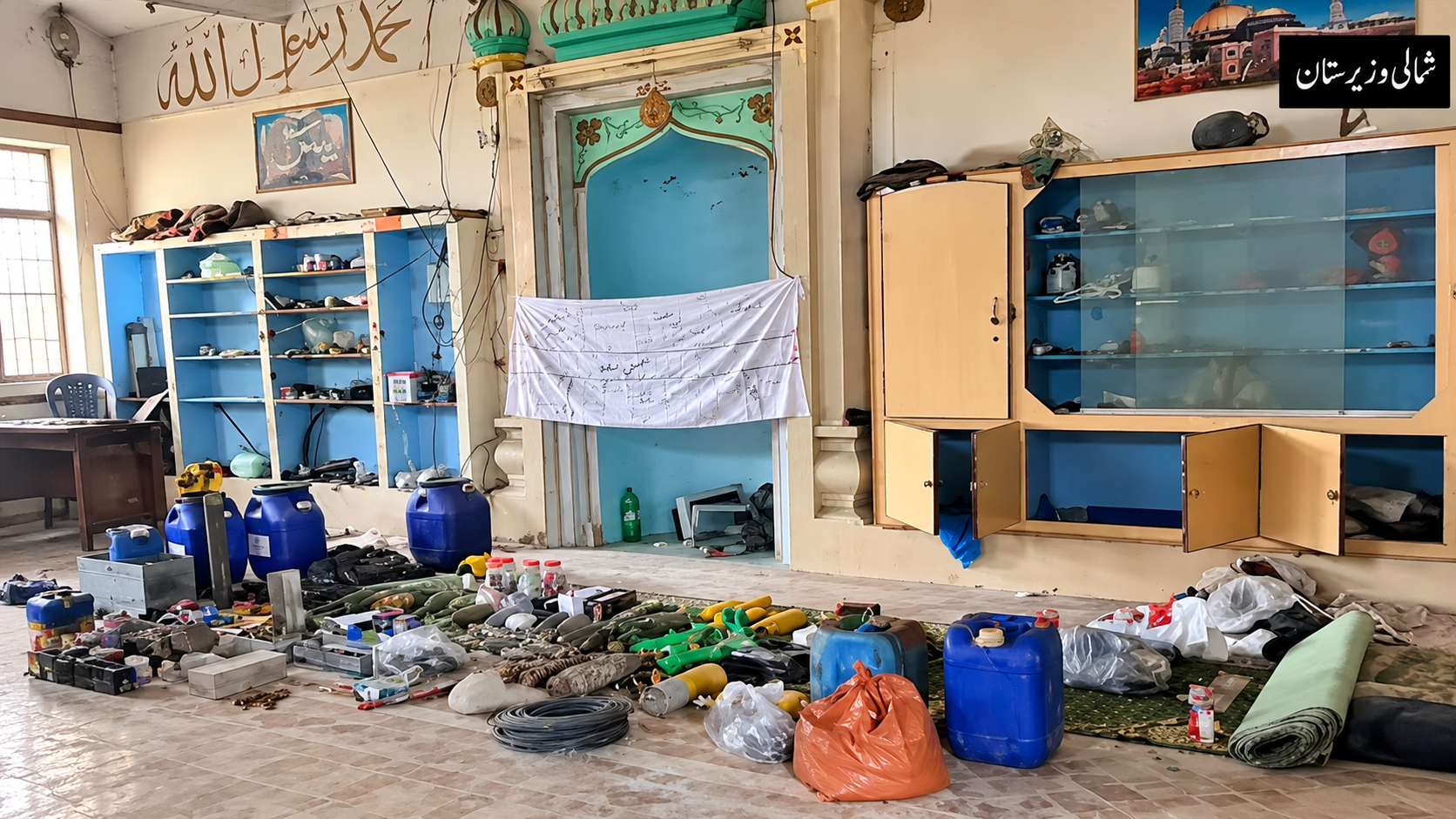
Peshawar: Security forces recovered improvised explosive devices (IEDs), weapons, ammunition and explosives from two suspected militant hideouts inside mosques in North Waziristan during an intelligence based operation conducted on Sunday, according to the military's media wing.
The Inter Services Public Relations (ISPR) said on Monday that the operation took place in Muzak village, on the southern outskirts of Mir Ali, targeting hideouts allegedly operated by the banned Tehreek e Taliban Pakistan (TTP). The military refers to the TTP as Fitna Al Khawarij, a designation used for the proscribed organisation.
According to ISPR, security personnel searched and cleared two hideouts established inside mosques, where militants had allegedly stored explosive materials and operated detention and torture facilities. The military condemned the alleged use of places of worship for militant activities, saying it demonstrated disregard for religious principles and the sanctity of mosques.
ISPR also accused the militants of receiving support from the Afghan Taliban authorities, an allegation that was not independently verified in the statement. The military said further clearance operations were under way to identify and eliminate other suspected militant hideouts in the area. It did not report any arrests or casualties during the operation.
The recovery comes amid an increase in militant violence across Pakistan, particularly in Khyber Pakhtunkhwa, where security personnel have been among the principal targets. According to data compiled by the Armed Conflict Location & Event Data (ACLED) monitoring organisation, recorded attacks in Pakistan increased from 658 in 2022 to 2,425 in 2025.
Security reports presented to the federal cabinet in October indicated that terrorist incidents in Khyber Pakhtunkhwa had increased by 195 percent between March 2024 and September 2026.
The reports found that 73 percent of attacks recorded in the province during 2026 targeted police and security personnel. They also identified the growing use of drones and IEDs as operational challenges for law enforcement agencies.
Pakistan has repeatedly accused Afghanistan's Taliban administration of allowing TTP militants to operate from Afghan territory and conduct attacks across the border.
A United Nations Security Council monitoring report published in February 2026 raised concerns about increased TTP attacks originating from Afghanistan and reported that the group continued to receive support and operational freedom there. The report also identified links between Al Qaeda and the TTP, including training and access to military equipment.
Islamabad has maintained that cross-border militant activity remains a major obstacle to improving relations with Kabul. ISPR said counter terrorism operations would continue under Azm e Istehkam, the national campaign approved by the Federal Apex Committee on the National Action Plan.
The latest operation highlights the security challenges facing North Waziristan, where militant networks continue to pose a threat despite repeated intelligence based operations.