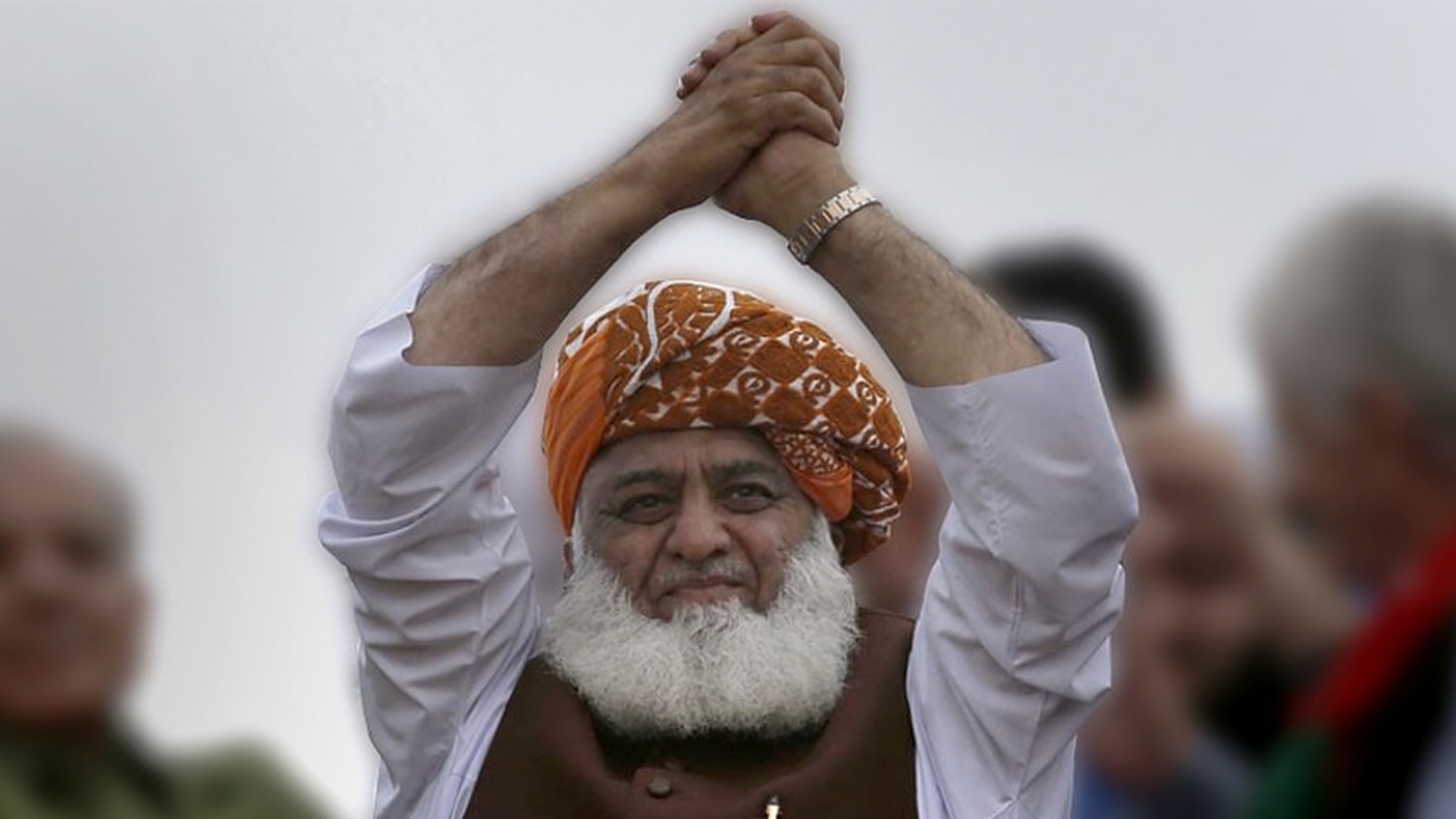
Peshawar: Jamiat Ulema e Islam Fazl (JUIF) chief Maulana Fazlur Rehman demanded fresh, transparent elections, saying the country's political and economic problems cannot be resolved through assemblies that lack genuine public representation.
Addressing a gathering in Peshawar, Rehman criticised the federal government over the imposition of governor's rule and an emergency in Khyber Pakhtunkhwa.
He maintained that political decisions were being made without the public's consent and accused powerful institutions of influencing the formation and removal of governments.
Rehman said politicians were routinely blamed for the country's failures despite having limited control over important decisions.
Government abandoned understanding with PTI, says Rehman
Rehman recalled his involvement in negotiations between the federal government and Pakistan Tehreek e Insaf (PTI) during the party's planned long march towards Islamabad.
He said a PTI delegation approached him for mediation, while the government also sought his involvement.
According to Rehman, Prime Minister Shehbaz Sharif invited him to a meeting, where he presented PTI's demands and discussed possible ways of ending the confrontation.
He said PTI representatives indicated that they would call off their march if their demands were accepted.
However, Rehman alleged that despite the discussions, the government subsequently decided to impose governor's rule in KP.
He criticised the decision, questioning why the government abandoned negotiations rather than resolving the dispute politically.
Rehman said the government was now pursuing contacts with the PTI founder and facilitating the release of party workers in Punjab.
He argued that the political confrontation would not have intensified if those steps had been taken earlier.
Questions raised over governor's rule and minerals
The JUI F chief questioned whether governor's rule and the emergency improved the security situation in KP.
He asked why similar measures were not introduced in Balochistan, where terrorism and security challenges also persisted.
Rehman linked the decisions to disagreements over provincial mineral resources.
He pointed out that Balochistan passed legislation concerning minerals while KP did not, suggesting that this difference explained the federal government's approach.
He also criticised restrictions in tribal areas, alleging that valuable resources were being removed during curfews imposed on weekends.
Rehman said his party supported investment but opposed measures that undermined provincial rights and control over natural resources.
Criticism of constitutional and economic governance
Rehman said Pakistan failed to fulfil the expectations of different political and ideological groups nearly eight decades after independence.
He questioned the country's economic performance, citing inflation, exports and the rupee's value against the US dollar.
He also criticised the limited implementation of recommendations issued by the Council of Islamic Ideology.
According to Rehman, a provision introduced through the 26th Constitutional Amendment was intended to ensure parliamentary discussion of the council's recommendations, but meaningful progress did not follow.
He reiterated his opposition to proposals for dividing existing provinces without considering the rights and wishes of their populations.
Military should defend the country, not dominate politics
Rehman said his party was not opposed to the armed forces and wanted a strong military capable of defending Pakistan against external threats.
However, he argued that military strength should not be used to dominate political representatives.
He also accused the authorities of reopening cases against political opponents who challenged the prevailing narrative.
Concluding his address, Rehman renewed his demand for free and fair elections, arguing that assemblies without a genuine public mandate could not effectively serve citizens.
He said such legislatures ultimately served powerful interests rather than the electorate.