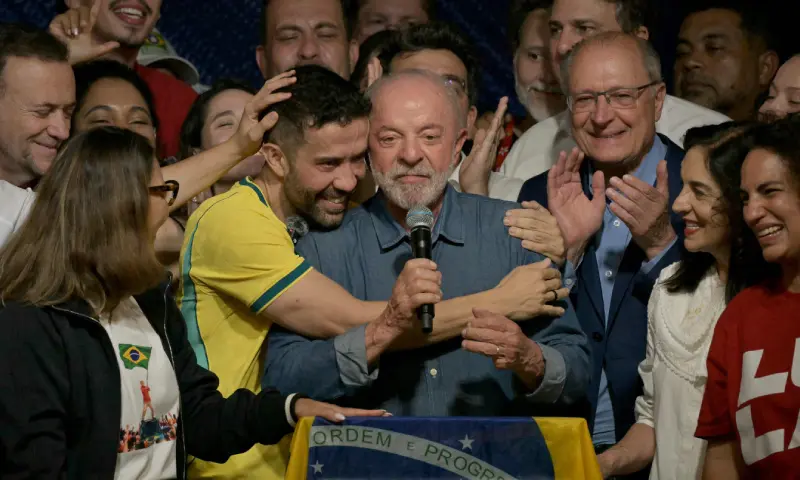
Brasilia: Brazilian President Luiz Inácio Lula da Silva won re election on Sunday, securing an unprecedented fourth term after overturning his first-round defeat against conservative senator Flávio Bolsonaro, who has rejected the outcome and pledged to challenge it.
According to official results, Lula received 51.8 percent of the vote against Bolsonaro's 48.2 percent, a margin of approximately 4.4 million votes. The result marks the first time since Brazil restored direct presidential elections in 1989 that a candidate who lost the first round went on to win the runoff.
Lula, who turns 81 on Tuesday, will remain in office until 2030, extending a political career that began with his first presidential victory in 2002. His re election also contrasts with recent political shifts across Latin America, where conservative parties and candidates have gained ground in countries including Argentina, Chile, Colombia and Peru.
Bolsonaro rejects results over voting extension
The election dispute centres on a Supreme Court decision to extend voting by two hours after some polling stations had already closed. The ruling followed complaints from Lula's campaign that buses had been withdrawn from service in several cities, preventing some voters from reaching polling stations.
Bolsonaro had separately requested additional voting time in areas affected by heavy rainfall. However, he criticised the court's decision and questioned the election's legitimacy. "It is impossible to recognise the results. I am going to request the annulment of these elections," Bolsonaro said during a statement in Brasília.
The senator, 45, is the son of former president Jair Bolsonaro, who is serving a 27 year prison sentence for attempting to overturn the outcome of the 2022 presidential election.
The latest challenge adds another electoral dispute in Brazil, where questions over accepting election results have remained politically significant since the previous presidential contest. The reported results gave no immediate indication that Bolsonaro's proposed legal challenge would alter the official outcome.
Voter mobilisation changes runoff outcome
Lula's victory followed a campaign effort to increase voter participation after his defeat in the first round. His Workers' Party organised rallies, expanded its social media activities and campaigned against the return of the Bolsonaro political movement to the presidency.
Voter abstention declined from 21 percent in the first round to 19 percent in the runoff, indicating higher participation in the final contest.
Speaking after the results, Lula credited voter mobilisation with helping secure his victory. "People went to vote because we managed to convince them that voting was very important for ensuring democracy in the country," he said.
Supporters gathered in São Paulo and Rio de Janeiro after the announcement, carrying Workers' Party flags and celebrating the result.
The campaign also involved a dispute over social media platforms. Lula's team accused Meta, which owns Facebook, Instagram and WhatsApp, of favouring Bolsonaro through alleged algorithmic manipulation.
Meta denied the allegation but acknowledged that technical errors had mistakenly deactivated some advertisements from Lula's campaign. After his victory, Lula said regulating social media companies would remain on his government's agenda.
Economic concerns and political divisions
The election took place against a backdrop of concerns over living costs, public security and economic conditions. During Lula's third term, Brazil saw reductions in inflation and unemployment, along with improvements in food security.
However, concerns about household expenses and crime continued to influence voters, providing Bolsonaro with an opportunity to attract support beyond his conservative base. Bolsonaro presented himself as a more moderate alternative to his father and appealed to voters seeking a change in government.
Despite Lula's victory, the result showed the electorate's division, with nearly half of participating voters supporting his opponent.
The president will also face a Congress dominated by right wing parties, potentially complicating efforts to advance legislation and implement his policy agenda.
Lula's political return and fourth term
Lula first became president in 2003 after rising through Brazil's trade union movement and establishing himself as a leading figure in the Workers' Party. He served two consecutive terms until 2010, then returned to office after defeating Jair Bolsonaro in 2022.
Corruption proceedings interrupted his political career and led to more than 18 months of imprisonment. Courts later annulled those convictions on procedural grounds, allowing him to run again.
His latest victory extends his time in national leadership, although his fourth term will begin amid continued disagreements over economic policy, public security and the balance of power between the presidency and Congress.
Lula will be 85 when his new term ends in 2030.
The election also affects Brazil's relations with the US and other Latin American governments. US President Donald Trump has built ties with several conservative leaders in the region, while Lula has emphasised Brazil's sovereignty in trade and diplomacy.
During the campaign, Lula criticised Washington's commercial and diplomatic pressure and made national independence central to his political message. "This country will not accept being anyone's backyard," he said following Sunday's victory.
As Latin America's largest economy, Brazil's foreign policy matters for regional trade, investment, and diplomatic cooperation. Chilean President José Antonio Kast and Ecuadorian President Daniel Noboa sent congratulatory messages, both of whom maintain close ties with Trump.
The president now enters another term facing a divided electorate, opposition control of Congress and a legal challenge to the election result from his defeated rival. While the official count confirms Lula's victory, Bolsonaro's refusal to concede leaves the electoral dispute unresolved as Brazil prepares for its next presidential term.