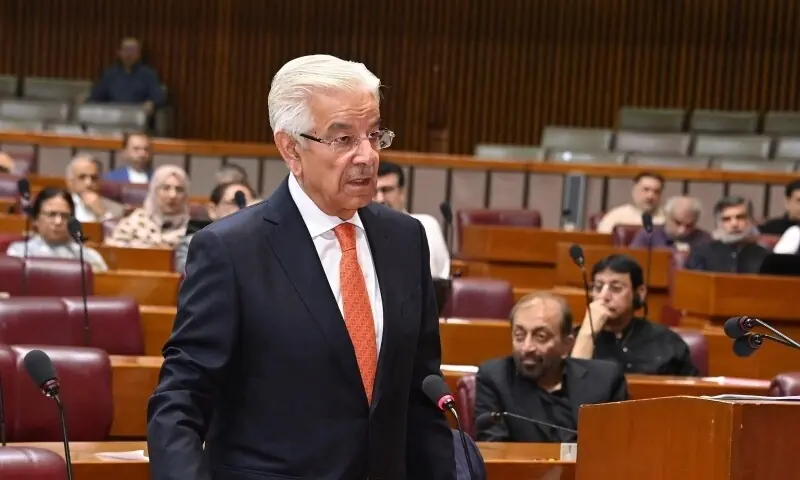
Islamabad: Defence Minister Khawaja Asif has supported the creation of new provinces in Pakistan, saying the country could be divided into as many as 12 administrative units if the restructuring is based on governance requirements rather than linguistic, ethnic or political considerations.
Speaking to Geo News on Sunday, November 8, Asif argued that Pakistan's growing population and the concentration of authority in provincial capitals had weakened the delivery of public services at the local level.
His remarks come amid reports of a proposal to reorganise Pakistan's four provinces into 12 units through a possible 28th Constitutional Amendment. However, no final government decision has been announced regarding the proposed boundaries, administrative arrangements or constitutional process.
Asif calls for decentralisation of authority
The defence minister said administrative powers should not remain concentrated in Lahore, Karachi, Quetta and Peshawar.
He argued that smaller administrative units could improve access to public services and make decision-making more responsive to local needs. Asif also questioned the existing distribution of financial resources between federal, provincial and local governments.
According to the minister, funds transferred by the federal government often remain under provincial control, leaving local government institutions dependent on provincial administrations for financial and administrative authority.

He called for transferring resources and decision making powers to institutions closer to communities. The minister also urged political leaders to recognise that public office was a responsibility entrusted to them by citizens rather than a means of retaining authority.
Referring to Pakistan's administrative history, Asif recalled the One Unit scheme, under which the provinces and territories of West Pakistan were merged into a single administrative unit in 1955. The arrangement was abolished in 1970. Recent media reports suggest that a proposal is under consideration to increase the number of provinces from four to 12.
Under the reported arrangement, Punjab could be divided into four provinces, Khyber Pakhtunkhwa and Balochistan into three each, and Sindh into two. A nationwide referendum has also been discussed as a possible step before introducing a constitutional amendment.
According to reports citing sources familiar with the proposal, constitutional changes could be considered during the first half of 2027. However, these remain reported proposals rather than an approved government plan. No final boundaries or implementation timetable have been confirmed.
MQM P renews demand for administrative units in Sindh
Meanwhile, the Muttahida Qaumi Movement Pakistan (MQM P) reiterated its demand for new administrative units in Sindh, arguing that decentralisation was necessary to address governance and municipal service problems in urban areas.
The demand was renewed during a meeting chaired by party convener and Federal Minister Khalid Maqbool Siddiqui at MQM-P's Bahadurabad headquarters in Karachi.
According to a party statement, the leadership discussed preparations for upcoming local government elections, development priorities and the distribution of resources across urban Sindh.
Siddiqui said addressing the grievances of urban communities, securing administrative reforms and strengthening the party's representation in local government were among its priorities.
He directed party representatives and organisational departments to mobilise workers and engage communities at the neighbourhood level. MQM P maintained that the transfer of powers and financial resources to local institutions was necessary to improve municipal services and strengthen accountability.
Constitutional hurdles to creating new provinces
Although several political figures have supported administrative restructuring, changing Pakistan's provincial boundaries would require constitutional approval.
Under Article 239 of the Constitution, an amendment must receive the support of at least two-thirds of the total membership of both houses of parliament. Any amendment affecting the boundaries of an existing province must also secure a two thirds majority in that province's assembly.
This means the creation of new provinces would require negotiations involving federal and provincial political parties, particularly in areas where restructuring could alter existing political representation and resource distribution. Pakistan's Constitution also provides for elected local governments under Article 140A, including the devolution of political, administrative and financial responsibility.
The debate therefore raises two related but distinct questions: whether Pakistan requires additional provinces and whether existing provincial governments should transfer more authority to local institutions.
Governance reform or political restructuring?
Supporters of new provinces argue that smaller administrative units could improve public service delivery, reduce distances between citizens and government offices, and distribute development resources more effectively.
However, creating provinces would also involve establishing administrative institutions, redistributing public resources and addressing questions of political representation. New provincial boundaries would not automatically guarantee stronger local governments unless financial and administrative authority were also transferred.
For Sindh, the debate is particularly significant because MQM P has long demanded greater representation and resources for Karachi and other urban centres. Asif's comments place administrative reform within a wider national discussion, but the reported 12-province proposal remains at a preliminary stage.
Any further progress will depend on whether the federal government formally presents a restructuring plan and whether political parties can secure the constitutional majorities required to implement it.