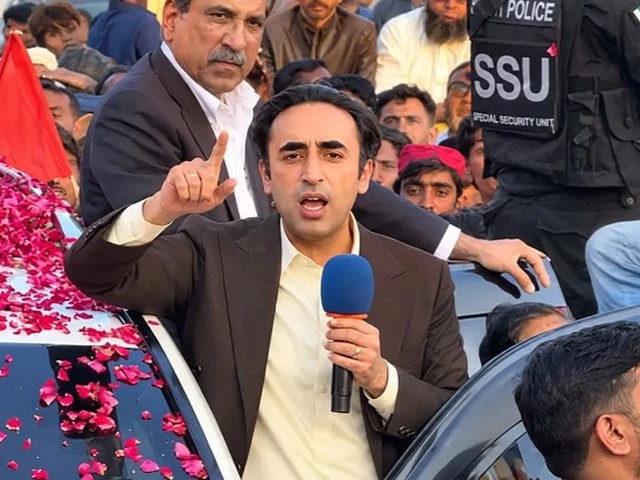
Rahim Yar Khan: Pakistan Peoples Party (PPP) Chairman Bilawal Bhutto Zardari on Friday, November 27, rejected proposals to divide Punjab into four provinces, saying he would support changes to provincial boundaries only if they were endorsed by the people and the Punjab Assembly.
Addressing party workers during a visit to Rahim Yar Khan, Bilawal said the PPP supported the creation of South Punjab province because the demand had emerged from the region and received backing from the provincial legislature.
"I do not endorse the idea of dividing Punjab into four smaller provinces," he said, referring to proposals under discussion to reorganise Pakistan into 12 administrative units.
He maintained that the people of Punjab and their elected representatives should determine whether the province should be divided into two, three or four parts. "If the people of Punjab, or their elected representatives, make that decision, I will respect their mandate and abide by it," the PPP chairman said.
Bilawal stressed that his party would not accept decisions imposed without consulting the population of the affected province. Explaining his position, Bilawal referred to the Punjab Assembly's May 2012 resolutions supporting the creation of South Punjab province and the restoration of Bahawalpur province.
The resolutions were passed during the PPP led federal government's tenure, when the Pakistan Muslim League Nawaz (PML N) governed Punjab. Rana Sanaullah, who was Punjab law minister at the time, presented the resolutions, which received support from lawmakers across party lines, including the PPP.
Bilawal said the assembly's endorsement provided a basis for pursuing the demand through constitutional and parliamentary procedures.
The creation of South Punjab has remained part of the political debate for years, with supporters arguing that a separate province could improve administrative representation and access to resources in the region. However, the proposal has yet to result in legislation establishing a new province.
Bilawal's remarks come amid discussions about restructuring Pakistan's administrative boundaries to create additional provinces. One proposal circulating in political and media discussions would increase the number of provinces from four to 12, dividing Punjab into four units, Sindh into two and Khyber Pakhtunkhwa and Balochistan into three each.
Supporters of the proposal argue that additional provinces could bring administrative institutions closer to residents and improve the delivery of public services. Opponents have questioned the political implications, financial costs and potential disputes over resources and territorial boundaries.
Interior Minister Mohsin Naqvi has suggested holding a referendum to gauge public opinion on creating provinces, while other political figures have called for parliamentary debate.
No agreed constitutional amendment establishing the proposed provinces has been presented for approval. The issue has also exposed differences among parties over whether administrative restructuring should take place across the country or be considered separately for individual regions.
While supporting South Punjab, the PPP has opposed proposals to create provinces within Sindh, where it leads the provincial government. The Sindh Assembly passed a resolution in September rejecting attempts to divide the province or alter its geographical boundaries.
Bilawal has previously warned against imposing territorial changes without the consent of the people and their elected representatives. The party maintains that its position on Punjab and Sindh is consistent because it is based on the decisions of the respective provincial assemblies.
However, the contrasting positions have also prompted questions about how demands for provincial autonomy should be assessed across different parts of the country.
The PPP argues that changes must follow constitutional procedures rather than unilateral decisions by the federal government. Article 239(4) of Pakistan's Constitution requires any constitutional amendment altering a province's boundaries to receive the support of at least two-thirds of the total membership of the provincial assembly concerned.
Such an amendment must also secure the constitutionally required majorities in both houses of parliament. This means that creating South Punjab or dividing any existing province would require agreement at both the federal and provincial levels.
Although the Punjab Assembly's 2012 resolutions expressed support for new provinces, they did not themselves create a province or replace the constitutional amendment process.
The proposed restructuring would also require decisions on the distribution of resources, administrative institutions, provincial assets and political representation. For the PPP, the immediate position remains support for South Punjab while rejecting a wider division of Punjab without a mandate from the province.
Bilawal did not announce any legislation or timetable for pursuing the South Punjab proposal.
His remarks underline the political challenge facing advocates of new provinces: securing agreement not only on the need for administrative reform but also on where boundaries should be drawn and how public consent should be established.