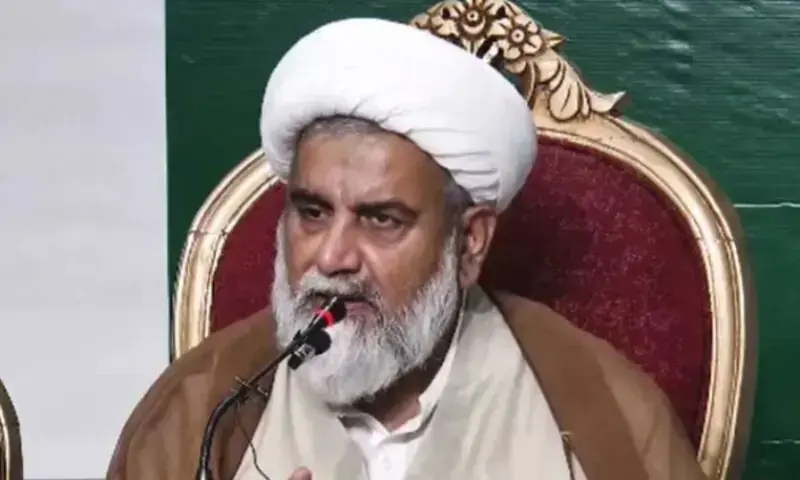
Islamabad: Senate Opposition Leader Allama Raja Nasir Abbas has urged the federal government to keep Pakistan out of the conflict in Yemen and pursue diplomatic mediation, warning that involvement in the war would contradict parliament's unanimous resolution adopted in 2015.
Speaking at the Shuhada i Muqawamat and Tajdeed i Ahd Conference organised by Majlis Wahdat i Muslimeen (MWM) in Islamabad on Sunday, Abbas questioned whether the government had obtained parliamentary approval for any involvement in the conflict.
The MWM chairman said Pakistan should prioritise a ceasefire, negotiations and regional stability rather than participate in military action against Yemen. His remarks come amid regional tensions involving Yemen, Iran, the United States and the occupying forces in Palestine.
Opposition leader invokes 2015 parliamentary resolution
Abbas referred to the resolution passed by a joint sitting of Pakistan's parliament in April 2015, when Saudi Arabia sought support for its military campaign in Yemen. The resolution called for Pakistan to maintain neutrality in the Yemen conflict while supporting diplomatic efforts to restore peace.
It also expressed support for Saudi Arabia's territorial integrity and sovereignty. Abbas argued that any decision to involve Pakistan militarily in Yemen would undermine the parliamentary position and could have consequences for national sovereignty and foreign policy. He questioned the authority under which Pakistan might become involved in the conflict and called on the government to clarify its position.
The opposition leader said Yemen had offered Pakistan a mediatory role and claimed that he had written to Prime Minister Shehbaz Sharif about the issue. He also said he had raised concerns with the foreign minister, questioning how Pakistan could act as a mediator while becoming involved in the fighting.
The claims regarding Yemen's mediation offer and Pakistan's possible involvement were made by Abbas. The supplied report does not establish that Pakistan has formally joined military operations in Yemen.
Calls for ceasefire and regional diplomacy
Abbas condemned attacks on Yemen and linked the conflict to wider tensions over Palestine.
He argued that Yemenis were being targeted because of their support for Palestinians and opposition to Israeli military operations in Gaza. These assertions reflected the MWM leader's political assessment of the conflict.
He called on Islamabad to pursue negotiations and diplomatic engagement rather than become involved in another regional war. Pakistan has historically maintained close defence and economic relations with Saudi Arabia while also seeking to avoid direct involvement in conflicts that could complicate relations with other countries in the region.
The 2015 parliamentary resolution remains an important reference point in debates over Pakistan's military commitments and the role of parliamentary oversight in foreign policy.
Abbas criticises US and Israeli actions against Iran
During his address, the opposition leader also condemned US and Israeli military actions against Iran. He alleged that attacks on Iran and the assassination of its supreme leader were intended to pressure the country into surrendering.
Abbas maintained that Iran had resisted those efforts and accused Washington and Israel of seeking to reshape the regional political order. He argued that the consequences of the conflict extended beyond individual states and affected the future of Palestine and the wider Middle East.
His remarks were political allegations and assessments made during the conference, rather than independently established findings. Abbas also criticised the federal government's approach towards US President Donald Trump, including expressions of support and proposals concerning a Nobel Peace Prize nomination.
He argued that Pakistan's foreign policy should be guided by national interests and sovereignty rather than efforts to secure the approval of foreign leaders.
Opposition leader raises domestic political concerns
Turning to domestic affairs, Abbas said the state belonged to the people of Pakistan and that public institutions should protect the rights of citizens across all provinces and regions. He specifically referred to Balochistan, Sindh, Punjab, Khyber Pakhtunkhwa, Gilgit Baltistan and Azad Jammu and Kashmir.
The opposition leader expressed concern over political freedoms and argued that the use of state force could not resolve public grievances. He also called for former prime minister Imran Khan to be given an opportunity to contribute to national reconciliation, describing him as a political figure with support among a substantial section of the population.
The remarks connected the party's position on regional conflicts with its wider demands for constitutional rights, political participation and national sovereignty.
Conference calls for constitutional supremacy
The conference was also addressed by MWM Vice Chairman Allama Syed Ahmed Iqbal Rizvi, Chief Organiser Syed Nasir Abbas and Central Secretary for Political Affairs Syed Asad Abbas Naqvi. Speakers expressed solidarity with Palestine and Yemen and called for national unity, sovereignty and constitutional supremacy.
The gathering highlighted concerns among sections of the political opposition about the possibility of Pakistan becoming involved in regional military operations. However, the available report does not include a government response to Abbas's allegations or confirmation of any decision to deploy Pakistani forces in Yemen.
The immediate question remains whether Islamabad will clarify its position on the conflict and the diplomatic role it intends to pursue. For Pakistan, the debate concerns not only relations with regional partners but also the extent to which major foreign policy and military decisions should remain subject to parliamentary scrutiny.