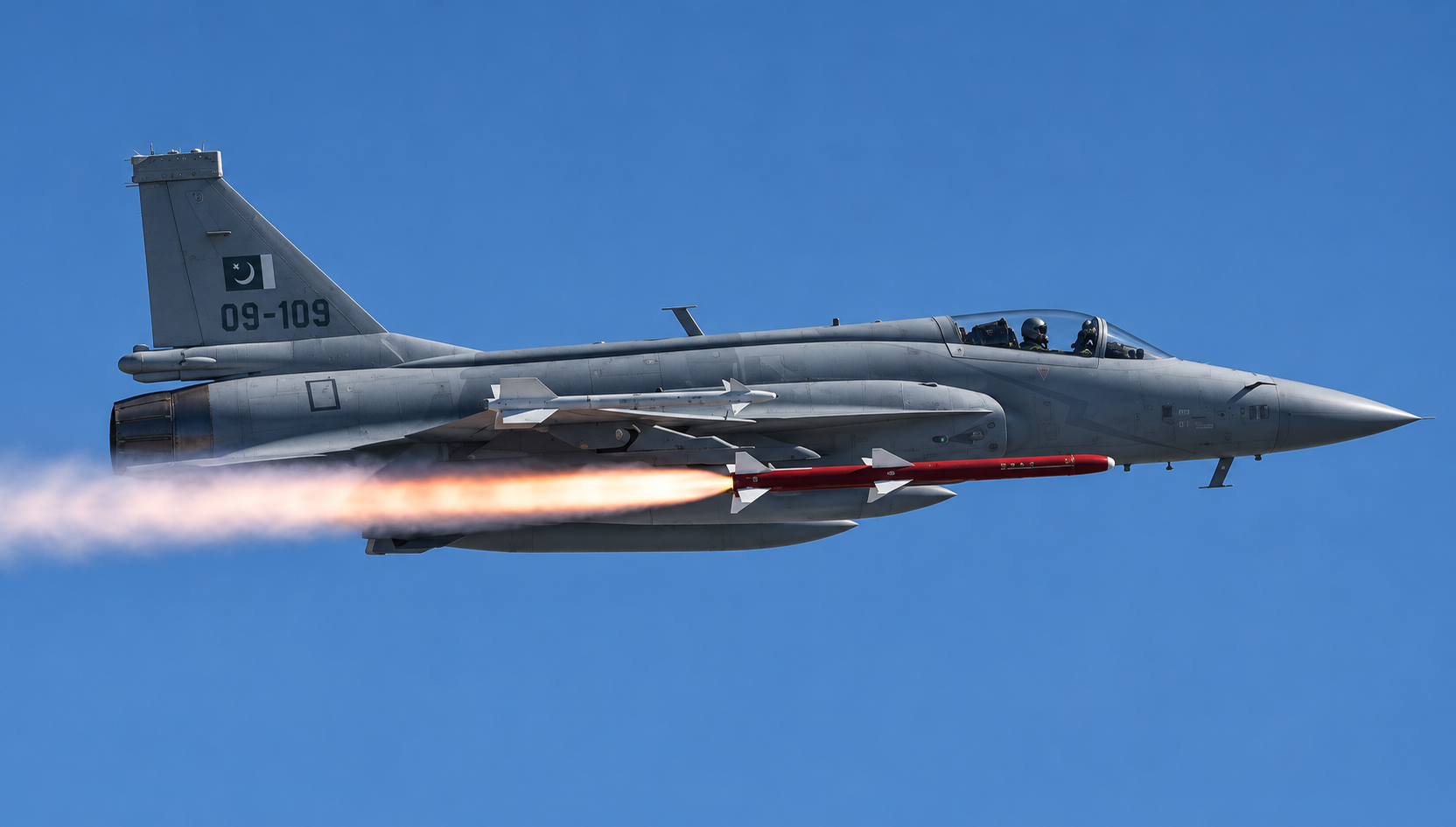
Islamabad: Pakistan has successfully conducted the first flight test of its indigenously developed Fa’az air to air missile, marking a step towards domestic production of aerial weapons, the military's media wing announced on Tuesday. According to the Inter Services Public Relations (ISPR), the missile is equipped with a terminal guidance system designed to engage aerial targets at extended ranges.
The military said the development would improve the Pakistan Air Force's (PAF) operational flexibility and contribute to the country's defence capabilities. The test was witnessed by senior officers of the armed forces, along with scientists and engineers involved in developing the missile.
President Asif Ali Zardari, Prime Minister Shehbaz Sharif, Chief of Army Staff and Chief of Defence Forces Field Marshal Asim Munir, and the services chiefs congratulated the development team.
Fa’az missile development and capabilities
The Fa’az programme forms part of Pakistan's efforts to manufacture military equipment domestically and expand its aerospace industry. The missile has been developed under the National Engineering and Scientific Commission (NESCOM), while variants were publicly displayed at the International Defence Industry Fair in Istanbul in 2023.
According to defence industry specifications reported by Dawn, the Fa’az missile family has a projected range exceeding 100 kilometres. However, the ISPR did not officially disclose the range of the missile tested on Tuesday. Reports indicate that the missile was launched from a JF 17 Thunder fighter aircraft, jointly developed by Pakistan and China, although the military's statement did not specify the launch platform.
A longer-range version, known as Fa’az 2, is also reportedly under development. Details concerning the missile's production schedule, operational deployment and induction into the PAF have not been announced. Pakistan seeks to reduce dependence on imported weapons The development comes as Pakistan continues efforts to reduce its reliance on foreign suppliers for military equipment.
The PAF currently operates aircraft equipped with air to air missiles supplied by countries including China and the US. Domestic production could provide Pakistan with greater control over maintenance, upgrades and procurement while reducing the impact of restrictions on imported defence equipment.
However, a successful flight test does not necessarily mean that a missile is ready for operational deployment. Further evaluation, production arrangements and integration with aircraft may be required before it enters service.
The Fa’az programme also reflects Pakistan's broader investment in aerospace manufacturing through organisations involved in aircraft production, engineering and defence research.
Regional security and defence modernisation
The test comes against the backdrop of Pakistan's efforts to modernise its military capabilities following its confrontation with India in May 2025, during which both countries used missiles, drones and fighter aircraft. The conflict drew attention to the role of air defence systems and long range aerial weapons in regional security. Pakistan has continued testing domestically developed missile systems as part of its defence programmes.
In October 2026, the military announced tests of extended range variants of the Fatah 2 ballistic missile and the Fatah IV ground launched cruise missile. The Fa’az test adds an air to air missile programme to these developments, although the systems serve different military purposes. What does the test mean for Pakistan?
The development could support Pakistan's efforts to expand domestic defence manufacturing and lessen dependence on imported equipment. It could also provide opportunities for research institutions, engineers and manufacturers involved in the aerospace sector.
However, the economic and operational implications will depend on production capacity, testing outcomes and procurement decisions. The government has not disclosed the programme's cost or announced when the missile could enter operational service.
For now, the flight test establishes a reported development milestone, while the extent to which Fa’az changes the PAF's capabilities will depend on subsequent testing and deployment.