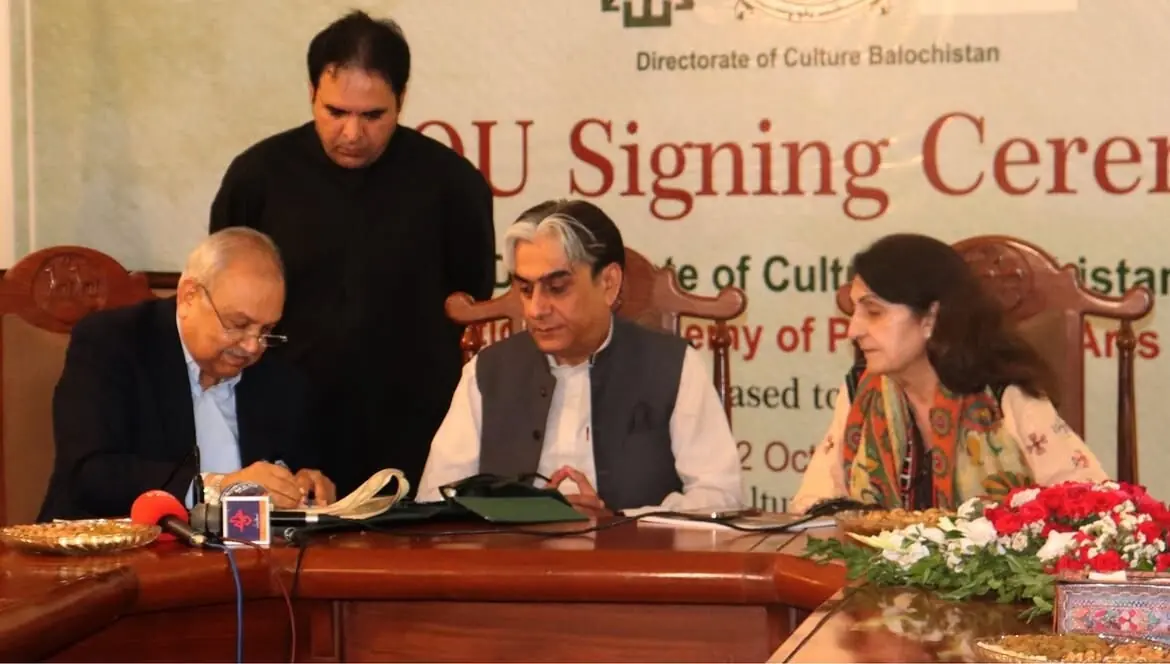
Quetta: The National Academy of Performing Arts (NAPA) has signed a memorandum of understanding (MoU) with the Balochistan government's Directorate of Culture to establish its first campus outside Karachi, marking a significant expansion of performing arts education in Pakistan.
The agreement was announced through NAPA's social media accounts on Tuesday, October 13, and represents a new partnership aimed at developing artistic talent and strengthening cultural activities in Balochistan.
The MoU was signed by Syed Javed Iqbal, chairman of NAPA's board of governors, and Balochistan Culture Secretary Hamidullah Nasir.
The signing ceremony was attended by NAPA board member and former senator Roshan Khursheed Bharucha, Director of Culture Dawood Tareen, artists, media representatives and members of civil society.
Speaking at the ceremony, Iqbal and Bharucha described the collaboration as an important step towards promoting arts and culture in Balochistan.
Nasir and Tareen also welcomed the agreement, expressing hope that the proposed campus would help preserve the province's cultural heritage while improving the professional skills of local artists.
Balochistan has frequently attracted national and international attention because of security challenges, militant violence and political tensions. However, the province also possesses a rich cultural heritage that receives comparatively limited visibility in mainstream discussions.
Its traditions encompass Balochi, Brahui and Pashto music, storytelling, poetry, theatre and other forms of artistic expression that reflect the region's linguistic and cultural diversity.
The establishment of a NAPA campus in Quetta could provide an opportunity to bring greater attention to these traditions while creating new pathways for aspiring performers, musicians and theatre practitioners.
For young people interested in the performing arts, access to formal training within the province could reduce the need to relocate to larger cities such as Karachi or Lahore to pursue artistic education.
The initiative could also encourage collaboration between established artists and emerging talent, allowing local cultural expressions to reach wider audiences.
Beyond individual artistic development, such institutions can contribute to a broader cultural environment by supporting performances, workshops, exhibitions and creative exchanges.
The proposed expansion also highlights the importance of developing cultural institutions beyond Pakistan's major metropolitan centres.
While Karachi, Lahore and Islamabad host many of the country's prominent artistic institutions and cultural events, opportunities for structured performing arts education remain unevenly distributed.
Establishing institutions in provinces such as Balochistan could help address this imbalance and provide greater representation to communities whose artistic traditions are often overlooked.
Cultural education can also play a role in strengthening social connections, encouraging dialogue and creating spaces where people from different backgrounds can share their experiences.
For Balochistan, an institution dedicated to performing arts could offer another platform through which the province is recognised for its creativity, heritage and artistic contributions, rather than being discussed primarily through the lens of security.
At a national level, greater investment in regional arts could strengthen Pakistan's cultural presence internationally by introducing audiences to the country's diverse musical, theatrical and storytelling traditions.
However, the long term impact of the Quetta campus will depend on the availability of qualified instructors, sustainable funding, accessible training programmes and opportunities for local artists to showcase their work.
Details regarding the campus's location, academic programmes, admission procedures and opening date have not yet been announced.
The agreement nevertheless represents an initial step towards expanding Pakistan's performing arts infrastructure and creating new opportunities for Balochistan's creative community.