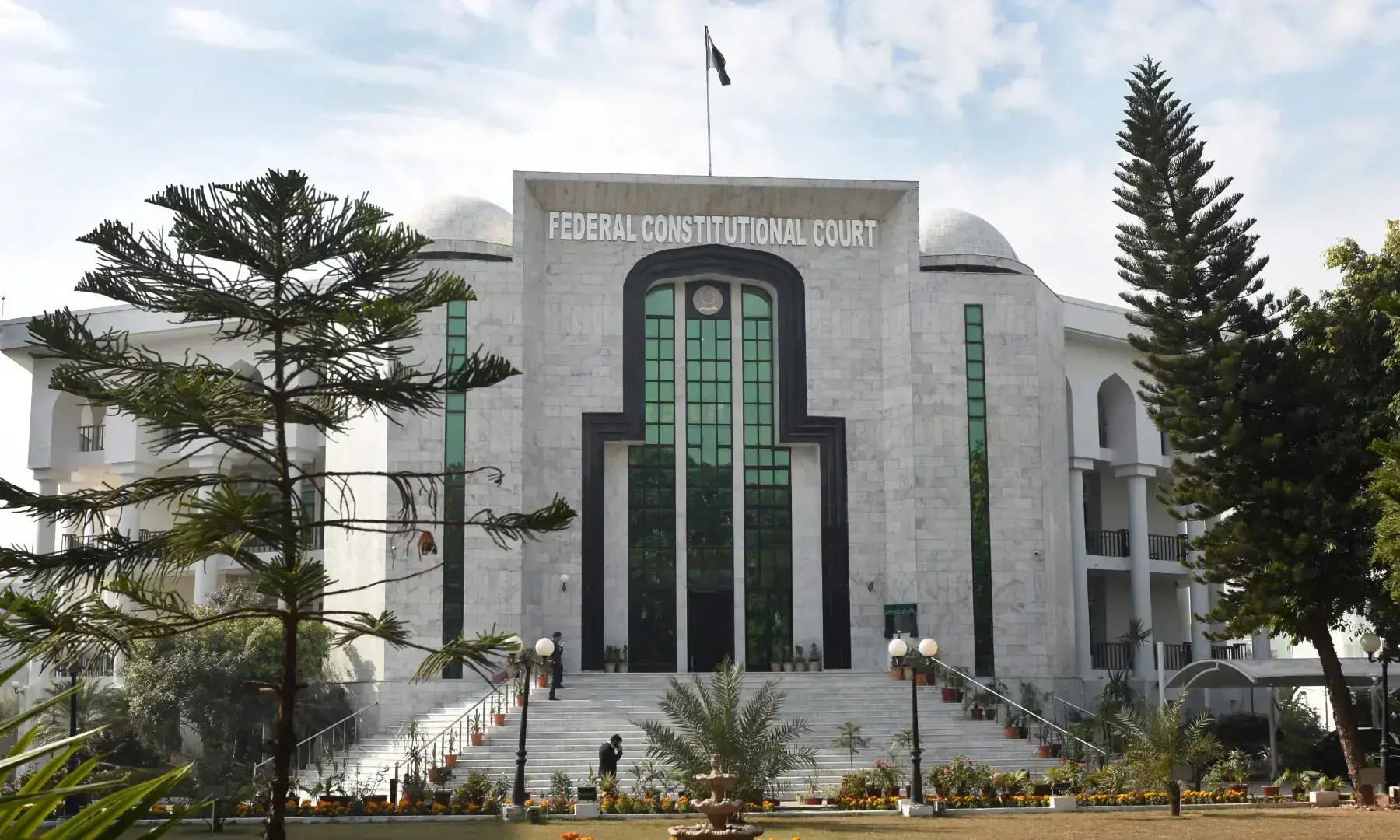

Islamabad: The Federal Constitutional Court (FCC) on Tuesday affirmed that fundamental rights, including the right to religious freedom, are not absolute but must be balanced against broader public considerations.
The ruling came when the court dismissed a plea challenging the official ban on a set of 23 Ahmadiyya publications.
Justice Aamer Farooq leading two judge bench delivered a consolidated judgement, rejecting petitions filed by Muhammad Abdul Qadoos and several others against notifications issued by the Punjab government under Section 99 A of the Criminal Procedure Code (CrPC) and Section 19 of the Press, Newspapers, News Agencies and Books Registration Ordinance, 2002.
The petitioners challenged the October 2025 and April 2024 judgements of the Lahore High Court, as well as the Multan bench, which dismissed their petitions for failure to avail themselves of an alternate remedy within the prescribed limitation period.
In their appeal before the FCC, the petitioners challenged the legality of Notification No. SO (IS-III) 6-15/2010, issued by the Punjab Home Department on June 25, 2014, under Section 99-A of the CrPC. Through the notification, Rohani Khazayeen, Volumes one to 23 was banned and all its copies ordered forfeited.
The petitioners also contended that the executive action banning the publications had infringed upon their right to religious freedom guaranteed under Article 20 of the Constitution.
Authored by Justice Farooq, the 13 page judgement explained that Article 20 guarantees religious freedom subject to law, public policy and morality. It dismissed the claim that Article 20 was violated, observing that determining the validity of the ban and forfeiture required careful examination of the strength and underlying reasoning behind the action taken under the CrPC and relevant ordinance.
The judgement noted the court could not proceed in the absence of the actual material on record due to a failure by the petitioners to avail themselves of the appropriate remedies.
“It is restated that the assertion of the counsel for the petitioners that the impugned actions on part of the executive violate their Religious Freedom clause seems to be an afterthought and was nothing more than wittering on about the subject of Fundamental Rights in general and Religious Freedom clause in particular,” the judgement observed.
It added that instead of attempting to show the court the content of the material and its impact, the petitioners had made a general discourse. Under the Punjab Rules of Business, 2011, authority is delegated to the provincial government and the home department acted competently by taking action according to the ruling.
Regarding the allegation that the publications were forfeited without application of mind, the judgement explained that, an Ulema board was constituted that, after deliberations, decided that the material in the volumes could cause hatred among the Muslim community and recommended that it be forfeited.
It continued that In the present case, authority was clearly traceable to statutory instruments, namely the CrPC and the ordinance. These enactments expressly empowered the chief secretary to undertake the measure taken, thereby placing the action within a statutorily conferred framework rather than the realm of unfettered executive discretion, the judgement explained.