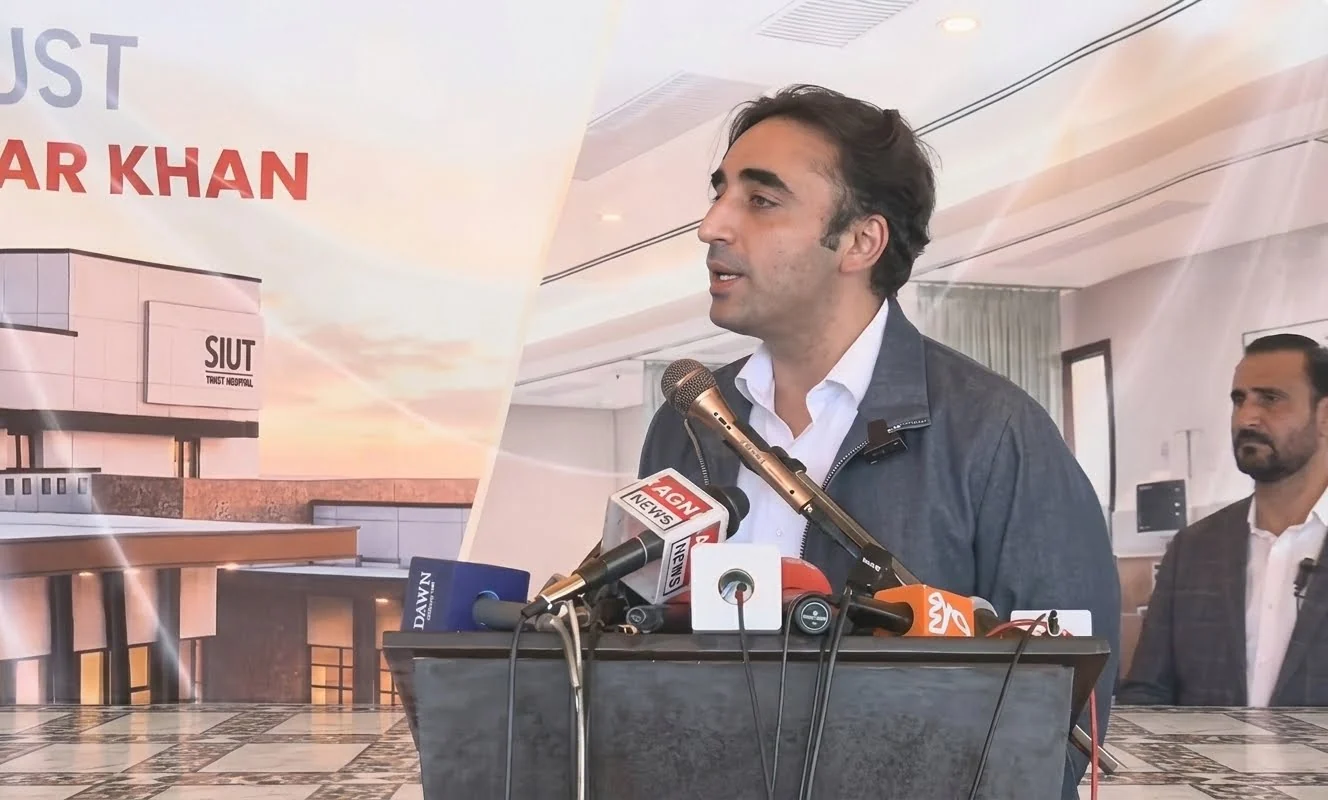
Rahim Yar Khan. Pakistan Peoples Party Chairman Bilawal Bhutto Zardari has said the country is facing an economic crisis, inflation, unemployment and poverty, and political parties should set aside their differences to focus on easing the hardships of the people. He said it would be an injustice to the public if politicians kept their attention on taking revenge on their opponents.
Bilawal was speaking at the foundation stone ceremony for the first phase of a free treatment hospital of the Sindh Institute of Urology and Transplantation, or SIUT, in Rahim Yar Khan. He said the country was passing through extraordinary economic difficulties and he feared these could grow because of domestic and regional conditions. He said people wanted their economic burden reduced, workers to be paid fairly for their labour, farmers to get a fair price for their crops, and the elderly and the sick to have access to treatment.
Bilawal said the first phase of the SIUT hospital in Rahim Yar Khan would have 50 beds. It would offer dialysis, emergency care, laboratory tests, kidney stone treatment, ultrasound and digital X ray services, all completely free of charge. He said work on the project began in October 2026, and the aim was to start free treatment next year once the first phase is complete. Operation theatres and other medical facilities will be added in the second phase.
The PPP chairman thanked Punjab Chief Minister Maryam Nawaz for her cooperation, saying she had not placed any obstacles in the way of the project in South Punjab. He said projects in the public interest should not fall victim to political differences. He also thanked the Sindh chief minister and his team for their help in providing land for the project.
Bilawal said that in the past, projects started by one government were halted when another came to power, and the public bore the cost of this political tug of war. He said Benazir Bhutto and Nawaz Sharif had agreed that both parties would respect each other's mandate, would not take part in conspiracies to topple governments, and would not block each other's public projects. He said it was essential to maintain this democratic tradition.