

ExclusiveWorld
Iran has lost significant control over the Strait of Hormuz.
Iran’s grip on the Strait of Hormuz is weakening as most ships now use the Omani route under US naval protection. While Iran can still disrupt traffic, analysts say its ability to control the vital waterway has significantly diminished.
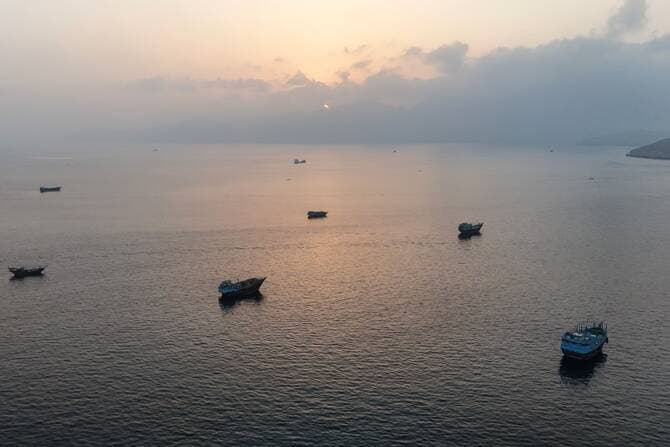
The struggle for control of the Strait of Hormuz has emerged as one of the defining fronts of the Iran war. In recent months, both Iran and the United States have claimed the upper hand, creating considerable uncertainty over who actually controls the vital waterway.
The picture is becoming clearer. With US naval forces patrolling the strait, Washington appears to be gaining influence, while Iran’s ability to control traffic through the waterway has weakened significantly.
According to Kpler, which tracks vessels using transponders and satellite data, more than 80% of ship transits through the Strait of Hormuz over the past two weeks have used the Omani route — a UN-authorized shipping channel that Iran strongly opposes.
Iran has declared the strait to be under its control and has attacked dozens of vessels attempting to use the route along Oman’s northern coast. Despite the risks, however, most ships have increasingly ignored Iranian demands and are crossing under the protection of US naval forces.
“It increasingly looks like Iran has at least partially lost control of the strait,” said Homayoun Falakshahi, head of crude oil analysis at Kpler.
A shift in control
The situation marks a sharp change from just a month ago, when Kpler recorded virtually no shipping activity through the Omani route. The decline in traffic along Iran’s preferred route has also limited Tehran’s ability to impose tolls on vessels passing through the strait, something it had done earlier in the spring.
The expiration this week of a Memorandum of Understanding between the United States and Iran theoretically allows Tehran to resume collecting tolls. But according to Kpler, there is little evidence that Iran has been able to enforce them.
“Iran’s request to collect tolls is something that most Middle East folks don’t want to do and haven’t been doing,” said Dan Pickering, founder and chief investment officer of Pickering Energy Partners. “So the Oman route absolutely makes the most sense.”
Kuwait, Saudi Arabia and the United Arab Emirates have also chartered Very Large Crude Carriers — the world’s largest oil tankers — to move crude out of the Persian Gulf through the Strait of Hormuz. According to Andy Lipow, president of Lipow Oil Associates, the oil is then transferred to customer vessels outside the danger zone in the Gulf of Oman.
Some tankers have attempted to evade Iranian attacks by switching off their transponders for weeks at a time. This “dark traffic” can be difficult for commercial tracking services such as Kpler to detect, although satellite imagery can still identify some vessels.
The United States, however, has substantial military forces deployed in and around the waterway and says it has visibility on shipping activity that may not be captured by conventional tracking systems. US officials have consequently reported significantly higher oil flows than many independent estimates.
Energy Secretary Chris Wright said last week that oil transits through the Strait of Hormuz, combined with shipments rerouted around the waterway, amounted to roughly 15 million barrels per day over a seven-day period. That is significantly closer to the pre-war average of around 20 million barrels per day.
Neither side has complete control
The conflicting claims have made it difficult to determine exactly who controls the strait.
President Donald Trump said Monday that the United States has “total control” of the waterway, a claim he has repeatedly made during the conflict. But Iran’s continued attacks, combined with oil flows that remain below pre-war levels, suggest that Washington does not have complete control of the Strait of Hormuz.
At the same time, Iran clearly does not have the level of control it once claimed.
“If their goal is to be ‘in charge,’ then I’d say they were never completely in control to start with,” Pickering said. “It feels like their goal is deterrence, in order to be validated as in-control. I think they are still deterring.”
Still, if US estimates of oil flows through and around the strait are accurate, Iran’s ability to deter shipping and dictate traffic through the waterway has weakened considerably compared with a month or two ago.
The situation is further complicated by talks between Oman and Iran aimed at restoring freedom of navigation through the strait without US involvement — a development that has angered Trump. It remains unclear how those negotiations could affect shipping flows or the broader balance of control over the waterway.
“I would take all the information and headlines ‘under advisement,’” Lipow said. “But it is fair to say that Iran has partially lost control of the strait.”

What to Read Next
View all
Pakistan
Pakistan condemns "Israel" for creating regional instability

Pakistan
Breakthrough in AI technology promises faster data processing

Pakistan
IMF approves Pakistan fiscal tranche

Pakistan
Parliament passes key economic reform bill in Pakistan.
Pakistan
Population growth key reason for new provinces, say experts
Pakistan