

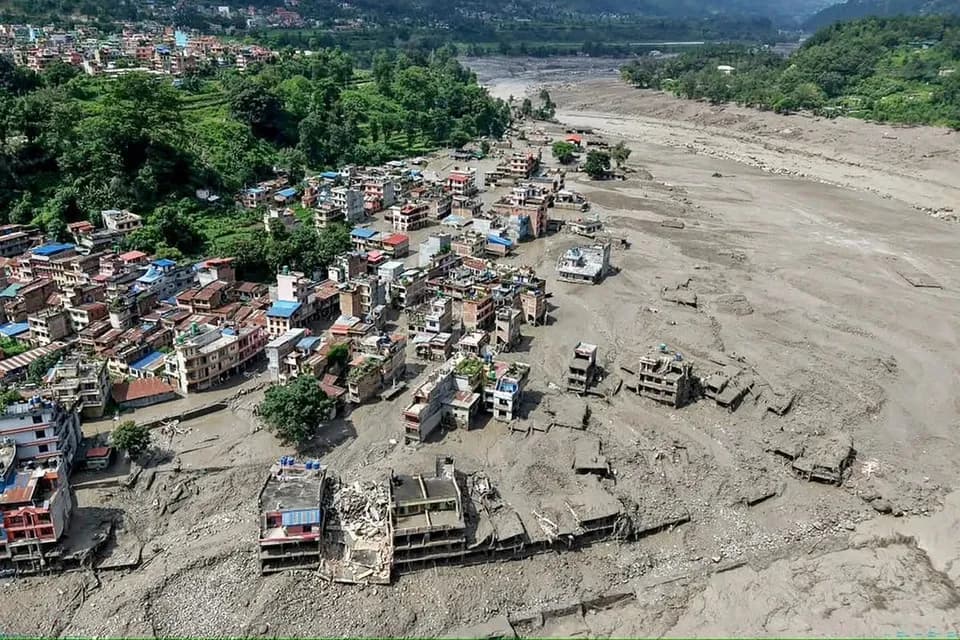
Khatmandu: Rescue teams in Nepal used heavy machinery on Friday to search through mud and debris following a catastrophic flash flood triggered by a glacier collapse two days earlier. The disaster has claimed at least 469 lives in Nepal, with nearly 1,000 people missing across Nepal and neighbouring Tibet.
The flood originated on Wednesday morning when a glacier collapsed in the Himalayan mountains, sending a massive torrent of rock, ice, and mud through river systems. The deluge destroyed power stations, roads, and bridges along a key route connecting Kathmandu and Lhasa, a corridor heavily used by trekkers and pilgrims. Among the missing are at least 540 foreign nationals, including a group of American trekkers from Virginia.
Emergency operations are underway on both sides of the border. Nepalese authorities deployed helicopters to drop emergency supplies to isolated communities and search for survivors. Search teams using sniffer dogs have retrieved dozens of bodies from downstream plains, including 103 bodies recovered in Chitwan district, roughly 100 kilometres from the high-impact zone in Trishuli. Local authorities in Chitwan have established temporary tents to handle the influx of bodies as hospitals reach capacity.
In Tibet’s Gyirong County, Chinese authorities reported 558 people missing, including 260 foreign nationals, with three confirmed deaths. High velocity muddy water destroyed infrastructure at the Gyirong border crossing, where access roads remain blocked by mudslides. Chinese Premier Li Qiang visited the disaster site in Gyirong on Thursday as clearing efforts continued.
Attention has also turned to preventing secondary disasters caused by blocked waterways. In Nepal, the disaster management authority warned that a barrier lake formed by debris damming the Bhotekoshi River is rising and risks bursting. Across the border, Chinese officials estimate that three million cubic metres of water will flow into an already dammed lake over the next three days, posing a high breach risk expected to peak around September 1.
An eight member Chinese engineering team is conducting aerial surveys and 3D modelling to plan a drainage channel at the dam's lower point. However, steep cliffs and difficult terrain created by the glacier collapse continue to hinder access and technical assessments.
Governments in both nations stated that rescue, relief, and monitoring efforts are operating at full capacity. International aid offers have been extended to assist with ongoing operations.